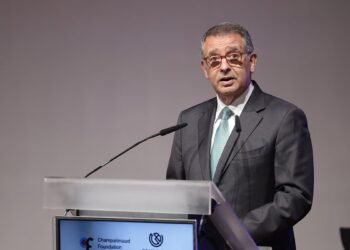
The country’s largest sources of tax and contributory revenue – Value Added Tax (VAT) and contributions to Social Security – show that the Portuguese economy is growing “much more” than what is said or indicated by the first indicators, said the Minister of Finance, one of the main speakers at the Diário de Notícias Grand Annual Conference.
In the auditorium of the Champalimaud Foundation, in Lisbon, Joaquim Miranda Sarmento reviewed some initiatives and some recent successes in finance and the Portuguese economy, but took advantage of the stage to signal that, despite the crisis currently being experienced with the oil shock and the war, plus the high uncertainty, the economy seems to be resisting much better than you think.
The minister recalled that the National Statistics Institute (INE) will only calculate the final Gross Domestic Product (GDP) of 2024 with a two-year lag (this year, in 2026) and the final reading of 2025 will only be finalized in 2027.
As happened in 2025 with the final revision of the 2023 GDP, “INE carried out an increase, a significant revision of the nominal GDP and the real GDP” of that year.
According to the ministers, based on the data that he already has in his possession for collecting taxes and discounts, “I could be wrong, but I will be surprised if INE does not do the same” with the GDP of 2024 and 2025.
And why? “Because the two best proxies (approximate indicators) of GDP are VAT and social security contributions and both are growing, they grew in 2024 and 2025 by around 9%”. For Miranda Sarmento, “nominal GDP had to grow much more than the first indicators indicate”.
Regarding the shock of the war on the economy and prices (with more inflation), the minister devalued alarmist readings, saying that, despite this less favorable impact that accumulates with the complicated legacy of last winter’s storms, “this shock, fortunately, is only concentrated in oil, in the price of gasoline and gas. Unlike 2022, it has not had a significant impact on the price of gas and has not yet had a significant impact on the price of food.”
“So this was a different shock from 2022 and we, Portugal, are the fifth country in the European Union in which the responses have the greatest weight as a percentage of GDP.”
The government official recalled “the mechanism for reducing the Tax on Petroleum Products (ISP) and a set of support for specific sectors of transport, agriculture, firefighters, taxis and an increase in support for bottled gas, it was a quick response, but without compromising budgetary stability”.
“When we look at the budget part of this year, we have fiscal revenue from taxes alone reducing and we have social security contributions increasing their weight as a percentage of GDP because wages will grow by around 6% and employment is growing by around 2%”, a very significant increase, noted Sarmento.
This Monday, also in Lisbon, the governor of the Bank of Portugal, Álvaro Santos Pereira, presented the economic bulletin with new forecasts and, although maintaining the outlook for economic growth at 1.8% (the same as three months ago), he put forward an estimated deficit of 0.2% of GDP for this year, the most negative budget balance calculated by the main institutions that released forecasts in the first half of this year (EC, OECD, IMF, CFP).
The governor also warned that, according to the central bank’s accounts, Portugal may already be violating the net primary expenditure rule, one of the main pillars of the new Stability Pact.
Miranda Sarmento seemed calm. “Primary current expenditure is under control, as a percentage of GDP it has stabilized in the last 3 years”, “expenditure has increased a lot because we are implementing the Recovery and Resilience Plan (PRR) in 2025 and 2026, whether grants or loans, but this is a temporary effect of investment without structural impact”, guaranteed the minister.
“If we remove the extraordinary measures, that is, the support for Ukraine, the supplement for pensioners and the court decisions that the State was condemned, namely the additional solidarity from banks, and if we then also withdraw the PRR loans, we will have a balanced budget balance” and this shows “a very robust budgetary situation”, he reiterated.
Objective: debt equal to Germany’s by the end of the decade
The weight of public debt remains high, close to 90% of GDP, therefore, well above the maximum limit of 60% defined by the European pact, but Miranda Sarmento highlighted that, last year, the debt ratio “was already very close to the euro zone average and this year it will be below” that average. It is “an important milestone that we have placed public debt below 90%”.
The weight of Portuguese public debt “fell by around 45 percentage points of GDP from 2021 to 2025, an average of almost ten percentage points per year”. “It’s an absolute record break” and “this has received significant media attention.”
“In terms of public debt, we have to continue this path and forecasts indicate that we could reach the end of the decade with debt in the order of 75% of GDP, a value close to what Germany will also have at the end of the decade, predicts the head of Finance.
The official also said that “expectations for the Portuguese economy in existing surveys are considerably more favorable than for the international economy”.
“Last year, we grew above the euro zone” and “we continue to have very dynamic tourism and a very strong summer is expected”, and “our exports, which are one of the great success stories of the Portuguese economy over the last 15 years, have grown in tourism, but much more in other services, namely technology and consultancy services”, he highlighted.
(updated at 6:45 pm)