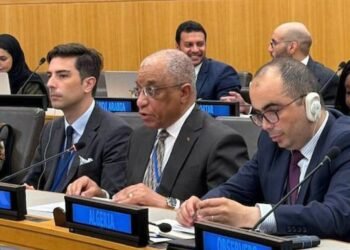
New York (United Nations), June 19, 2026 (SPS) – African and Asian countries affirmed their demand to respect the right of the Sahrawi people to self-determination and independence, during the speeches they delivered before the substantive session of the Special Committee on the Situation of Implementation of the Declaration on Granting Independence to Colonial Countries and Peoples (the Committee of Twenty-Four), which began its work on Monday at the United Nations Headquarters in New York.
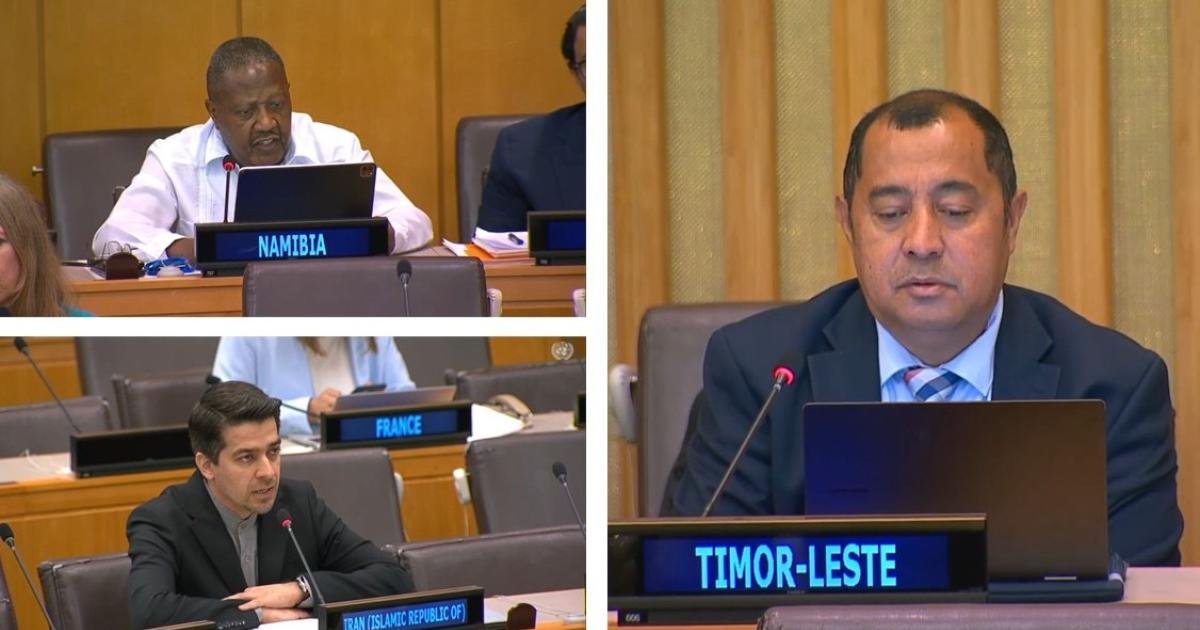
The representative of Namibia emphasized in his intervention that the Special Committee still constitutes an essential part of the path towards achieving the right to self-determination for the peoples of the remaining seventeen territories subject to decolonization, including the Sahrawi Arab Democratic Republic.
He stated that Western Sahara has been subject to illegal occupation for more than fifty years by the Kingdom of Morocco, which since November 1975 has illegally settled hundreds of thousands of Moroccans in the territory of Western Sahara, despite the October 1975 decision stipulating that Morocco does not have any sovereign rights over Western Sahara.
He added that the issue of Western Sahara remains an issue of decolonization, according to the agenda of the Special Committee and the Fourth Committee, in accordance with Resolution 1514, which includes the Declaration on Granting Independence to Colonial Countries and Peoples.
He stressed that it is necessary for the international community to continue its commitment to supporting the United Nations Charter, which explicitly recognizes the right to self-determination as a basic principle. He expressed Namibia’s happiness with the UN Security Council’s extension of the mandate of the United Nations Mission for the Referendum in Western Sahara (MINURSO) until October 2026, following the 2025 report of the United Nations Secretary-General, which expressed deep concern about the situation in Western Sahara and called for a just, lasting and mutually acceptable political solution.
He stated in this context that UN Security Council Resolution No. 2797 issued in October 2025 did not impose the Moroccan “autonomy plan,” but rather reaffirmed the necessity of reaching a lasting political solution acceptable to both parties.
He pointed out that the mandate of the United Nations Mission for the Referendum in Western Sahara (MINURSO) still exists, and among its tasks are to verify the reduction of Moroccan forces in the territory of Western Sahara, organize and ensure the holding of a free and fair referendum to enable the people of Western Sahara to choose between independence or integration with Morocco, and announce its results.
In this context, he recalled that prior to the establishment of the United Nations Mission for the Referendum in Western Sahara (MINURSO) on April 29, 1991 by the Security Council, the Kingdom of Morocco had agreed, on August 30, 1988, jointly with the Polisario Front, on the broad outlines of the plan presented by the Secretary-General of the United Nations on holding a referendum to determine the fate of the people of Western Sahara, and on ways and means to ensure the organization and supervision of this referendum by the United Nations in cooperation with the Organization for Unity. African Union, which has now become the African Union.
In conclusion, he called on the presidency and office of the Special Committee to intensify your efforts in implementing the Committee’s mandate and to visit the territory of Western Sahara to closely examine the situation and submit a detailed report to the Committee.
For his part, the representative of East Timor stated that his country is a nation whose history has been profoundly shaped by the struggle for self-determination and independence, which is why East Timor attaches the utmost importance to the work of the Special Committee and to the urgent completion of the decolonization process in all remaining territories.
Regarding Western Sahara, he recalled that the territory is still included on the United Nations list of territories subject to decolonization, and therefore its status is categorically governed by the principles of decolonization, and its people retain an inalienable and non-negotiable right to determine their political future.
He reaffirmed firmly that the right of the people of Western Sahara to self-determination, as recognized in the Charter of the United Nations and General Assembly Resolution 1514 (XV), must constitute the central and basic element of any political solution. This principle cannot be diluted, restricted or replaced, but must be achieved through the free and sincere expression of the will of the Sahrawi people.
He welcomed the continuing efforts made by the Secretary-General and his Personal Envoy, Mr. Staffan de Mistura, to reach a political solution that is peaceful, just, lasting and acceptable to both parties, and encouraged engagement constructively and in good faith in the United Nations-led process, while emphasizing that dialogue must serve the realization of the right to self-determination, not replace it.
In conclusion, he stressed that the issue of Western Sahara cannot remain unresolved indefinitely, as the United Nations bears a historical and legal responsibility to complete the process of decolonization. Therefore, the United Nations must act with renewed determination to end this process once and for all, in full accordance with its Charter and its obligations to the people of Western Sahara.
The representative of Iran reiterated the permanent responsibility of the United Nations towards the Sahrawi people, whose aspirations must guide all efforts aimed at determining their future political status in a way that reflects the approved standards of the United Nations framework and maintains the integrity of a process based on international legitimacy.
In this context, he stressed that it is necessary to actively engage the people of Western Sahara in any process facilitated by the United Nations, and to ensure their views clearly in accordance with the relevant resolutions, ensuring that their future is shaped by their free will without any influence from external political considerations.
In conclusion, he encouraged continued cooperation with the United Nations in a way that supports the ongoing political process and contributes to creating a climate conducive to progress, and praised the efforts of the Secretary-General of the United Nations and his personal envoy, whose role remains extremely important in facilitating dialogue and maintaining the necessary momentum to reach a just, lasting, comprehensive and mutually acceptable political solution in accordance with the principles and purposes of the United Nations Charter and relevant resolutions. (SPS)