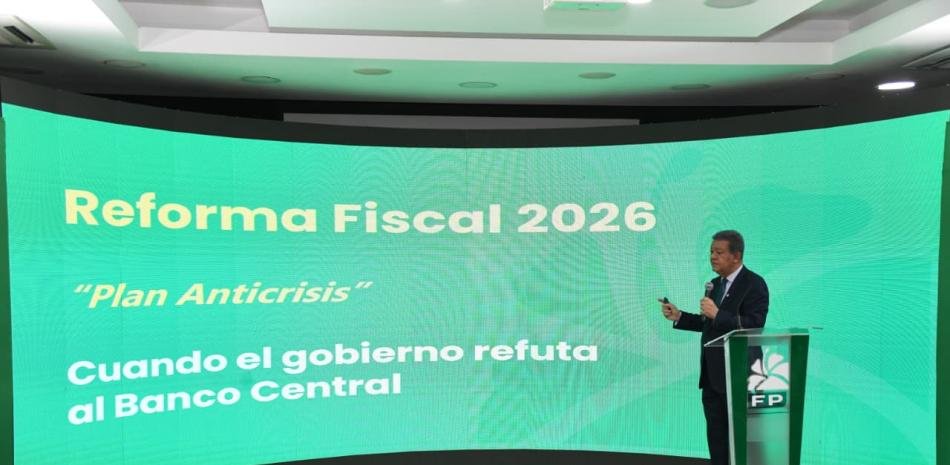
In front of the “anti-crisis plan“, which they describe as a covert tax reform aimed at mitigating the effects of the conflict in Middle Eastthe Fuerza del Pueblo party rejected the Government’s proposal and advocated for its withdrawal.
Although the political organization assured that the country needs an alternative to guarantee sustainability and protect the economy, it opposes any proposal that involves an increase in taxes.
These statements were issued by the former president of the Republic and leader of the Power of the People, Leonel Fernandezduring a press conference at his party’s home, this Tuesday.
About the anti-crisis plan
When referring directly to this initiative promoted by the Government of the Modern Revolutionary Party (PRM), the former president expressed that the proposal “constitutes a hidden fiscal reform, whose purpose is to obtain more income to cover the excessive growth of the administration’s current spending.”
This after comparing the official figures issued by the Central Bank and the constant pronouncements of the authorities that highlight the growth and resilience of the national economy.
“The Tax Reform proposed by the Government constitutes a scapegoat to hide its misguided public spending policy,” said Fernández.
The former president questioned the government’s approach, pointing out that there is an obvious contradiction between the Government’s speech and the information offered by the State’s own economic authorities.
Fernández recalled that recently the Central Bank highlighted the resilience of the Dominican economy in the face of international events and assured that the country has shown improvement during the first months of this year. Likewise, he cited official reports indicating that the Dominican economy registered a growth of 4.0% between January and April 2026, driven mainly by the construction, free zone manufacturing, hotels, bars and restaurants sectors.
“If the economy is growing and improving, then it is not in crisis, so there will never be valid reasons to impose new taxes on the population,” said the opposition leader.
Increase in fuel
During his intervention he noted that, although the government linked its plan to the Middle East crisis, he assured that a recent downward trend in oil prices is evident, which will reduce the cost of subsidies assumed by the State.
Fernández also cited international economic information that shows a significant drop in the price of oil after diplomatic advances aimed at reducing tensions in Middle East.
He indicated that, according to reports from international markets, crude oil registered a drop of more than 3% in a single day, reaching its lowest level in more than three months, a situation that considerably reduces the fiscal pressures associated with the energy subsidies contemplated in the General State Budget for 2026.
“We propose the withdrawal of the project in everything related to the tax burden “because today it does not make sense; As lawyers would say, it has no purpose,” he said, adding that with the reduction in oil prices, the 40 billion pesos that are intended to be collected “are no longer necessary.”
He said that, according to budget estimates, only around 889 million pesos would be required and not the 40 billion that are sought to be obtained through new taxes,” he said.
Therefore, the People’s Force advocated for a reformulation of the General State Budget for 2026 that allows prioritizing public spending, correcting budget distortions and easing the burden on productive sectors.
Details about the proposal
Last week, the Minister of Finance, Magín Díaz, presented the details of the “anti-crisis” bill motivated by the conflict in the Middle East.
However, the peace agreement between Iran and the United States to end almost four months of war and proceed to reopen the Strait of Hormuz will not stop the measures established by the Government in the project.
This law was submitted to National Congress with a strategy that seeks to raise between RD$40,000 and RD$50,000 million in response to the pressures that the international crisis imposes on public finances.