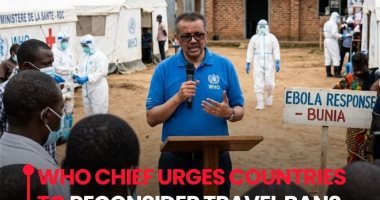
Dr. Tedros Adhanom Ghebreyesus, Director-General of the World Health Organization, said during a press conference Ebola Today, Wednesday, he said that 6 people have recovered so far in the Democratic Republic of the Congo, calling on residents to quickly go to health facilities as soon as symptoms appear.
The Director-General stressed that the response still faces 5 main challenges:
First: examinations and diagnosis
The organization seeks to expand laboratory and diagnostic capabilities, to reduce delays in confirming cases and accelerate response decision-making, and is working to decentralize laboratory and diagnostic services in priority areas, including Mangowalo, Beni, Aru, Yaconda, and Karume.
He stressed the need to enhance preparedness in the provinces and neighboring countries, especially in the areas of epidemiological surveillance, diagnosis and health services.
Second: Contact tracing
He explained that the contact tracing process has not yet reached the required level, as only about 45% of contacts are being followed up, while containment is required. Ebola outbreak Raising this percentage to more than 90%.
He pointed out that the security conditions and the continuous displacement and movement of residents make the process of contact tracing more difficult.
Third: Travel restrictions
He criticized the imposition of comprehensive travel restrictions by some countries, stressing that they disrupt supply chains and hamper the health response.
He explained that the World Health Organization recommends screening procedures upon departure at airports, ports, and border crossings to prevent the transmission of cases and contacts, calling on countries that imposed general travel restrictions to lift them.
Fourth: Lack of societal trust
Tedros revealed that some of the community leaders he met still believe that Ebola does not actually exist, stressing that building trust with local communities is an essential element in controlling the outbreak.
Fifth: The absence of vaccines and treatments
He stressed that combating this outbreak is currently taking place in the absence of approved vaccines or treatments, explaining that the World Health Organization and its partners are working to accelerate the launch of clinical trials as quickly as possible.
He added that he chaired for the second time the meeting of the Temporary Medical Countermeasures Network, where 3 main priorities were agreed upon, including expanding support for decentralized diagnosis, providing immediate support to affected countries to lead clinical trials in cooperation with local communities, and accelerating investments to support all axes of the response.
He stressed that vaccines and treatments may constitute an important addition, but the decisive factor in ending the outbreak is not only medical, but rather depends on national leadership, local communities’ ownership of the response, strong partnerships, and building trust.
After Ebola…
The Director-General stressed that Ebola is not the only health threat facing affected communities, noting residents’ fears that the response to the disease will withdraw resources from the health and other humanitarian services on which they depend.
He added that the true measure of success is not only stopping the current outbreak, but also preventing future outbreaks and improving the health of the population in the long term.
He said that the Democratic Republic of the Congo has extensive experience in dealing with Ebola, having previously succeeded in containing 16 outbreaks of the disease, stressing that controlling the current outbreak is a matter of time.
He concluded his statements by emphasizing that the World Health Organization and its partners are committed to supporting the Congolese government until the outbreak ends, and after that continuing to support local communities to build stronger and more sustainable health and humanitarian services.