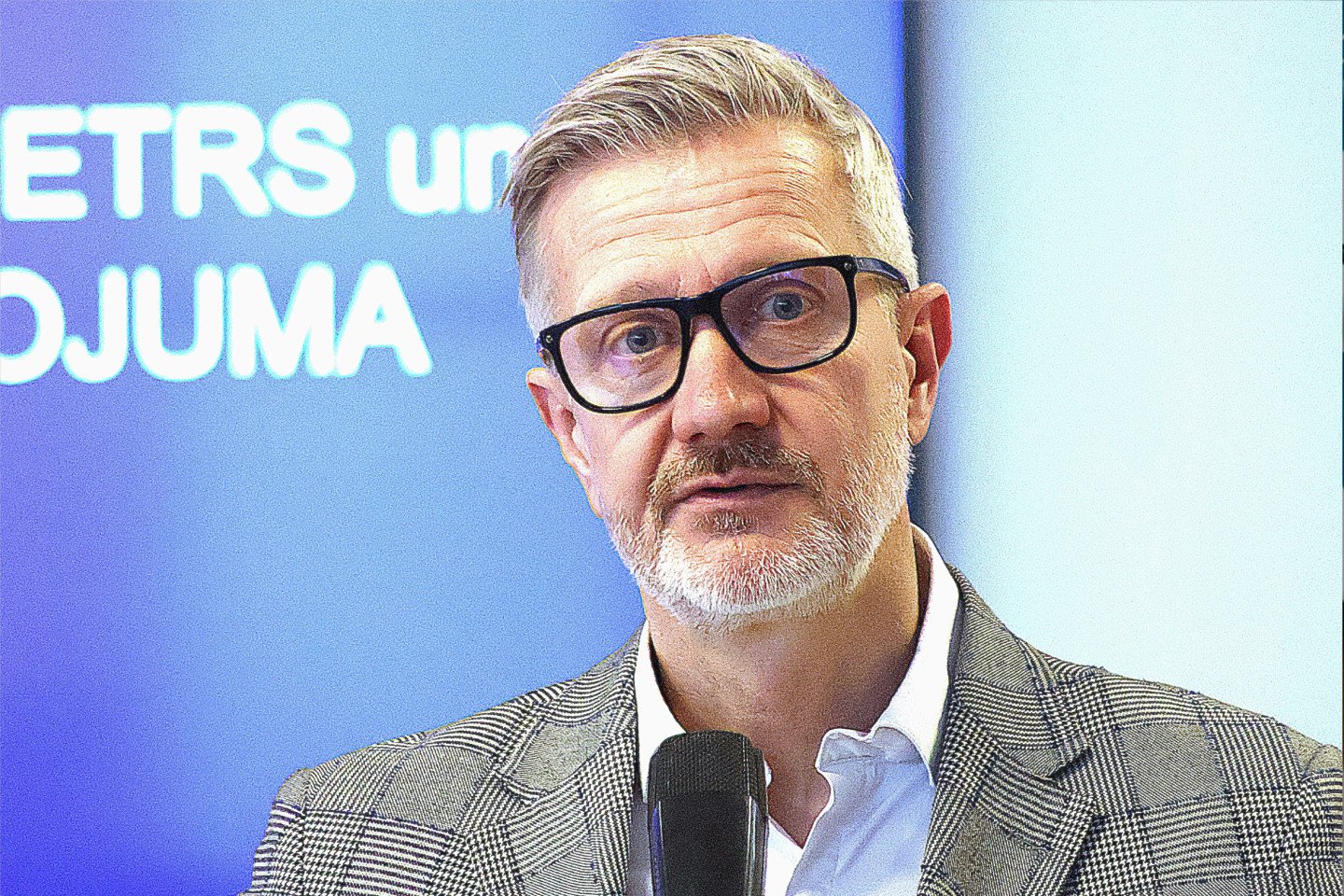
Members of the State Administration and Local Government Commission of the Saeima scolded Jānis Endziņš, head of the Bureaucracy Abandonment Group (BAG), that they needed vivid examples of combating bureaucracy that could be cited in the 15th Saeima election campaign, rather than reports, in which Endziņš also failed to explain the connection between the recorded numbers and real life to the members.
At the meeting of the State Administration and Local Government Commission on June 16, several deputies requested from J. Endziņas materials to be used in the fight for re-election of these deputies and the parties they represent in the 15th Saeima. The chairman of the commission, Olegs Burovs, an independent member of parliament who established relations with the Green and Farmers’ Union (ZZS), summarized that such demands are not irony, but the reality of the pre-elections. J. Endziņš undertook to fulfill the demands of the deputies and to transform his reports into a situation-appropriate format by September, which many deputies expressed with one single word: “Examples! Examples! Examples!”
Money and happiness were near but gone
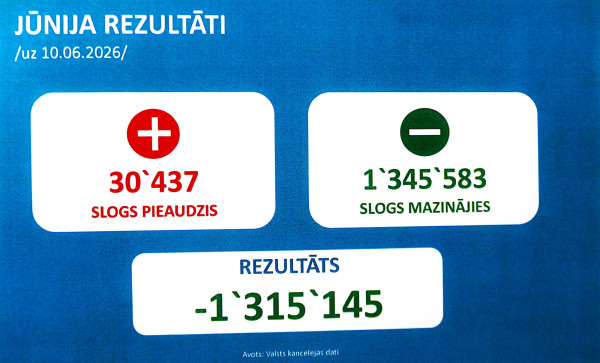
The MPs were irritated by the report presented in the form of an advertising booklet of the BAG, and especially the page with the figures, that in the last month and a half since May 1st, the burden caused by the state administration has decreased by 1.3 million and a little more euro:
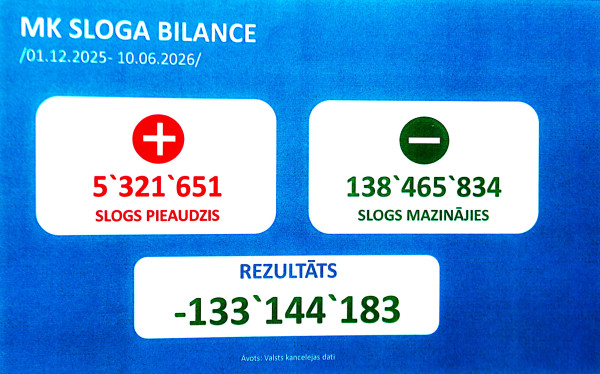
In the second plan, the overall result was that since the official start of BAG’s activity on December 1 of last year, BAG has already blessed the society with 133 million euros:
The longest period of time is more difficult to review or recall, however, from the events of the last month and a half, the deputies really wanted to create valid stories for the pre-election campaign. However, they should be easily understood by the audience, which should be addressed to those who have decided to run in the next Saeima elections. When it became completely clear that even with the help of J. Endzis, it would not be possible to get anything suitable for public use from BAG, expectations naturally turned to anger: “Beautiful pictures and numbers from which you can’t understand anything. I’m not saying that there’s nothing underneath, but it’s not humanly readable. I want to explain to the voters where that million comes from. We need examples!” The common sentiment was expressed by Inga Bērziņa, a member of the “New Unity” party.
Daiga Mieriņa, a representative of ZZS, put forward the same requirements in a more lenient way: “Bureaucratic calculations are very good, but then you have to tell people what they got in this way. Therefore, it would be good if success stories appeared in the presentation that would help us convey this information to people. They are hardly interested in virtual numbers, which of course is also good, but people want to understand what has changed in their lives.”
Independent MP Andrejs Celapīters argued that reducing the bureaucratic burden should be reflected in the reduction of state budget expenditures. His line of thought is that those stages of the state administration that organized and controlled the fulfillment of the requirements that the state now considers to have been abolished should be eliminated. Ilze Stobova, deputy of “Latvija first” came to the same conclusion: “If we have reduced the bureaucracy, then we must reduce the costs in one place, giving money to other sectors that previously felt the lack of funds.”
J. Endziņas had to agree to everything and promise that in the first half of September he would bring the required materials to the Saeima for the final chord of the pre-election campaigns.
Artificial intelligence more voracious than a natural official
In parallel with the reduction of red tape that has already been done, BAG is building a machine, after which the red tape reduction will be different from the current red tape reduction in the same way that digging with an excavator differs from digging with a shovel. Of course, we are talking about artificial intelligence (AI), which was also announced with a promotional poster:
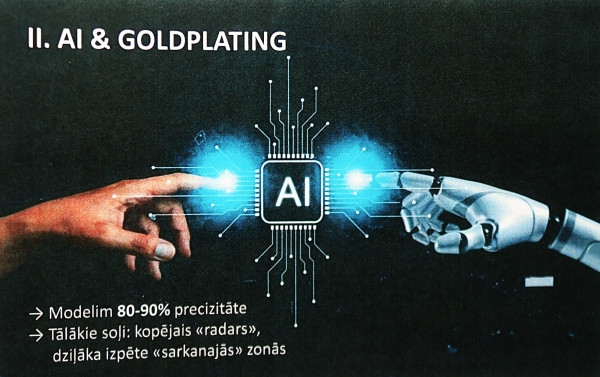
The interpretation of the image is that computer programs raised to the rank of AI are being prepared, which will compare all Latvian regulatory enactments with their primary source – with the European Union’s regulatory enactments, which Latvia has committed to form in accordance with the norms of the Latvian language and political culture. It is said that the norm of the political culture here is exaggeration of EU demands. In order to confirm, deny and ultimately turn such stories into action to change local legislative norms, the AI will be activated.
However, the good intentions of increasing work capacity and raising the authority of work results with the authority of AI (with the assurance that changing the norms of law cannot be dictated by human greed or any other malicious intentions against other people or institutions) face several problems. That too J. Endzins recognized that MI needs to be trained. In other words, MI can answer precisely asked questions, whether a concretely presented Latvian law norm X is consistent with a concretely presented EU norm Y. In that case, double doubts arise. First, is the question not formulated in such a way as to get exactly the answer that the questioner wants to get. Second, the preparation of the exact question does not require more time and state money than amending Latvian laws without MI mediation.
I. Stobova explained the second question precisely: “We have implemented many different systems. No one knows their number and total costs in this country. We always want to reduce bureaucracy, but isn’t the number of employees in the state administration so large because the systems they serve are extremely complicated? In reality, the system costs more than man-hours. We don’t direct this money to people, their families, children. We direct money to corporations that become richer, but people become poorer. Life becomes more complicated when we add all kinds of attachments to these systems that divert people away from public administration.”
We must also agree with D. Mieriņa’s remark that the Latvian language is not so poor that the changes in the Latvian state administration should not be dressed up in words taken from English (as can be seen in the picture above), but perhaps in hopes of increasing their impact.