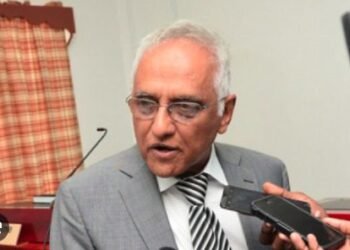
Leader of the People’s National Congress Reform (PNCR) Aubrey Norton says the Government failed to adequately engage and negotiate with the United States over concerns surrounding Cuban medical missions, arguing that the health system still benefits from the expertise and support provided through its longstanding partnership with Havana.
Speaking at his party’s weekly press conference on Friday, Norton said the government should have treated the matter as a foreign policy issue requiring diplomacy rather than allowing the medical cooperation programme to end.
“And so I do believe that there is a failure of the government to engage, negotiate and protect our interests because our interest also lies in us having the expertise and the support from the Cuban system to facilitate and help our health system,” Norton said.
According to Norton, Washington’s position appears to be that countries should discontinue the use of Cuban medical personnel on the grounds that the workers are being exploited.
“As I understand it, the government of the United States of America is contending that we should get rid of the Cuban workers. And the sole premise seems to be that the Cuban doctors are being exploited because a lot of the resources go to the government rather than the doctors,” he said.
However, Norton argued that the issue should be examined within its historical and geopolitical context.
He noted that during the early 1970s the United States moved to establish diplomatic engagement with countries such as China and the Soviet Union, even as relations with Cuba remained strained due to the longstanding U.S. embargo.
At that time, Norton said, then Prime Minister Forbes Burnham questioned why similar engagement could not occur with Cuba. This led to several Caribbean leaders taking the decision to formally recognise both Cuba and China he stated.
Guyana established diplomatic relations with Cuba in 1972 and subsequently developed several cooperation programmes, including medical initiatives that saw Cuban doctors and other health professionals serving locally.
“And through that collaboration our system was helped,” Norton said, adding that the assistance extended beyond Guyana to several countries across the Caribbean.
“In my opinion therefore we have some kind of a moral obligation to help the Cubans,” he said.
At the same time, Norton stressed that supporting cooperation with Cuba should not be interpreted as opposition to the United States.
“And helping the Cubans doesn’t make you anti-American,” he said, noting that Guyana values U.S. support in the ongoing territorial controversy with Venezuela.
However, he maintained that Guyana should avoid aligning itself with policies that could undermine Cuban society.
“But we should never put ourselves in a position where we become part and parcel of a mechanism that seeks to starve and destroy the Cuban society,” he said.
Norton also warned that small states such as Guyana must carefully structure their foreign policy in a manner that protects long-term interests stating that the United States is a sovereign powerful state and it has its right to make decisions. But we as a small state must recognise that there are certain things that we are vulnerable to and the time will come when we need other small states’ solidarity,” he said.
He further argued that governments must consider how international alliances may shift over time.
“The United States as a government pursues its interests and then the government changes and in probably three years you will be in a different position,” he said. “One therefore has to structure their foreign policy so that it is applicable across the board in various seasons.”
Norton said that while the government may view its current approach as pragmatic, it could have longer-term consequences.
“And so I am of the view that the government has failed the people of Guyana by taking what they call a pragmatic position that might be pragmatic now but opens or portends things that will affect us in the future,” he said.
Earlier reporting by Stabroek News noted that Norton had criticised what he described as a shift in the government’s foreign policy stance toward Cuba.
Speaking previously at a Ghana Day celebration on March 8, he said he had “grave difficulty” with the termination of medical partnership programmes that had seen Cuban doctors serving in Guyana for decades. His remarks came following the Shield of the Americas Summit in Doral, Florida, where President Irfaan Ali met with U.S. President Donald Trump and Secretary of State Marco Rubio.
After the meeting, Ali indicated agreement with the U.S. position that the current political situation in Cuba must change.
In an interview with Fox News, Ali said regional leaders had discussed the issue during meetings of the Caribbean Community (CARICOM) and concluded that the “status quo cannot remain.”
For decades, Cuba has provided medical personnel and scholarships to countries across the Caribbean, programs which Norton said should not be easily discarded.
“I have grave difficulty with us abandoning people who helped us sincerely,” he said.
By contrast, the 47th CARICOM Heads of Government Conference last year expressed “grave concern” over the U.S. embargo against Cuba, describing it as an unjust unilateral measure. That language was notably absent from more recent regional discussions following high-level engagements with U.S. officials.
At the Florida summit, Trump also predicted major political changes in Cuba, telling regional leaders that the island nation was in its “last moments of life” and suggesting that a resolution to the issue could come quickly.
“I think a deal would be made very easily with Cuba,” Trump said.
Norton, however, suggested that the shifting geopolitical alignment risks weakening long standing Caribbean solidarity with Cuba and other regional partners.