Climate risks and tipping point concerns
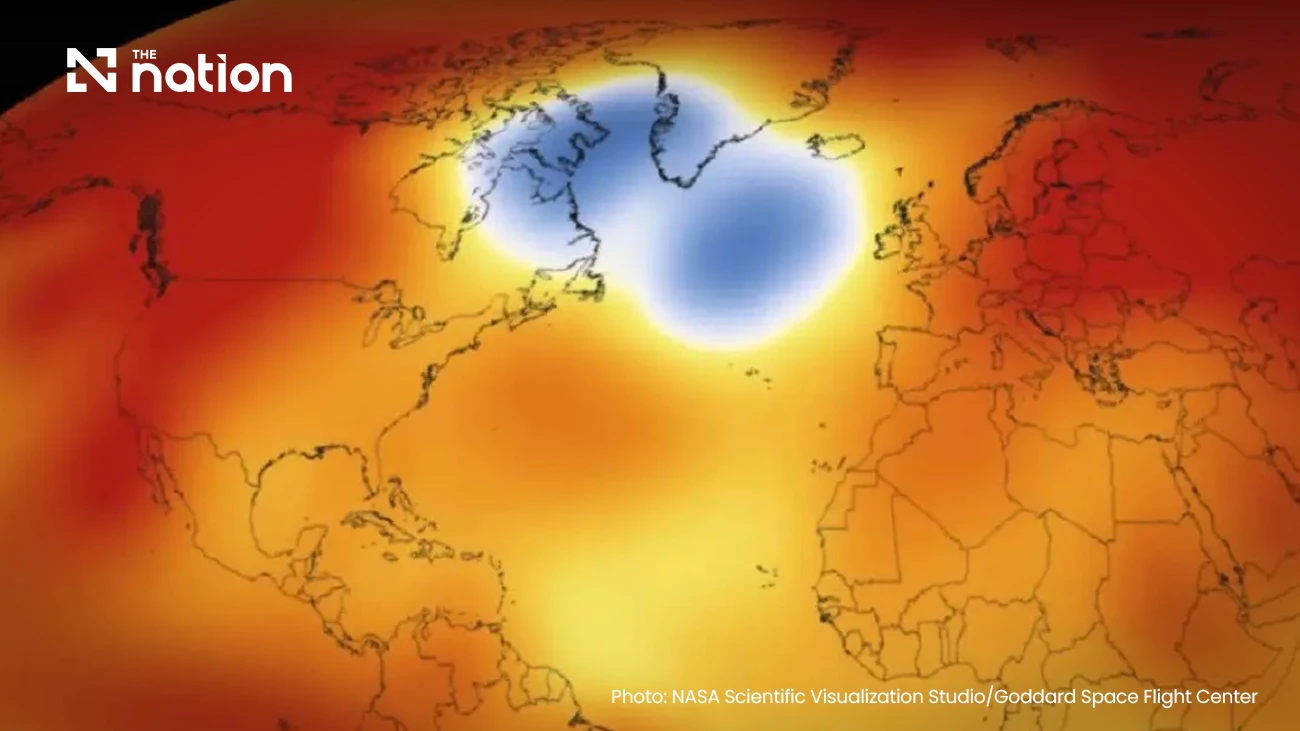
If the “cold blob” is indeed a warning sign of a weakening Atlantic Meridional Overturning Circulation (AMOC), scientists caution that the system may be approaching a critical tipping point — a threshold beyond which it could undergo abrupt and potentially irreversible collapse.
Such a scenario would carry severe global consequences. Climate models suggest that Europe could experience significantly harsher winters, with temperatures in some regions falling by 10–15°C under extreme scenarios. In Iceland, the potential collapse of the circulation system is considered a national security concern, as winter temperatures could plunge to around -45°C, posing major challenges to infrastructure, livelihoods and economic stability.
At the same time, the disruption would not be confined to the Northern Hemisphere. Parts of the Southern Hemisphere could experience additional warming, while shifts in atmospheric circulation could displace African monsoon systems, increasing the risk of prolonged drought and placing pressure on food security and ecosystems across multiple regions.
The weakening of AMOC is also expected to affect global sea levels. On the US east coast in particular, altered ocean dynamics could accelerate relative sea level rise, with some studies estimating that coastal flooding events may have increased by 20–50% since 2005 due in part to circulation changes.
Researchers stress that the precise proximity to a tipping point remains uncertain. However, most climate models indicate that a major transition could become possible within this century — potentially earlier than previously projected. This has raised urgency among policymakers to treat AMOC weakening as an emerging global risk requiring closer monitoring and preparedness.
Ultimately, the “cold blob” is no longer viewed as a mere oceanographic curiosity. Instead, it is increasingly interpreted as a potential early warning signal of large-scale changes in Earth’s climate system. While uncertainties remain, the convergence of recent studies suggests that the planet may be edging closer to a critical threshold with consequences that could unfold over centuries.
Sources:
- NOAA Ocean & Climate information: https://www.noaa.gov
- NASA Earth Observatory – ocean circulation: https://earthobservatory.nasa.gov
- Geophysical Research Letters (AGU journal): https://agupubs.onlinelibrary.wiley.com/journal/19448007
- CNN Climate reporting (AMOC overview): https://edition.cnn.com/specials/world/global-warming
- Live Science (climate science explainers): https://www.livescience.com
- ScienceAlert (AMOC / cold blob analysis): https://www.sciencealert.com
- The Washington Post (climate & oceans coverage): https://www.washingtonpost.com/climate-environment/
- UK Met Office climate science: https://www.metoffice.gov.uk
- Story Credit: Bangkokbiznews