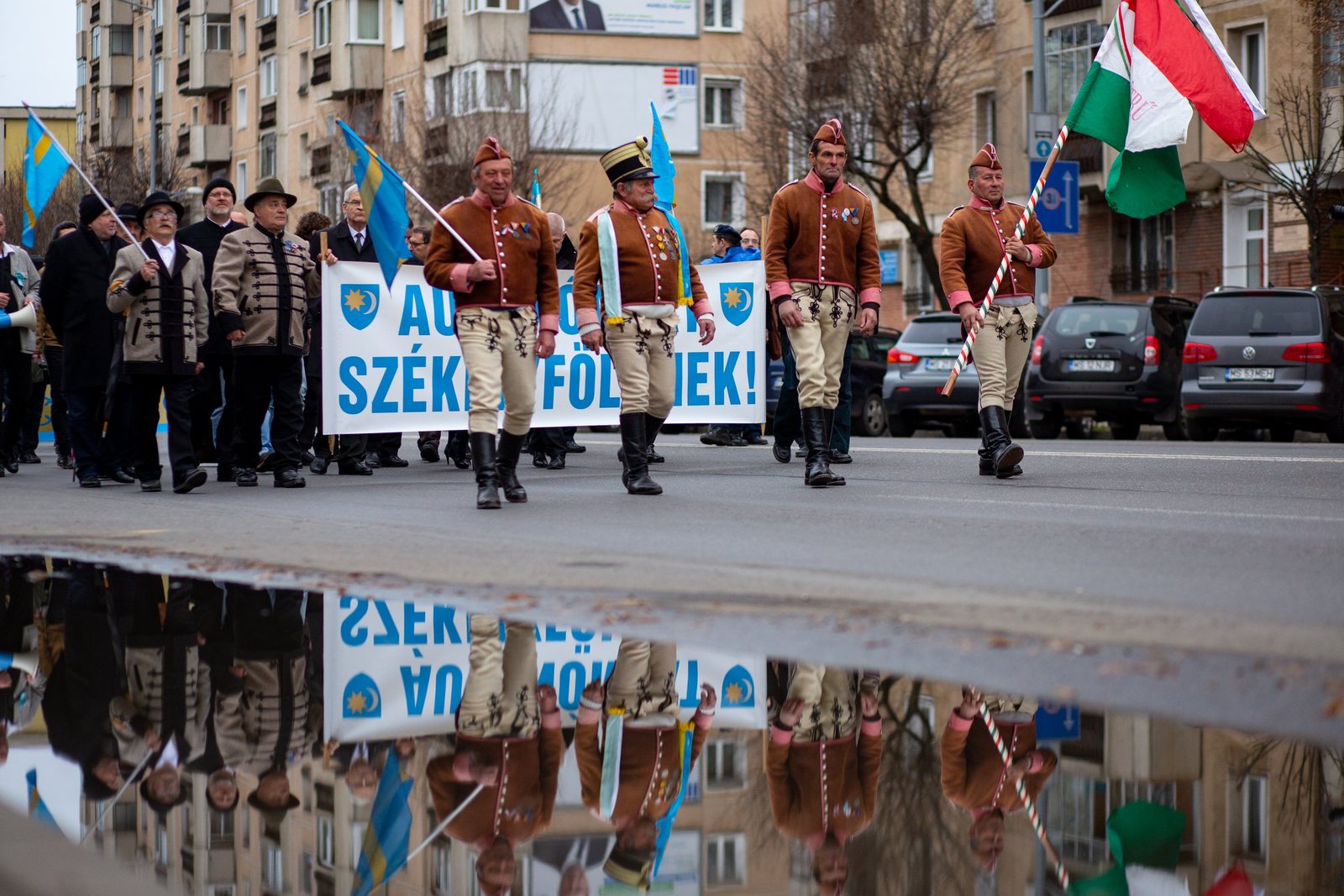

Nearly two-thirds of Romanian residents believe that relations between Romanians and Hungarians are characterized by cooperation, and nearly half believe that the Hungarian community in Romania contributes to the better functioning of the Romanian political system, based on a joint study by the Romanian National Institute for Minority Studies and the Szeklerland Institute for Public Policy, which was presented at a press conference in Cluj-Napoca (Kolozsvár) on Wednesday.
The study, titled “Xenophobia, Anti-Hungarian Sentiment, and AUR Voters,” was based on a representative large-scale survey of Romania’s entire population. Its main question was how attitudes toward Hungarians, immigrants, and other minority groups have evolved in a political context, and what factors account for the rise of the far-right Alliance for the Union of Romanians (AUR).

Researchers and public policy experts present findings from the “Xenophobia, Anti-Hungarian Sentiment, and AUR Voters” study at a press conference in Cluj-Napoca on June 10, 2026. Photo: MTI/Kiss Gábor
At the presentation, moderated by Csaba Zoltán Novák, president of the National Institute for Minority Studies, political scientists István Gergő Székely and Tibor Toró, along with sociologist Tamás Kiss, presented the research findings, which they also compared with data from representative surveys conducted in previous years.
The telephone survey was conducted between October and December 2025 using random sampling, with a margin of error of 3.1%. The sample of 1,013 respondents is representative of Romania’s total population, with Hungarians in Transylvania represented in proportion to their share of the population.
The survey’s authors structured their questions around four themes:
trust in institutions, geopolitical orientations, attitudes toward Hungarians, and social and political fault lines.
Political scientist Tibor Toró, a lecturer at Sapientia Hungarian University of Transylvania, commented on attitudes toward Hungarians, stating that 60% of respondents view relations between Hungarians and Romanians as cooperative, 22% as conflictual, while 18% believe they are characterized by mutual indifference.
Based on party preferences, a striking change is evident among voters of the National Liberal Party (PNL): compared to 2020, the proportion of those who perceive Hungarian-Romanian relations as conflictual has dropped from 25% to 5%. Researchers explain this by suggesting that the party’s “nationalist voters” may have defected to the AUR.
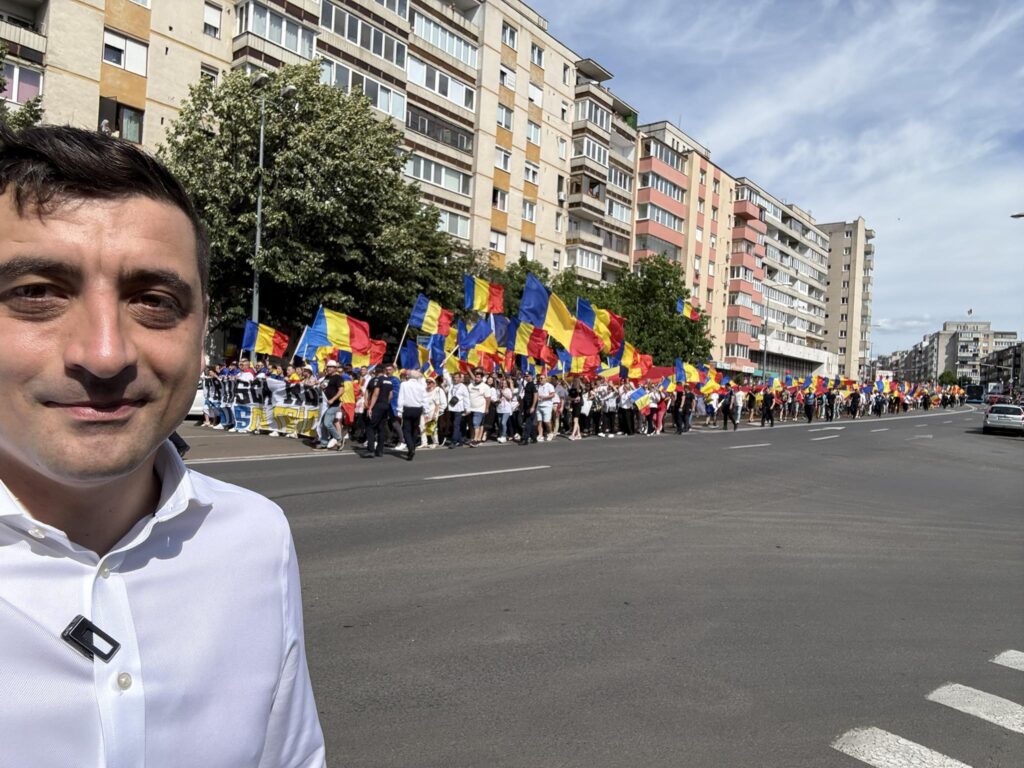
George Simion, Chairman of the AUR. Photo: Facebook/George Simion
Twenty-eight percent of those surveyed believed that Hungarians pose a security threat to Romania, while forty-six percent felt it was more accurate to say that the Hungarian community contributes to the better functioning of the Romanian political system. The latter view is most common among supporters of the PNL and the centrist Save Romania Union (USR).
Regarding minority rights, 57% of Romanian residents believe that minorities have exactly as many rights as necessary, 35% believe they have too many, and 8% believe they have too few. Nearly two-thirds of Romanians agree that Hungarians should be able to study in their native language; 60% support Hungarian-language secondary education, and 58% support Hungarian-language university education, but only 36% agree with the establishment of separate Hungarian schools. Thirty-five percent of Romanians also accept the use of Hungarian in public institutions, and fifteen percent support territorial autonomy for regions with a Hungarian majority.
The proportion of responders who are not bothered if Hungarians speak Romanian poorly has increased significantly, by 20%, over the past five years. Seventy-one percent of respondents are also not bothered when people speak Hungarian around them, but only thirty-five percent agree with this if it happens in the presence of Romanians.
The majority of Romanians are also accepting regarding the issue of Hungarian citizenship: 60% are not bothered if Hungarians in Transylvania hold it.
Regarding trust in institutions, it was found that Romanians trust Euro-Atlantic structures just as much as they did in 2020: 50% trust the European Union, and 49% trust NATO. Among Romanian institutions, the military enjoys a similarly high level of trust at 50%; 39% of residents trust local governments, 17% trust the government, while only 10% trust the parliament.
Hungarians in Transylvania show less trust in Euro-Atlantic institutions—43% trust NATO and 35% trust the EU—while their trust in local governments is much higher at 68% and in the national government at 31%. Compared to previous surveys, trust in the EU is also declining among the general population; it stood at 78% at the time of accession in 2007, but currently stands at 49%.
The Romanian population is also deeply divided regarding geopolitical orientations. Forty-nine percent blame Russia for the outbreak of the war in Ukraine, while 16% and 15% blame NATO and Ukraine, respectively, and nearly 22% did not respond.
Regarding social and political fault lines, sociologist Tamás Kiss noted that a pro-Western and a pro-Russian bloc are emerging. Acceptance of immigrants has grown among the general population, though this is less evident among Hungarians in Transylvania: 32% of Romanians believe immigrants have a positive impact on the country’s development, while only 15% of Hungarians in Transylvania share this view.
Acceptance of ethnic and sexual minorities has also increased among the general population, whereas Hungarians in Transylvania have become more hostile toward social minorities.
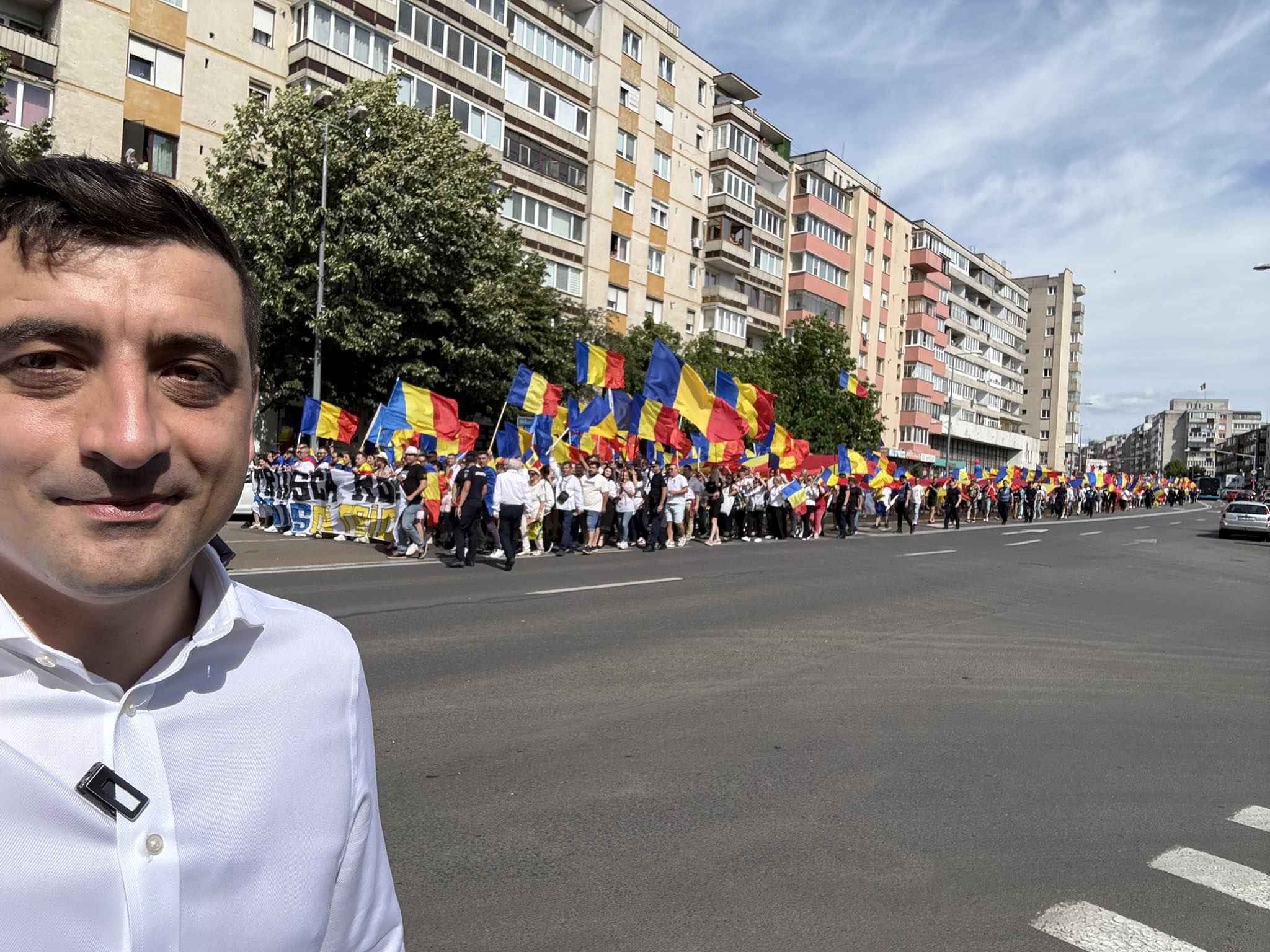
Via MTI; Featured photo: Photo: Facebook/Székely Nemzeti Tanács