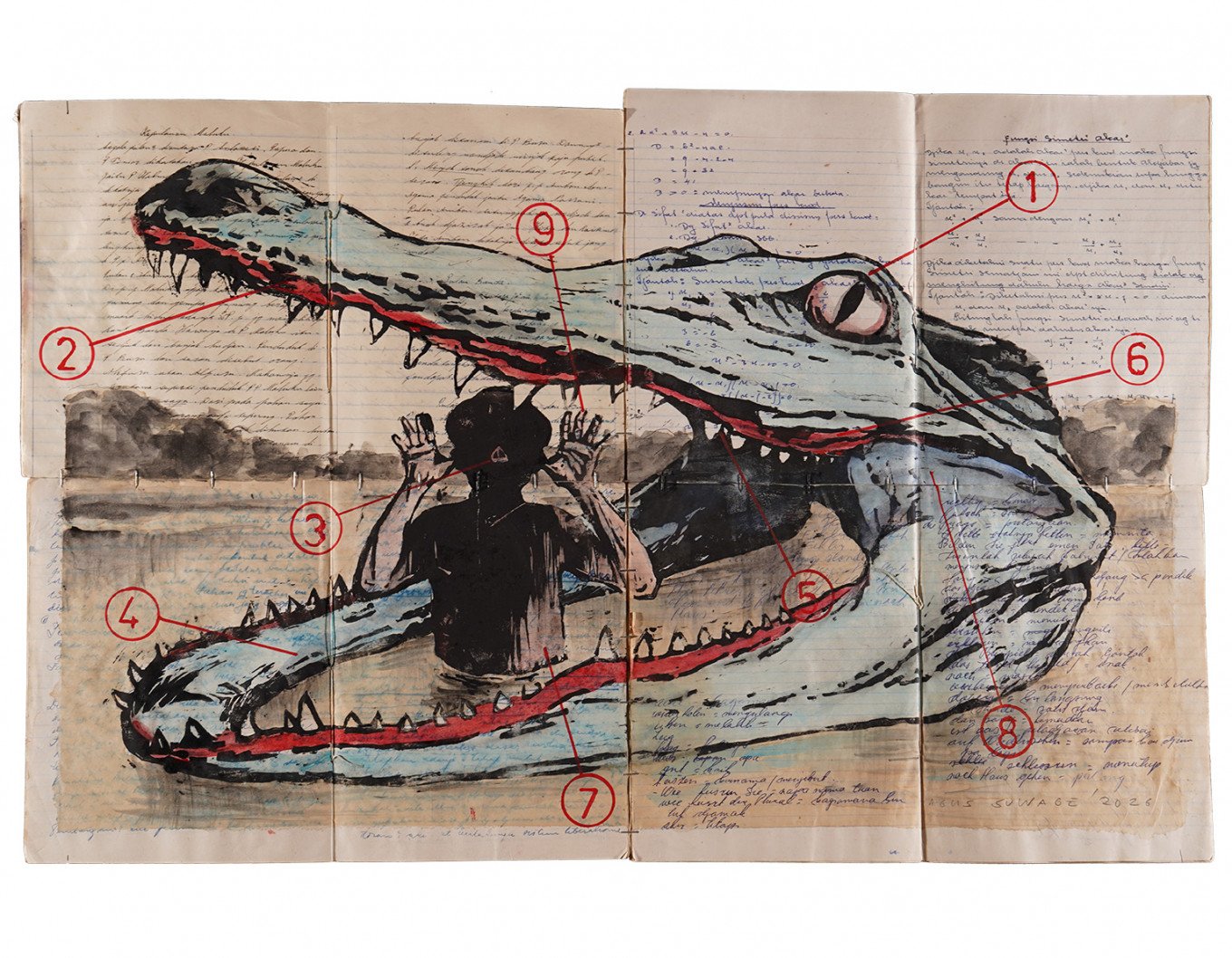
he Indonesian Pavilion is hosting an exhibition titled Printing the Unprinted at the 61st Venice Biennale in the famed Italian city, presenting a narrative that begins long before Europe imagined itself the center of the world, before imperial ships crossed the oceans and before maps divided the world into colonies and possessions.
It begins millions of years ago in Africa, where the earliest ancestors of humanity walked the earth. It then continues through the flooding of Sundaland and the formation of the Malay Archipelago, through the rise of riverine and maritime civilizations in Africa and Asia and the networks of exchange that connected peoples across oceans, long before the arrival of European powers.
To begin the story here is not an exercise in longing but a decolonial gesture, a reminder that human histories did not begin with conquest, extraction or empire. Printing the Unprinted brings together erased or marginalized histories and forgotten stories, including local, regional, indigenous, transnational and colonial counternarratives.
Long before colonial modernity, people forged complex worlds of knowledge, trade, spirituality and kinship across continents. One example is the Bugis seafarers of Sulawesi, whose navigational knowledge connected distant shores across the Indonesian archipelago and beyond.
Their histories remind us that the sea was never an empty space between lands but a living territory of encounter, exchange, memory and belonging.
The story of the Indonesian Pavilion for the 61st Venice Biennale begins with “The Great Voyage” of Datu Na Tolu Hamonangan recorded in pustaha, Batak divination manuscripts traditionally compiled by datu (ritual specialists). The “Voyage” reimagines a 15th-century Batak expedition from Sumatra’s Lake Toba along a northwestern route across the Strait of Hormuz, the Red Sea, Alexandria in Egypt, Venice and further north toward Passau in Germany and Amsterdam.
The manuscript frames the journey as a passage through time, during which history is no longer written from a European perspective but from an Indonesian one. Europe is thus repositioned, not as the center but as a distant point within a wider world map of movement and exchange.