‘Meet Us, Don’t Eat Us’ has been the slogan of whaling organizations protesting against whaling for years. Alongside Japan and Norway, Iceland is the third country in the world to allow commercial whaling in their own so-called Exclusive Economic Zone (and then there’s pilot whale hunting in the Faroe Islands).
The past one two years whales were not hunted because it was not economically viable, but this summer the hunt will start again. Along the wharf in Reykjavik harbor, opposite a visitor center and the boats that take tourists out to watch whales, are two boats from Hvalur, Iceland’s last commercial whaling company.
The government authorized the killing of 150 fin whales and 168 minke whales this year. Hvalur is expected to sail one of these days. Sea Shepherd Conservation Society founder Paul Watson has said he is heading to Iceland to stop the whalers.
A boost for those who are against whaling, but the Icelanders have some reservations. In 1986, Watson sank two boats that were about to set out for the hunt. This was seen as outside interference even by the fiercest opponents.
“That has had a negative impact on our struggle,” says Valgerdur Árnadóttir, president of the organization Hvalavinir (whale friends). Together with co-founder Anahita Babaei, she explains on a remarkably warm day in Reykjavik how Watson’s actions still have an impact. “Kristján Loftsson, the CEO of Hvalur, received support from the population and the hunting quotas went up. Sinking boats in a fishing nation is one of the worst things you can do. Loftsson still portrays us as terrorists and then refers to Watson. He was able to position himself as the victim, and an entire country got behind it.”
Babaei adds: “Other fishermen suddenly feared: what if they come and attack us too?” She herself sat in the mast during previous protests to prevent sailing. “Then you only damage yourself, not Icelandic property,” she explains.
Also read
Sea Sheperd shifts focus: ‘If we don’t stop the krill industry, the entire ecosystem will collapse’
:format(webp)/s3/static.nrc.nl/bvhw/files/2024/02/data111042780-3d867f.jpg)
Icelanders against hunting
Whaling is not very popular in Iceland: out figures Last year it turned out that only 2 percent of Icelanders sometimes eat whale meat and that a majority is in favor of a ban on hunting. A five-year permit was granted in 2024 and in the autumn the government wants to see whether there is a majority in parliament to amend the constitution and ban commercial whaling.
It remains a big mystery why Hvalur wants to open the catch again this year. The company does not respond to interview requests. Owner Loftsson does not answer his cell phone and questions by email or text message remain unanswered.
:format(webp)/s3/static.nrc.nl/wp-content/uploads/2026/06/18134937/180626BUI_2034076642_7.jpg)
The tail of a humpback whale can be seen from a tourist boat.
photo Sigga Ella
The hunt was canceled over the past two years because it was not profitable. The fact that the move is now underway and that a majority in parliament for a ban was not sought before the summer, has to do with a referendum to be held in August. Icelanders will then have to choose whether they want to resume talks for possible accession to the EU. The polls show that it will be tense. If that ban were to come into effect now – the EU is against commercial whaling – it will be seen by doubting Icelanders as a restriction of freedom and a threat to sovereignty. So waiting is safer.
Loftsson can do whatever he wants. Thanks to his investments in the fishing industry, fishing companies depend on him. He is also a leading member of Iceland’s largest opposition party, the Independence Party (Sjálfstaedisflokkurinn), who has not been part of the government only once before since 1983.
“No opposition party is pushing the government, and now it is being emphasized that everyone is free to run his or her business,” Árnadóttir said. According to her, “Icelands are good for the well-being of humans, not for the well-being of animals.” In Iceland there are also controversial blood farms, where five liters of blood are drawn from pregnant mares every week for the sake of the fertility hormone PMSG (Pregnant Mare’s Serum Gonadotropin).
Despite the fuss, there is still a market for that hormone: the bio-industry. This does not apply to whale meat. Previously, Hvalur was able to sell in Japan thanks to its own processing company, but that country now catches enough itself. “Hvalur has now requested permission to sell the meat as pig feed,” says Árnadóttir.
Babaei: “For him, whaling is a kind of trophy hunting. But pigs?” Three years ago he made it even worse, they say. “Then he proposed exporting the meat to African countries for hungry children. This was banned by the government because it would damage Iceland’s image. Moreover, whale meat is bad for children. The countries he contacted explained to him that their country was not a dumping ground for his hobby.”
Hvalur has now requested permission to sell the meat as pig feed
The fact that some people see whaling as a tradition is short-sighted, according to the two. Eating whale meat is not Icelandic. In the past, only the meat that was left on the carcasses after the Norwegians hunted whales was eaten. “It is linked to a kind of Viking ideal that does not exist at all. During the traditional midwinter festival Thorrablót, whale meat is eaten, as if the original Icelander were to eat it, but it is not an Icelandic custom. Hunting has always been for export.”
Also read
Iceland does not kill whales for the second year in a row: ‘It is a dying industry’
:format(webp)/s3/static.nrc.nl/wp-content/uploads/2025/04/15154950/data130913394-af0025.jpg)
See a whale tail up close from a boat
Iceland only makes money from the whale thanks to boats where tourists can see a water spout and a whale tail up close. The north of Iceland in particular thrives on it.
“Every year when whaling continues, you see a decline in visitor numbers,” says Daníel Annisius. He is deputy director of Gentle Giantsa whale watching company in Húsavík. When he was twelve he started as a cleaner in the summer months, then became a guide. “Without tourism this would be a ghost town, and we are already having a hard time this year because the tourist tax for cruise ships has gone up significantly. When it is known that the whaling season is about to start, you always notice that people cancel,” he says in his office overlooking the bay.
:format(webp)/s3/static.nrc.nl/wp-content/uploads/2026/06/18140420/180626BUI_2034076642_11.jpg)
:format(webp)/s3/static.nrc.nl/wp-content/uploads/2026/06/18140401/180626BUI_2034076642_10.jpg)
The harbor of Húsavík, where whale watching company Gentle Giants lets tourists on boats see the whales up close.
photos Sigga Ella
He has seen a lot of changes in the whales’ presence since the company started in 2002. “Initially we were dependent on the minke whale, but in recent years it has mainly been the humpback whale that swims here, followed by the blue whale. The number of humpback whales has increased around Iceland.” This is partly due to climate change, but also due to a changing food pattern, he thinks.
Whaling has been unnecessarily politicized, he believes. “Loftsson has too much influence with national politicians. He starts with the catch simply because he can. No one wants it.”
Statement against whaling
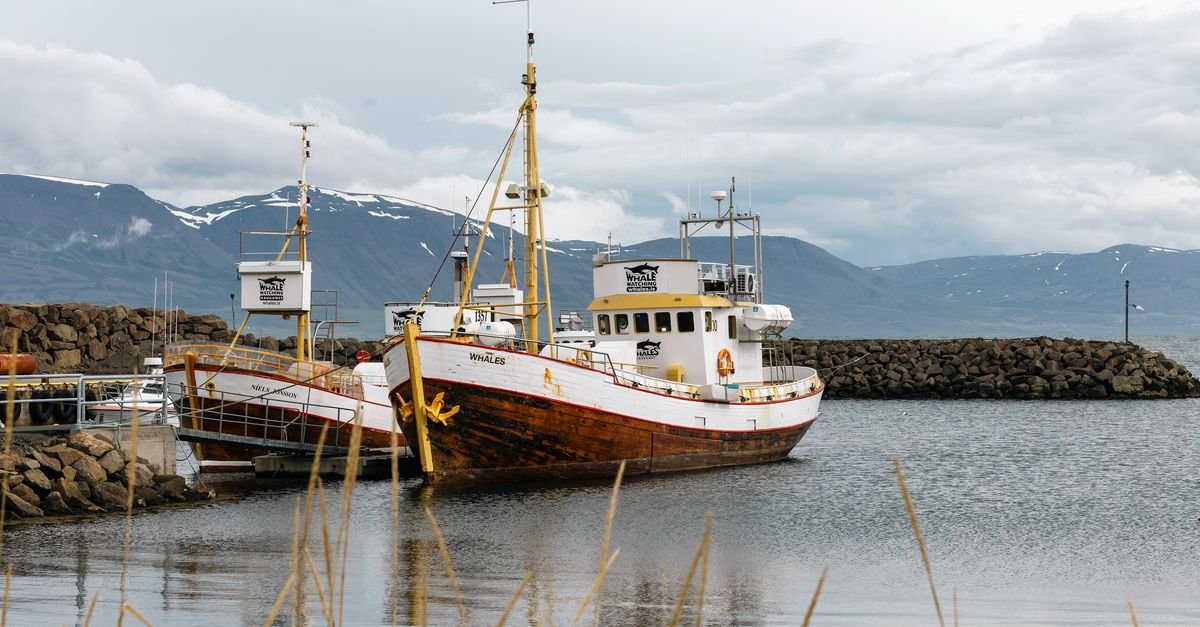
An hour away is the town of Hauganes, which is home to the oldest whale watching company in Iceland. Whales Watching Hauganes started in 1993 and has boats made of ‘old-fashioned oak’, as the advertising signs say. A quarter of tourists in Iceland take a whale watching tour. Some of these come every year 350,000 tourists watching whales. “Almost everyone in the whale watching industry is affiliated with the ICE Whales organization, as a statement against whaling,” says guide Júlia Yr Thorvaldsdóttir.
:format(webp)/s3/static.nrc.nl/wp-content/uploads/2026/06/18134953/180626BUI_2034076642_9.jpg)
:format(webp)/s3/static.nrc.nl/wp-content/uploads/2026/06/18134925/180626BUI_2034076642_5.jpg)
The road to Hauganes in the north of Iceland, tourists search the sea for the glimpse of a whale.
photos Sigga Ella
Thorvaldsdóttir does not have a clear answer to the question of whether those countless boats are unpleasant for the whales. “Research has been conducted into whether the stress level of whales increases when so many people come and whether they suffer from noise pollution, but the data is not yet known.”
She does not understand why there is no ban on hunting yet: “Iceland makes money from whale watching, not from whaling. Loftsson has a lot of political influence and he emphasizes that hunting is good for employment. Yesterday I looked at how many are on that list and saw three employees.”
And then it’s time to set sail. Thorvaldsdóttir asks everyone on the boat to pay close attention if they see a whale: “The whale is free, looking for food. We are looking for them.”
:format(webp)/s3/static.nrc.nl/wp-content/uploads/2026/06/18134842/180626BUI_2034076642_4.jpg)
Guide Júlia Yr Thorvaldsdóttir.
photo Sigga Ella