HEALTH
HIGH in the foothills and mountain villages surrounding Mt Wilhelm – PNG’s tallest mountain – the famous ‘Wara Simbu’ begins its twists and turn down to Kundiawa Town, and continues its’ journey to join the Wahgi River and onwards.
Here, potato, bulb onions, cabbages, beans, broccoli, cauliflower, carrots, barley and the famous ‘everlasting flowers’ thrive – along with goats, pigs, and trout farms.
Planted on fertile mountain terrain and volcanic soil in patches surrounded by dangerously steep slopes and ravines, these nutritious vegetables – much sought after in towns and cities including in Port Moresby and usually out of reach – grow in abundance. Among the population of roughly under 30,000 people, the Mitnande Local Level Government (former Mount Wilhelm Rural LLG) in Chimbu’s Kundiawa-Gembogl District, women and children look healthy and well-nourished.
While outreach and immunisation rates have improved significantly for Chimbu in the last few years, and especially for Kundiawa-Gembogl – the top performing district in terms of health service delivery as per the 2025 SPAR Report – at closer look, health challenges still remain in these remote rural communities.

The Kundiawa to Gembogl road is among the best in the country. It takes roughly an hour on a good day to travel from Kundiawa town to Gembogl station and to Ward 1 of Mitnande at Mt Wilhelm. Yet, access to timely health services remains a challenge for a highly pregnant woman in the mountains and inter-land communities including Tar, Augl, Mondia Pass which borders Chimbu and Madang.
While the first 1,000 days (pregnancy to age 2) are critical for a child’s development, women and children in this part of the country continue to face these challenges – having to walk long distances over mountains and rugged terrain to reach the nearest health facility.
In early May, more than 100 village health assistants (VHAs) commenced a household monitoring survey in the four LLGs of Kundiawa-Gembogl District including in Mitnande, as part of a wider intervention to identify, address and reduce high stunting rates in PNG under the Child Nutrition and Social Protection (CNSP) Project implemented in Chimbu, Madang, East New Britain and Western provinces.
For the first time in PNG, the CNSP Project is implemented by three government agencies including Component 1 – National Department of Health (NDoH), Component 2 – Department for Community Development and Religion and Component 3 – Department of Justice and Attorney General, with financing from the World Bank – each leading a component to combat alarming stunting rates among children in PNG.
The household monitoring survey was also being rolled out for the first time in Chimbu, and continued for the rest of May to reach pregnant women and children under five years of age – led by mostly a youthful population of VHAs working in close consultation, supervision and oversight by the NDoH Nutrition team, Chimbu Provincial Health Authority, Save the Children and the CNSP Project team under Component 1 (NDoH).
There is already evidence of stunting in these Mt Wilhelm communities, according to NDoH’s Nutritionist Helen Palik, confirming the dangerous rising trend of stunting around the country.
You have a spirit that you can write history in the harshest mountain and the most difficult terrains. And that spirit is everything because everywhere in the world, in every country, it is not easy.”
While conducting awareness in the communities as part of the survey exercise, Palik encouraged mothers to take iodised salt, eat healthy nutritious meals, and have children immunized for protection against diseases. She highlighted the importance of Iodised salt as crucial for child development in the first 1,000 days for improving brain development, mobility, and overall growth and development of a child.
Palik highlighted the importance of the first 1,000 days of a child’s life. She encouraged mothers to practice exclusive breastfeeding, eating healthy meals and positive parenting practices and support from men which will all contribute to raising healthy and smarter children in the next generation.
“Pregnant and breastfeeding women need higher iodine intake to support the growing child and to provide adequate nutrition through exclusive breastmilk. Mothers must eat healthy meals from the four food groups including fruits and vegetables to improve a child’s chances at a better life in the future – including having healthier and smarter children in Kundiawa-Gembogl in the next five to 10 years,” Palik said.
After completing a week-long training in Chimbu, seven teams of VHAs were deployed by the CNSP Project supported by the NDoH, the provincial health authority and Save the Children, to conduct the Household Monitoring Survey in Kundiawa Urban, Waiye, Nilkande and Milkande LLGs while national and provincial trainers provided oversight and supervision throughout the survey exercise.
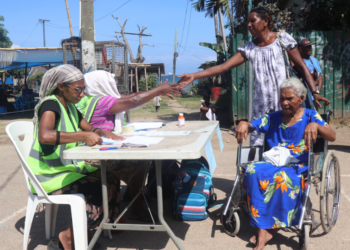
In the neighbouring Nilkande LLG area, officer in charge (OIC) of Kangir Community Health Post Sister Clara Moro and her daughter and community health worker Monica Gemba continue to provide health education and awareness to pregnant women and mothers, contributing to reducing stunting in this rough terrain communities along the Kundiawa-Gembogl road and further inland.
Clara supported a survey team with her health facility Ambulance and local knowledge to mobilize her community and catchment population of about 5,000 people – urging pregnant women and parents of children under five years to take part in the survey.
Capacity-building including training-of-trainer and VHA trainings aim to train healthcare workers and VHAs to effectively utilise surveys and behaviour change communication tools to engage effectively with families and to provide tailored support and education on nutrition and contribute to reducing stunting in the communities.
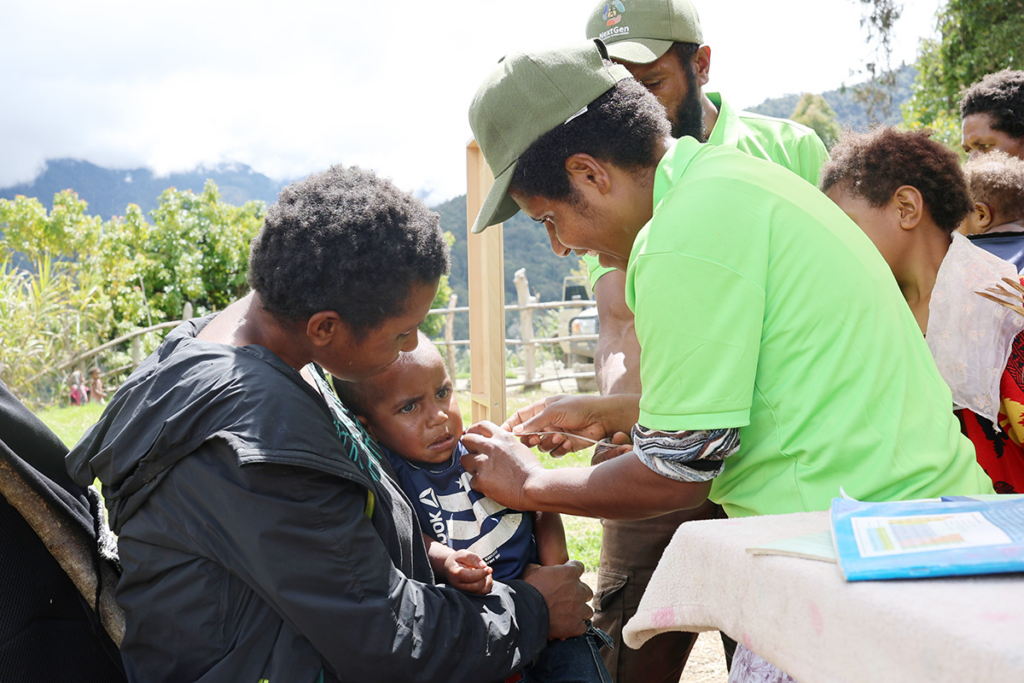
As part of their training to conduct the household survey, these community champions of VHAs were trained to provide the right health and nutrition education, engaged in practical sessions to use basic medical equipment including the weight scale to take a mother and child’s weight together, measuring the middle upper arm circumference (MUAC) of a child as a fast measure of malnutrition in children under five, and using height boards to measure the height and length of a child.

As part of their engagement under the CNSP Project, VHAs are equipped with weight scales, height boards, MUAQ tapes, BCC tools, and walk long distances within their wards and act as the ‘last mile’ between the communities and the health system.
While thanking the Department of Health, World Bank, Chimbu PHA and the national and provincial trainers for the support and training, Smark Umba, VHA for Mitnande Ward 1, urged VHAs to be positive role models in the community and own this programme. Smark’s role oversees communities in Mt Wilhelm from the border of Chimbu and Madang to the back of Jimi in Jiwaka. He believes that everyone is placed in the right place to contribute to change, for the good of the next generation.
Dr Neha Singh, senior programme manager – Health and Nutrition for Save the Children PNG thanked all partners for supporting the project while acknowledging the PHA. While supporting the survey exercise, Dr Neha was encouraged to see VHAs using the survey tools well to conduct the survey exercise this week in the communities.
“You have a spirit that you can write history in the harshest mountains and the most difficult terrains. And that spirit is everything because everywhere in the world in every country, it is not easy. You make it work and you will be the change makers in your communities,” Dr Neha told the VHAs.
Speaking on behalf of the chief executive officer of the PHA Dr Ken Kassi, acting Public Health Director Arnold Marme acknowledged the work of the VHAs under the CNSP Project. He said while all public health programs have VHAs, but the project is doing good work in the communities and these can be replicated in other programs as well.
Marme also acknowledged the contribution of the CNSP Project to improve the national indicators in the province and overall performance of the Kundiawa-Gembogl District in 2025.
Over 1,100 surveys have been conducted in the four LLGs of Kundiawa-Gembogl District in the first week of May.
By focusing on the first 1,000 days of a child’s life, the CNSP Project aimsto improve nutrition and empower vulnerable households through cash transfers and community-based interventions.
- Story and pictures by PAULA KARI from the Department of Health World Bank Projects