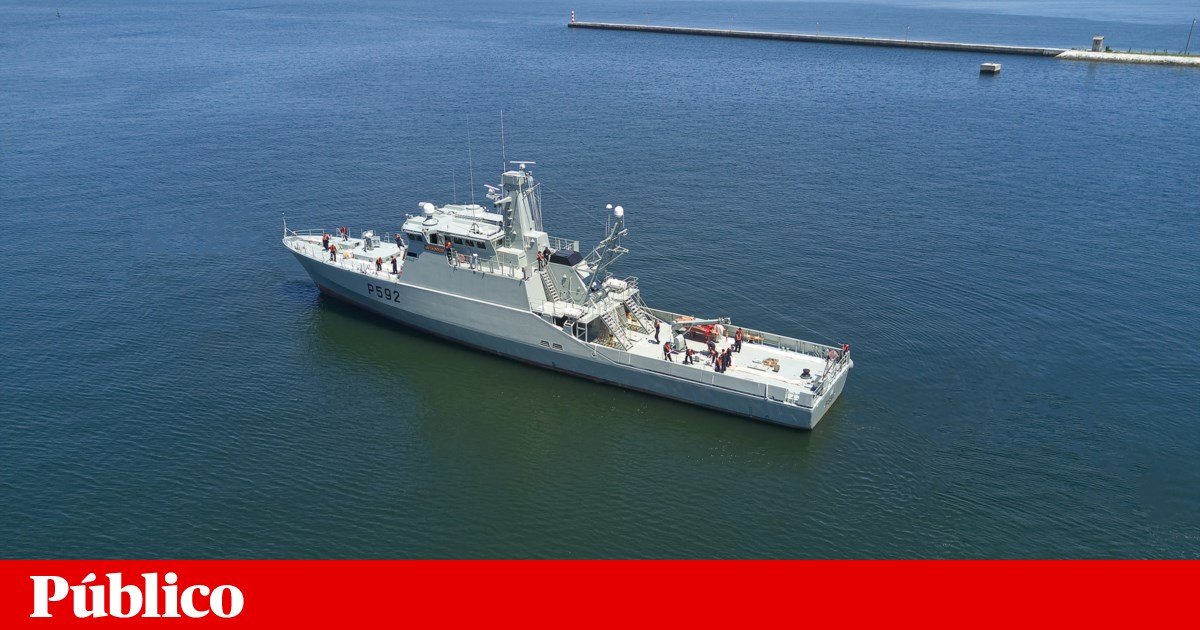
The Navy admitted an “internal failure” in notifying two soldiers who refused to board the patrol ship Mondego and would go to trial on Wednesday, but denied any disrespect towards the court.
At issue is the fact that the Lisbon court considered, this Tuesday, that the Chief of Staff of the Navy (CEMA) compromised the work of the trial of three military personnel accused of violating state secrets, sentencing Admiral Nobre de Sousa to a fine of 816 euros.
In response to questions sent by the Lusa agency, the branch said that “from the preliminary internal investigation carried out, an internal failure in the military notification procedure was confirmed”. The response adds that “this failure is entirely assumed by the Admiral Chief of the General Staff of the Navy, as commander of the Navy, but does not constitute any disrespect towards the Court”.
According to the order to which Lusa had access, the second trial session that was scheduled for Wednesday was postponed without indicating a new date, as the Chief of Staff of the Navy did not notify the two soldiers summoned as witnesses in a timely manner and the court was not warned in good time that there were obstacles to their appearance.
“It appears, therefore, that these witnesses are not, once again, notified and that they will not appear in this court”, the document reads.
This conduct by the Navy, considered the Central Criminal Court of Lisbon, where the trial is taking place, “seriously compromises the regular functioning of the service of this court, it intensely affects the image of effectiveness, readiness and rigor that the citizen expects from both institutions” — the court and the Armed Forces. Furthermore, “it constitutes an attempt to compromise the duty to comply with judicial orders and the authority of the courts”, reads the order, which adds that it is “a reprehensible and unjustified omission of the duty to collaborate with the court and an equally intolerable obstruction of the action of Justice”.
On the defense side of the three Navy soldiers, lawyers Paulo Graça and António Garcia Pereira told Lusa that they will ask for the sanction to be paid by the head of the Navy himself, and not by the Navy, and will request “the detention of the two witnesses to be taken under detention to a judge on the new date that will be designated”.
This is the second change to the second session, which was initially scheduled for May 6th and was postponed because one of the witnesses was on a mission and, at the time, the Lisbon Court pointed to the Navy’s lack of collaboration.
On March 11, 2023, 13 soldiers refused to carry out a mission to monitor a Russian ship, in the Madeira archipelago, citing a lack of security on the ship Mondego. The episode would give rise to two processes: one involving these three soldiers for violation of state secretswhose trial has already begun, and another involving 13 soldiers for insubordination and which is still in the investigation phase. At the time, CEMA was Gouveia e Melo; Currently, the position is held by Noble de Sousa.
The trial of the three Navy soldiers began on April 22, with the court rejecting the defense’s request to remove the military judge who is part of the panel of judges. For the Public Ministry, the military publicly disclosed confidential information about the condition of the ship, knowing the confidential nature of the data.
The three defendants “knew that the documents they prepared contained restricted, reserved and classified information about the non-compliance, location, mission and operational limitations of the NRP Mondego which, due to its nature and content, could not be disclosed”, reads the indictment to which Lusa had access.
The accusation classifies the actions of the three soldiers as “thoughtless, careless and omissive”.
In relation to the process in the investigation phase, the Public Prosecutor’s Office argued that the NRP Mondego “had the capacity to launch into the sea, although with some degraded conditions”, including cracks in the deck, an inoperative engine and a malfunction in the engine coolant pump”.
For the Public Ministry, if “impossible conditions to carry out the mission were met, the commander could decide to return to port”, reads the indictment.