SHIFTING FIRE:
While the tempo of purely military exercises around Taiwan has gone down somewhat, Beijing is working to isolate Lai diplomatically from support abroad
Chinese President Xi Jinping (習近平) is shifting tactics in his campaign to pressure Taiwan, ramping up diplomatic isolation of the nation while dialing down provocative displays of military aggression.
Taiwan recorded a daily average of five Chinese military aircraft crossing the Taiwan Strait’s buffer line with China through May this year — half the number logged in the same period last year. In March, Beijing did not send a single fighter jet near Taiwan for seven days, the longest absence on record outside of typhoon season. In comparison, China sent 153 planes near Taiwan during one day at its peak in 2024.
Beijing has not yet conducted any major military drills around Taiwan this year, and is testing new tactics for pressing its case without the People’s Liberation Army. China’s Ministry of Transport last week conducted patrols east of Taiwan for the first time, asserting Chinese territorial claims with survey vessels and coast guard ships.
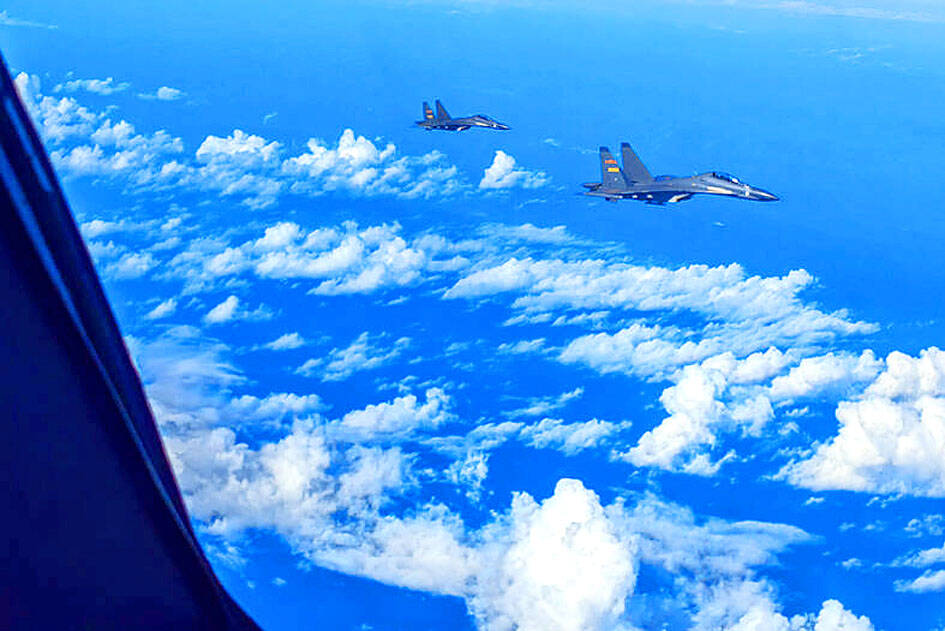
Photo: AP
At the same time, China focused more broadly on the First Island Chain, including areas near Japan and the Philippines.
The shift in military activity comes as China escalates efforts to silence President William Lai (賴清德) on the world stage.
In addition to expelling a New York Times reporter from China in February, Beijing has punished European and Japanese outlets that interviewed him, according to people familiar with the matter. Under Taiwan’s former presidents, such interviews were mostly met with verbal protests.
Adding to Lai’s problems, every other Taiwanese president this century had transited the US mainland by this point in their first term, but his planned trip has been delayed since last summer.
Lai’s attempt to make a rare visit to Africa this year sparked a cross-continent campaign by Beijing to close international airspace to his plane. Earlier this month, Chinese authorities sanctioned New Zealand lawmakers for the first time, after they traveled to Taiwan.
“Beijing has likely concluded its previous grey zone pressure tactics were harming its international reputation or building support internationally for Taiwan,” said Jeremy Chan, a senior analyst for China and Northeast Asia at the Eurasia Group. “What Beijing really wants is for Lai to lose at the ballot box in Taiwan’s next election in 2028.”
“In the meantime, China seeks to isolate him internationally in an effort to weaken his domestic support levels,” he added.
The change comes as US President Donald Trump casts doubt on any US commitment to Taiwan, after branding weapons sales to Taipei a bargaining chip with Beijing. That was a departure from the position of former US president Joe Biden, who said he would defend Taiwan from any invasion by China.
US officials such as US Secretary of State Marco Rubio and US Secretary of Defense Pete Hegseth have insisted there is no change in US policy on Taiwan, even as the Pentagon chief adopts softer language on China’s top red line issue and calls for a “strong, quiet and clear” approach toward the region.
Since coming to power in Taiwan’s tightly contested January 2024 election, Lai has given six interviews to overseas media, an uptick from Tsai Ing-wen (蔡英文), who did four in the same period.
China is “acting to enforce real consequences on those it sees as violating its claimed sovereignty — or otherwise legitimizing the Lai presidency, against which it seems to have a special animus,” said David Bandurski, director of the China Media Project. Before taking office, Lai called himself a “pragmatic worker for Taiwanese independence,” comments that have enraged Beijing.
After Agence France-Presse published an interview with Lai in February, China’s Foreign Ministry expressed its displeasure to the company, according to people familiar with the matter, who asked for anonymity to discuss sensitive matters.
China subsequently denied AFP reporters access to major political and diplomatic events, according to the people. The outlet was also denied visas for new reporters, The Wire China previously reported citing four people familiar with the matter.
“AFP is committed to covering China on the ground,” the company’s Asia-Pacific regional director Michael Mainville said in a statement. “We hope the Chinese authorities will continue to provide our journalists with the access they need to cover important stories in China.”
After Nikkei reporters in Taipei interviewed Lai in May last year, Chinese authorities threatened the publication with unspecified consequences, according to a person familiar who asked for anonymity discussing private matters. Since then, the Japanese outlet’s applications for long-term journalist visas have not been successful, they added. Nikkei declined to comment.
The New York Times last month announced that China expelled reporter Vivian Wang over a December interview with Lai conducted by her colleague via videoconference in the US.
China’s Foreign Ministry said in a statement that it “welcomes foreign journalists to report in China in accordance with laws.”
“At the same time, China firmly opposes foreign media outlets that provide a platform for the Taiwan authorities to spread the ‘Taiwan independence’ separatist fallacy and even blatantly refer to China’s Taiwan province as a nation,” it added. “Any act that tramples the red lines of the one China principle will pay a price.”