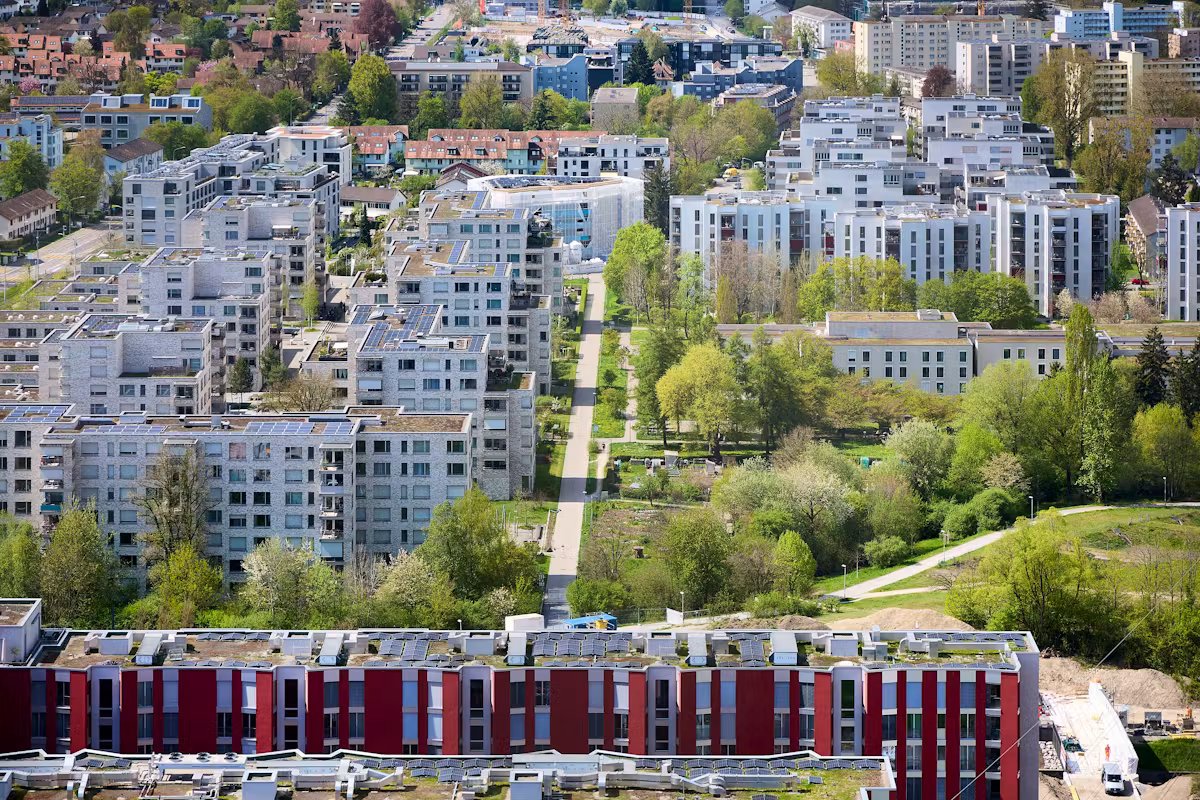
- Because the SVP’s 10 million Switzerland initiative was rejected, Switzerland will continue to grow – and need more housing, argues the construction lobby.
- After the vote, she is therefore putting pressure on people to quickly dismantle regulations, weaken tenant protections and move forward with large residential developments.
- The tenants’ association disagrees: More apartments are needed, but in order for rents to actually come down, effective state housing protection is needed.
The Swiss construction lobby is happy about that No to the SVP initiativeas Karin Bührer, managing director of “Development Switzerland”, says. The association is backed by many large general contractors and real estate investors such as Implenia, Frutiger, Marti, Erne and HRS. «We are committed to a no vote. But we are convinced that there is no way to continue as before. Now we must provide answers to people’s most pressing problems, including: Housing crisis. The vote shows that people are ready and have trust to solve the challenges together. We want to move forward.”
“We have to build more apartments because the population will continue to grow and therefore demand will continue to increase.”
The thrust is clear: “We are building fewer apartments today than in 1980, even though almost two million people have been added since then. This is not a force of nature, but the result of political decisions. Apartments are already becoming scarce and rents are rising. We need to build more housing because the population will continue to grow and therefore demand will continue to increase.

In well-developed areas, more apartments are needed in the available space, where it makes sense: high-rise buildings, otherwise mainly five to seven-story developments. “This is the only way we can protect nature because we build more where it makes sense. Density needs acceptance. And these only exist with intelligent projects that people enjoy living in. Nobody objects to a house that they would move into themselves.” However, housing construction is currently being slowed down too often. The association specifically identifies five problems.
Michael Töngi, Green National Councilor and Vice President of the Swiss Tenants Association, is also happy about the no to the SVP initiative. He also says the high rents need to be addressed now. But when it comes to “how,” he has different ideas.
Construction lobby demand 1: “Too many and outdated regulations”
“We could have built enough apartments for a long time, the spatial planning actually provides for this,” says Bührer. The problem: “Many of our projects are delayed or slowed down by regulations. Sometimes we would have a great project, but it is purely a commercial zone and you don’t want to rezone it in order to have more flexibility. Sometimes the community doesn’t want us to make full use of the utilization rate.” All of this slows down good projects.

That’s what the tenants’ association says
Töngi says that these are ultimately municipal issues and therefore democratic processes. He doesn’t see any need for change: “If the developer presents a good project, it complies with the regulations and the voters in the communities say yes to it.” People’s skepticism stems from the fact that too many poor residential developments have been built, in which the return on investment was more important than sufficient green space.
Construction lobby demand 2: “Too much townscape and heritage protection”
Point two also plays into the topic of regulation: “In Zurich, 75 percent of the buildings are in the inventory of objects worthy of protection. Nobody wants to destroy Switzerland as we know it. But a little more sense of proportion would be necessary.” Bührer therefore calls for a greater balancing of interests in favor of housing construction. “When different interests collide, housing construction should be given more weight in the future than it is today.”

That’s what the tenants’ association says
“This 75 percent is very controversial; only a few buildings in Zurich are actually protected. And often the building owner simply has to prove that they are building high quality and preserving the townscape. It hurts people when the townscape is destroyed. You have to take that into account.”
Construction lobby demand 3: “Too little planning security”
“Today there are simply too many stakeholders who have a say in projects. Because of the many individual interests and because no one makes a binding decision, they are delayed.” According to Bührer, these delays and constant changes of direction damage planning security and make housing construction unnecessarily more expensive. Bührer is therefore calling for binding deadlines: “Four months for a clean building application, three for the specialist departments. If a specialist agency does not respond, it is considered a yes. That way everyone knows where they stand.”

That’s what the tenants’ association says
“In the last 15 years nothing has changed in terms of the requirements. Since the Spatial Planning Act of 2013, we have been building less on greenfield sites and wanting to increase density, which has certainly made building more challenging. But when it comes to noise protection, Parliament has even relaxed the requirements.” Here too, Töngi says: “If the projects are planned correctly, you also have planning security.”
Construction lobby demand 4: “Too many appeals”
“The right to appeal against a construction project is also absolutely central to us,” clarifies Bührer. But: “Appeals should be allowed to be submitted at the beginning of a project and only if the people making the appeal are actually affected by it.” Anyone who appeals simply because they don’t like a project or can’t enjoy a few hours of sunshine on the balcony will be asked to pay in the future. And one more thing: “Anyone who allows the withdrawal of an objection to be bought is committing a criminal offense and is harming society as a whole with this behavior.”
That’s what the tenants’ association says
«I understand this request, but it misses the main problem. You only notice whether someone is appealing maliciously or not during the process. So we still need the right to object.”
Construction lobby demand 5: “Too strong tenant protection”
“It’s a sensitive topic,” Bührer is aware. But: “If we cap rental prices, the result will be that renovations will no longer be carried out. If we don’t renovate, we won’t achieve the climate target and won’t be able to offer modern apartments.” In addition, excessively rigid tenant protection particularly helps those who have lived in an apartment for a long time. “But we have to make sure that we also offer attractive apartments for newcomers.” The association also calls for housing construction to be given greater political priority, for example by declaring it a national interest. Bührer proposes an incentive: “Anyone who renovates a building to make it more energy efficient should be allowed to build up to 30 percent more living space, provided they forego any rent increases due to the renovation. Today, Switzerland only renovates one percent of buildings per year; three would be needed to meet the climate target. This means we can get more modern apartments and even more of them, without a square meter of new flooring.”

That’s what the tenants’ association says
“If you see that rents are rising and rising, tenant protection in Switzerland can’t be that strict. On the contrary, there are too few specifications for renovations and new replacement buildings. Renovations are carried out regularly only in order to then charge significantly higher rents and thus make significantly more profits.
“Construction companies are ready to make concessions”
Bührer emphasizes that the industry is also prepared to make concessions. In larger developments, inexpensive apartments and green spaces are now often standard. And she puts a concrete offer on the table: “Where there is a new zoning, we commit to renting out at least 30 percent of the apartments on a long-term, affordable basis, which is binding in building law. In return, we accept that remote locations will be zoned out where no one has built for years. This is the trade: building land in the right place in exchange for affordable housing. If we want to solve the housing crisis, we need to increase supply. We can only achieve this if everyone is prepared to work towards a compromise.”
“Profit-oriented companies will not solve the problem”
For Töngi too, building more is not fundamentally wrong. “But the question is who is building. We don’t trust profit-oriented companies to solve the problem. If we want rents to really fall, we need housing subsidies like the one that came through in the city of Lucerne on Sunday: with a foundation that builds and rents out affordable apartments and a right of first refusal for the city.
How do you see the current demands for significantly more housing construction in Switzerland?

Daniel Graf (dgr) has been working for 20 minutes since 2020. He is head of the New department and has been a member of the editorial board since September 2023.