Loading Text-to-Speech…
The need to remain under observation for at least another two years the deer population in Parnithathe scientists indicate. As they conclude, the species is under pressure from both the wolf and the human presence, with the result that its population is at a tipping point. But the interesting thing is that the deer has now spread over a very wide area in Attica and Boeotia.
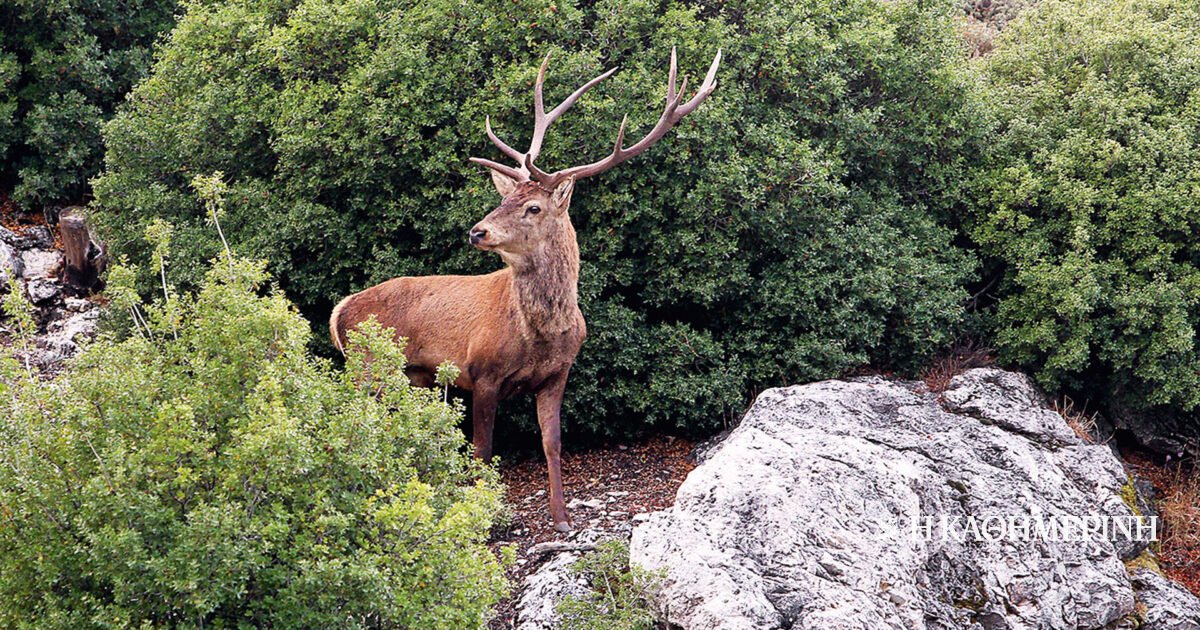
According to information provided by National Park Management Unit in the Animal Protection – Environment prosecutor, the population of the red deer (Cervus elaphus) is estimated for the year 2025 to be between 75 and less than 234 individuals, with the most likely consisting of about 132 individuals. The data comes from study undertaken on behalf of the Natural Environment Agency (OFYPEKA) the Wildlife Laboratory of the Department of Forestry and Natural Environment of the Aristotle University of Thessaloniki, headed by professor Dimitris Bakaloudis.
To reach this conclusion, AUTH scientists used three methods. “First, we sampled the faeces. Herbivorous animals are considered to have a constant daily defecation rate. Therefore, knowing this rate we can make a density estimate.” explains Mr. Bakaloudis. “At the same time, we proceeded to monitor (with a telescope or binoculars) the deer from points inside and outside the forest. This method is useful for recording population structure – how many males and females there are and how many young there are. Finally, we tried with genetic analysis in fresh feces to determine how many times we meet the same individual, that is, to estimate the abundance.”

The results are rather disappointing. “The population in Parnitha is small. The species is not in immediate danger of extinction, however there are some issues that concern us. For example, while we saw that in the summer there were many cubs, in the fall there were much less.
Most likely they were preyed upon by wolves, because they are easy prey. Also, there is a very large disproportion in the population: for every male there are between six and ten females. One interpretation is that we simply did not observe males because they are probably hiding. Another interpretation is that they are probably prey. When the ratio of the sexes predominates in females, reproduction decreases, something that remains to be proven.”
In Parnitha it is estimated that for the year 2025 their population ranges between 75 and less than 234, with more likely consisting of around 132.
small “tank”
The results of monitoring are not very favorable for the population of deer in Parnitha. “The worrying thing is that we have calculated a small “active” population, i.e. a population that participates in the genetic pool of the local population, around 35 deer. When the active population falls below 50 individuals, there are increased chances for homomixture, that is, to be produced less adaptively to environmental conditions.”
Mr. Bakaloudis supports that the monitoring of the species in Parnitha must continue, before management interventions are decided. “The measures are determined by three components: We have to manage the destruction of the forest, something we cannot do much about. We have to manage the presence of the wolf as well as the human. Don’t be surprised by the last point; has anyone ever wondered how many of the deer that people feed bread and shrimp will die, or how much more vulnerable they are to the wolf because they will get sick because they can’t digest the food?”
A common species of the Balkans
However, contrary to what many believe, the red deer is not found only in Parnitha (it is a common species of the Balkans after all), but has spread over a wide area. In a scientific program entitled “Ecological corridors – From mapping to implementation, aiming to improve the sustainability of the red deer population in Attica-Boeotia” implemented within the framework of the Wildlife Alliance (greekwildlifealliance.gr) by the Forestry Research Institute of ELGO “Dimitra”, WWF Hellas and “Kallisto”, the presence of six groups of deer in the plateau of Dervenochoria and their population is estimated to be at least 35-45 people.
“We quickly realized that there is a permanent population in Dervenochoria, but also in the area of Asopou – Tanagra, as far as Thebes”, explains Christos Astarasresearcher at the Institute of Forestry Research. “Parnitha ceased to be the “paradise” of the species due to successive forest fires, but also due to the natural spread of the wolf. Now the species has spread over a wide area and we still don’t know if it has reached Mount Pateras yet.”
It should be noted that within the framework of the program, measures have been taken to facilitate the spread of the deer population, but also to limit the problems from the “conflict” with agriculture.