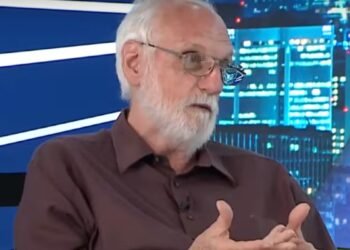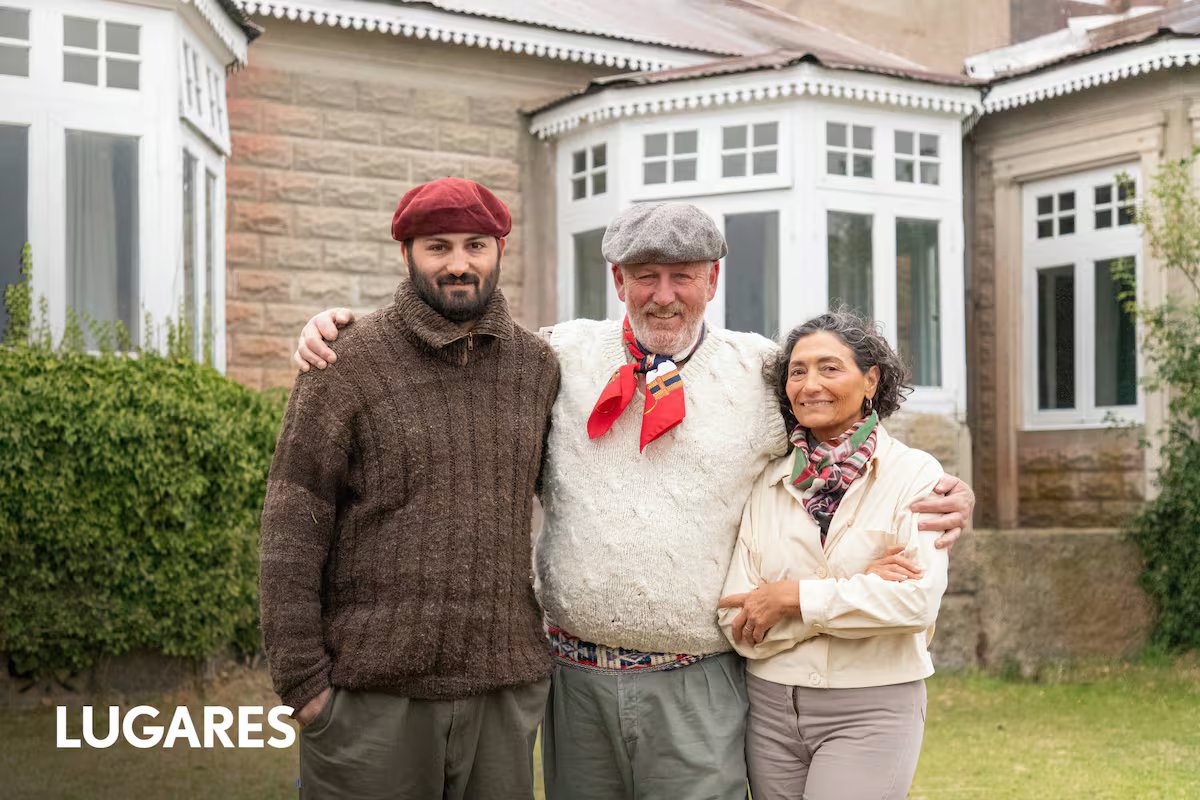
When I was a boy, Leslie Hewlett did not take subjects for a single purpose: to have the entire summer to spend in the countryside. And he liked it so much that he settled in the foreman’s house – and not in his family’s – so as not to miss any herding or corral work. Much of this counts, mate involved, in the kitchen of the main house of Coy Inlet ranch. With the gestures and tone of a country man, he delves into family history while his wife, María Rosa “Mara” Chesini, receives the guests.
“The first to come was my great-grandfather, John Smith, accompanied by his brothers Peter and William. They arrived from Malvinas when Carlos María Moyano, first governor of the national territory of Santa Cruz, went to look for people to populate Patagonia. They were Scottish and almost twenty years old. They did one section by boat and another on horseback. And, strictly speaking, the one who discovered this area was Peter, who worked for some miners who were looking for gold and, when passing through Puerto Coig, he was fascinated and returned to settle,” says Leslie about the origins of the establishments, one of the oldest in Santa Cruz, located where the Coyle River flows into the sea.
Founded in 1892, the ranch was born after the Smith brothers carried out one of the fastest and most effective herds of the time. After two unsuccessful attempts, they bought horses in Monte Hermoso, south of the province of Buenos Aires, They traveled 1,500 kilometers until they reached Puerto Coig with 400 sheep that they acquired in Gaiman. So that there is no doubt, they documented it in a travel diary. They settled, first and for a few months, in a basement that they dug and built with wood. Under some bushes, it is still preserved as an incredible lair. Then, in 1892, they built a small adobe and sheet metal house that gives the founding date to the establishment and which is still standing. Its presence summarizes the pretensions of those intrepid Scots who tried their luck and forged their destiny in Patagonia. With determination, they bought three plots (one for each brother) and, after acquiring another neighboring field, they reached 52,000 hectares.
“The ranch has a name that is half Tehuelche and half English,” explains Leslie. “Coy” means river in the native language, while “inlet” is “inlet” in English. That – the entrance of the river – is what happens with the river course that becomes an estuary and contributes to the scenic charm of the place. But there is more, because to the landscape of steppe and cliffs above the sea is added the house that the Smiths built in 1920 and that today – five generations later – is ready to receive guests.
“Nothing ever stopped them, not even Peter’s death from pneumonia at age 27. The wool business was booming… John and William always moved forward. They created the Puerto Coyle Livestock Joint Stock Company and worked hard for decades,” says Leslie, who inherited the sheep-breeding trade, as well as the hard work of the Smiths. It was passed on to her through Honoria “Lala” Smith, her grandmother, who married an Englishman, Rex Hewlett, and had John, her father, and her aunts Anne and Susan. “They say that Rex arrived from south London fleeing from a stepmother. I had heard about Patagonia thanks to going to school in England with the children of the Waldrons, owners of the Cóndor ranch and another ranch in Chile. He worked for them for years and in Punta Arenas he met my grandmother, who had grown up in this field and remembered walking among the scaffolding while they were building this house,” says Leslie.
“At the beginning of the last century, everything was in Punta Arenas. There they bought groceries and supplied themselves to survive all year round. What did arrive in Río Gallegos was coal from England to heat the rooms. They brought it in carts that returned loaded with wool. Only in the middle of the 20th century were they able to extract it from the Río Turbio mine,” he adds, honoring those oral traditions that survive thanks to people like him, interested in their origins and happy to share them.
After years of working in different fields in Patagonia (Chilean and Argentine), Rex Hewlett answered the call of his father-in-law, John Smith, and He settled in Coy Inlet in 1937 to run the family business. Years later, his son John married Mayo Mackenzie (founder of the British School of Río Gallegos) and had Leslie and her sister Yvonne, who were born in the capital of Santa Cruz in the 1960s. “I am a shepherd by blood and everywhere. I worked on several ranches and also in the oil industry,” he slips, and reveals – as if it were an adventure – that he lost part of a finger on a platform and had to be transported by helicopter.
In front of the room, Leslie lives between Río Gallegos and the countryside (which is open from October to April)where he leads the sheep business that reaches 8,000 head of cattle. He has been with Mara for more than 34 years, who was born and raised in the third section of the Tigre delta. He knew her because she arrived as a teacher in 1986 and then set up a kindergarten. Together they are parents to Kevin, Nicole and Luna. Additionally, Leslie has Rex, from a previous partner.
While the father of the family shares the history of the place, Mara takes care of cooking, setting the table (and highlighting the English dishes of her in-laws) and serving the guests. Kevin’s role, promoter of the opening to tourism, is also fundamental. “The house started to get big and we wanted to give it life,” he points out about the beautiful stone building that has bow windows, tin roofs, climbing ivy and several chimneys, and that It was recycled in 2018. Between poplars as a wind curtain and a garden in the process of restoration, the family cemetery is one of the must-see corners of the place.
In the surroundings of the town, you can go out to explore the countryside in a truck or do some trekking. Among the points to visit, on RP 57, A monument remembers Aldo Saravia, from Los Chalchaleros, who died in a car accident. It also makes sense to go to the Coig Lighthouse, from the 1960s, which is still active. Or contemplate the sea and the estuary from the ruins of what was Puerto Coig. Great opportunity to imagine those times of prosperity and export wool.
Useful data
Coy Inlet. On the RP 57, 45 minutes from the RN 3 from the Le Marchand area, you receive three rooms with new bathrooms, one en suite. Consult for coordination of activities. Good option to detour and make a stop on the way to Monte León National Park. From u$s 220 the double with half board, walk along the coast, to the lighthouse and the port. Rural street s/n. T: (2966) 48-8588. IG: @coyinletcasadecampo