By overcoming common stereotypes and avoiding slogans, this collection tries to create a platform between Iran’s expertise, art and field realities. With this motivation, we spoke with Maitham Mohammad Hosni, the producer of “Shahed Bash”, to learn more about the production strategies, the challenges of building trust with the subjects, and why cross-border audiences like this documentary.
Meisham Mohammad Hosni told Jam Jam about the basic strategy of the Shahid Bash series production team: The main strategy of this program is to consciously avoid imposing pre-made narratives. Our camera, as an impartial observer, provides a platform for direct confrontation with the truth, so that instead of engineering the audience’s mind, we can hear the “testimony” of narrators who directly tell about the bitter and sweet of Iran. The philosophy of this program is to break the fence of prejudices that have created a one-dimensional image of Iran. We believe that the intelligent audience has passed the conventional narratives and is thirsty to hear authentic voices. Therefore, instead of issuing political statements, we provide “objective evidence”. By presenting the pieces of the puzzle of reality, we leave the right of final judgment to the audience, which, although risky, is the only way to restore credibility to social documentation and reconnect the medium with the pulse of the people.
A conscious choice to return
Referring to the necessity of dealing with the return of elites, Mohammad Hosni continued: Dealing with the return of elites and Iranians abroad – especially the big wave that formed on the eve of the third Holy Defense – was an undeniable necessity that could not be easily ignored. In this documentary, we believe that return is never a mere geographical move or a change of postal address, but rather a deep intellectual stance and redefining one’s relationship with the concept of homeland in the most critical moments of history. This wave, which started in the early days of the Ramadan war, continues to flow in the lower layers of society, and we have the duty to narrate this continuation. I believe that the national media should approach this issue with a bolder view and from a non-stereotype angle, because every return contains a human drama and a conscious choice between personal well-being and the collective ideal. We sought to analyze the question of what kind of centrifugal force separates a person from the peace of sojourn and brings him back to the heart of the dangers of the homeland. Television should not only show the shell of this event, but it should depict the reason for this internal transformation. In “Witness” we tried to show that these returns are the decisive response of Iranian identity to the challenges of the times; A story that unfortunately has been neglected in the dust of daily life or superficial media coverage.
The producer of Shahid Bash emphasized the principle of avoiding false demarcations and said: In all the years of my media activity, one principle has been inviolable for me: avoiding false demarcations and factional alignments. In Shahid Bash, we tried to bring diverse intellectual and artistic capacities together under the umbrella of the Iranian flag. The presence of faces with different origins was not accidental but designed to show the true image of Iran; Where, despite the differences, “national race” is the common chapter of narratives. Instead of eliminating the differences, we saw them as complementary pieces of a puzzle and relied on the belief that Iran belongs to all those who have a heart for this land. Our goal was to show that it is possible to achieve convergence on the axis of love for the country while maintaining intellectual independence and to present a richer picture of today’s Iran from the heart of Taksar.
The link between the narrator and the event
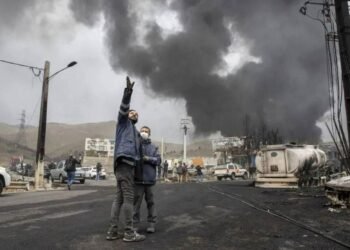
In explaining the engineering of narratives, he noted: In the engineering of witness narratives, we were looking for an organic adaptation between the identity of the narrator and the geography of the event. In the sense that each character is present in that location not as a stranger but as a “landlord” or “technical expert”. For example, Dr. Swabi’s presence in the ruins of a pharmaceutical factory is not just a simple visit, but with a scientific perspective, he analyzes the environmental consequences and secondary pollution caused by the bombing in order to clarify the hidden and scientific dimensions of the disaster for the audience. Or in another case, Homay’s flight reinterprets the role of art in the text of the disaster and becomes the narrator of the bands of musicians who voluntarily resounded the songs of hope among the ruins of war.
In response to a question about the subjects’ encounters, Mohammad Hosni added: In many cases, there was a gap between some subjects’ mental image of Iran and what they saw in the field encounter. Before returning, many did not imagine the country’s progress – especially in science and technology – to be so concrete, but being in the locations and seeing the achievements up close made them curious and sometimes really surprised; A “seeing with your own eyes” kind of surprise. Besides that, the unity and empathy of the people in public squares and streets was the most striking observation for them; A phenomenon that, according to them, was either dimmed or reflected in the narratives outside of Iran. This close encounter corrected their view and showed that the Iranian society has a high capacity for sharing viewpoints and social overlap. For us, these moments of confrontation were not marginal, but the narrative pillar was documented, and in the editing, the turning points of the subject’s crossing of preconceptions and reaching a new understanding of Iran were highlighted. I think the war had a clear message with all the bitterness: in historical moments, unity and empathy are formed, and sometimes we ourselves are surprised by its depth and breadth.
Honesty and professional courtesy
In explaining the challenges of building trust and the role of direct dialogue, this TV producer mentioned: I think the most important challenge in building trust is that the subject does not feel that he is going to enter a pre-drawn field; A land whose conclusions are ready and only asks him to “confirm”. My experience in media work has been that if we talk to people honestly, without preconceptions and without trying to put them in predetermined formats, a significant part of the subjects – as long as they don’t have stubbornness or a definite position – slowly become convinced and feel safe. This security is precisely what allows the camera to approach the deeper layers of the narrative. In Shahid Bash, we stood on several principles from the beginning: being transparent about the intention and direction of the narrative, respecting the subject’s personal boundaries and avoiding reducing the words to controversial headlines. For example, in the second season, we collaborated with Ms. Faride Sepah Mansour, who had not appeared in many programs before. Interestingly, at the beginning, we only had a phone conversation, and for the first time, just by listening to our explanations and measuring the tone and intentions of the team, they came to the conclusion that they can get the job done. Finally, I believe that honesty and professional courtesy itself creates a clear demarcation; Border between real conversation and drama conversation.
In explaining the final output and goals of the program, he added: The philosophy of Witness from the beginning was to avoid imposing defaults and leave the right of judgment to the audience by presenting the raw materials of reality. Concrete representation of Iran in the form of a narrative and not a slogan. The choice of guests outside the common categories, but patriotic, made their words realistic and believable. Wide acceptance of the program in dozens of countries – even in the era of internet restrictions – proved that the naked, direct and unexaggerated narrative always attracts its audience. Our goal is not to inject advertising hope but to create realistic hope based on possibilities and objective realities.