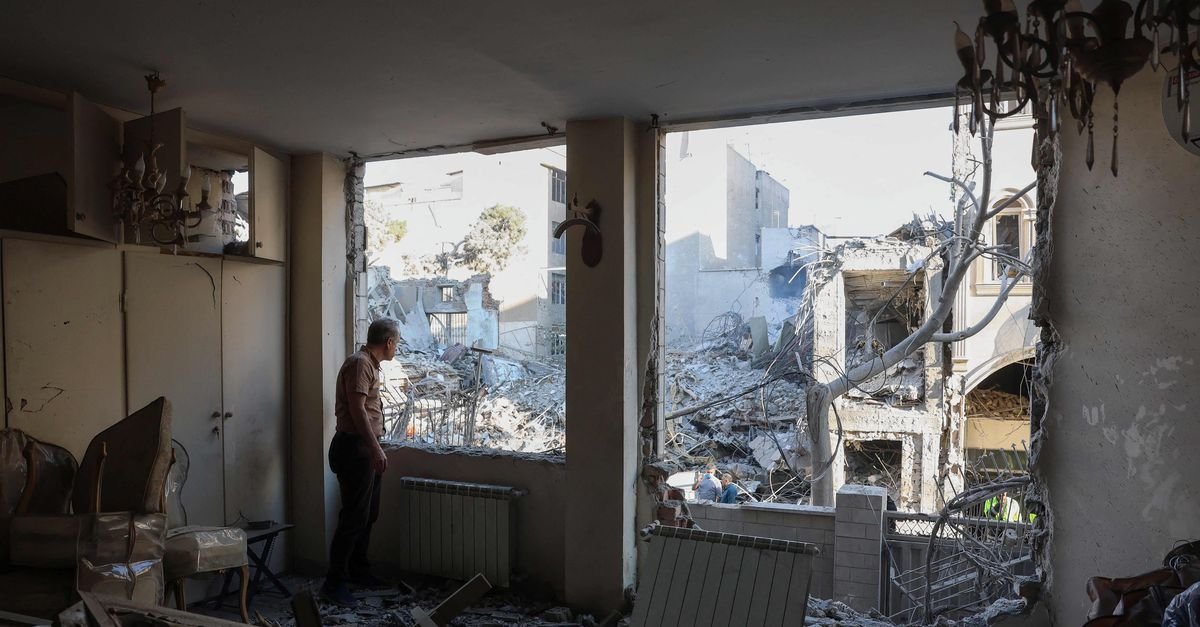
A year marked by “predatory attacks on multilateralism, international law and civil society.” And for what purpose? “A racist, patriarchal, unequal and anti-human rights order.” It was, according to Amnesty International Tuesday, not a good year for human rights.
The human rights organization’s warning comes at a time when firing in two linked wars in the Middle East – in Iran and Lebanon – has temporarily ceased. On Tuesday evening, President Donald Trump announced that the truce will be extended until negotiations with Iran are completed. That offers some hope, although the positions of both countries are still far apart.
Traditionally, war situations are referred to as ‘fog of war’ (fog of war): uncertainty about your position on the battlefield in relation to the enemy. Columnist Gideon Rachman of the Financial Times spoke on Monday of the fog of peace: there is a truce, but it is not really observed nor does it lead to lasting peace. Since the Israeli destruction of Gaza, this ‘temporary ceasefire’ has been a well-known phenomenon.
Traditionally in war situations people speak of ‘fog of war’, now of ‘fog of peace’
If Rachman has to bet his money on something, it is on escalation: according to him, both the US and Iran seem to think they can make the other side succumb first. “In the coming weeks, and perhaps months, periods of escalation will likely alternate with periods of consultation – with the two processes sometimes running in parallel.”
Also read
‘It is not international law that is defective, but states and politicians’
:format(webp)/s3/static.nrc.nl/wp-content/uploads/2026/03/11122253/110326BUI_2032145944_1-1.jpg)
Voracious predators
Trump is one of the “voracious predators” who have taken “unlawful prey” in the past year, according to Amnesty Secretary General Agnès Callamard. Like Russian President Vladimir Putin and Israeli Prime Minister Benjamin Netanyahu, the American president carried out his conquests for the sake of economic and political dominance “through destruction, oppression and violence on a massive scale,” says Callamard.
:format(webp)/s3/static.nrc.nl/wp-content/uploads/2026/04/21163558/210426BUI_2033174884_2.jpg)
President Donald Trump on April 1 during a televised address on the war in the Middle East from the White House in Washington.
Photo Alex Brandon / AFP
Trump’s attack partner Israel is not spared by Amnesty either. In a less than honorable paragraph, it is noted that Israel has committed genocide, as well as multiple war crimes and crimes against humanity, against Palestinians in Gaza. The “apartheid system against all Palestinians” also took a heavy toll, through intensive military operations and a sharp increase in state-sponsored settler violence.
Despite massive protests, Amnesty notes, “the world’s most powerful governments have generally failed to take meaningful action to stop the genocide or end Israel’s unlawful occupation and apartheid.” The report pays special attention to countries that, despite all the war crimes they commit, still export weapons to Israel.
Also read
Red Cross Chairman: ‘What we have seen in Gaza exceeds all legal, ethical, moral and humane standards’
:format(webp)/s3/static.nrc.nl/wp-content/uploads/2026/02/05120102/060226BUI_2030801291_1.jpg)
The enemies of the US and Israel also come off badly in the report. For example, Iran is being punished for killing thousands of demonstrators – “the largest mass murder in the country’s recent history” – and increasing the number of executions. Hamas tortured protesters and executed dozens of alleged collaborators with Israel.
Fuel on dry kindling
Amnesty director Callamard notes that “a global environment in which primitive cruelty can flourish” has been in the making for a long time. But in 2025, she writes, fuel was recklessly poured onto dry kindling. Sharp U-turns were taken away from the international order “that was designed from the ashes of the Holocaust and the utter devastation of world wars.”
Callamard argues that the international, rules-based world order no longer serves the interests of the politically and economically powerful and their accomplices. “They now want us to believe that it was just a chimera, a pleasant fiction that has outlived its purpose.”
But, says the French human rights expert: it is not up to the person who breaks the promise to label that promise as a fantasy. After all, their alternatives are “selfish.” She quotes US Secretary of State Marco Rubio, who presented a vision of a Western alliance of Christian peoples, led by the US, unapologetically and proudly rooted in a common heritage.
That legacy, says Callamard, also includes “domination, colonialism, slavery and genocide.” The new, predatory system is all too familiar: equality and reconciliation are mocked, war reigns, crimes go unpunished, and residents of the Middle East are once again plunged into chaos. Rubio’s vision is a vision of “unbridled hegemony, of a world without a moral compass,” said the Amnesty boss.
Also read
Is international law still relevant after ‘Gaza’? ‘We are heading into a dark decade’
:format(webp)/s3/static.nrc.nl/images/gn4/stripped/data138466769-0aedbd.jpg)
Europe can do more
While negotiations between the US and Iran yield little and the Strait of Hormuz remains blocked, the world is watching. Pakistan is making valiant attempts at mediation, but the rest of the world seems powerless to prevent a resumption of the war.
According to Amnesty International, a turnaround will require more resistance from other countries against the predatory order. Last year, the report said, few states found the courage to speak out. Rather than confront the predators about their behavior, most governments opted for appeasement, or even tried to emulate the predators.
In early 2026, some European states appeared to better understand the risks, the human rights group said, by refusing to join unlawful US and Israeli attacks on Iran. Yet Europe can do more: it can speak out more in favor of international law and human rights. It can take an example from Spain, which, according to Amnesty, consistently condemned the breakdown of standards.
:format(webp)/s3/static.nrc.nl/wp-content/uploads/2026/04/21163627/210426BUI_2033174884_3.jpg)
Smoke rises after a US-Israeli attack on the Iranian capital Tehran, April 7.
Photo Atta Kenare / AFP