WASHINGTON.– In the midst of the doubts that still surround the agreement between the United States and Iran to end the war, and the growing questions from Israel, donald trump moved forward this Monday with the understanding with the regime of the ayatollahs in view of the final signing scheduled for Friday in Geneva. At the same time, he stated that the Ships began to leave the strategic Strait of Hormuzwhose reopening is one of the central axes of the pact and could relieve pressure on the global economy.
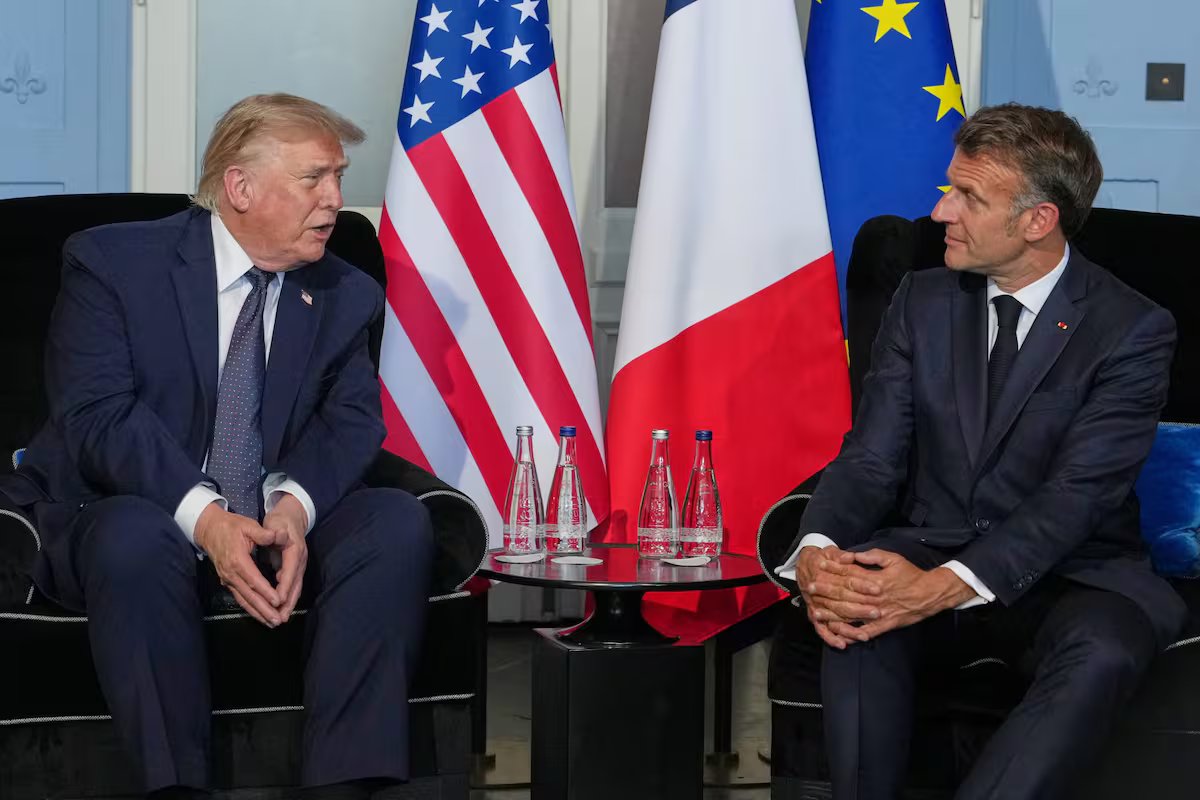
“The agreement is already signed. And the strait is already partially open”said the president, sitting next to the French president, Emmanuel Macronin Evian, where he traveled to participate in the G7 summit. It was not clear whether Trump was referring to a framework agreement or commitment ahead of the signing that will take place next Friday.
Shortly before, a senior Republican government official cited by Reuters had reported that the memorandum of understanding had already been signed by Trump and the vice president J.D. Vancerepresenting the United States, and by the president of the Iranian Parliament, former general Mohammad Bagher GhalibafTehran’s chief negotiator.
Trump repeated that Iran will not have nuclear weapons and stressed the importance of “oil prices are falling and stock markets are rising”.
The agreement anticipates new negotiations to resolve the main points of friction between the White House and the regime, such as the Iranian nuclear program and international sanctions against the Persian country.
As Trump himself told The New York Timesno consensus had been reached on that aspect, and that both parties will negotiate the period during which Iran would commit to suspending its uranium enrichment that would bring it closer to the production of nuclear weapons. That is, at the same time, one of the axes that most worries Israel.
The American president, on the other hand, left the door open to participate in the official signing ceremony on Friday, in Genevanoting that the full text of the Iran deal will be released sometime later the same day.
“I want it to be published because it is a very powerful document. It’s not like (former President Barack) Obama’s document, which was just a terrible document… So probably pretty soon (it will be released). “I would say sometime after Friday,” he said.
Hormuz
Trump stressed that “There will be no relief from sanctions until Iran does its part” and that the Strait of Hormuz will be “fully open” by Friday.
“We are ready to shoulder our fair share of the burden and be part of the commitment of the international community. It is a very important step towards peace, but also for the global economy,” Trump added.
The official quoted by Reuters said that New details of the agreement would be announced in a within 24 to 48 hourswhile technical talks would begin later in the week, before the signing scheduled for next Friday.
“Ships are beginning to move, many loaded with oil, out of the Strait of Hormuz. They go on the southern ‘highway’, which is totally safe, secure and spotless. “There are also other transit areas!” Trump had written earlier on his Truth Social network, while he was still traveling to the French town of Evian to participate in the G7 summit.
“We have an agreement according to which (the Strait of Hormuz) will be open and free of tolls”Trump later insisted, already on French soil after the trip from Washington.
With his message, Trump sought to convey confidence that maritime traffic on that strategic route – blocked by Iran after the start of the war – would soon be restored, through which, before the outbreak of the war, on February 28, it circulated near one-fifth of the world’s supply of oil and liquefied natural gas (LNG).
“They will see a significant increase in traffic in the Strait of Hormuzwhich in fact is already starting. It will gradually increase over time,” said the senior official quoted by Reuterson condition of anonymity. “We probably won’t be back to normal for two weeks, but we will see a considerable increase in traffic,” he added.
Beyond the signs of optimism from the White House, which seeks to end an unpopular conflict in the United States, shipping companies and energy operators They maintained a much more cautious attitude regarding the situation in the Strait of Hormuz. They warned it could take weeks to regain trust and that traffic will only resume on a sustained basis when there are concrete security guarantees.
“The accumulation of blocked ships and the need to carry out crew relief and rest periods means that A realistic return to normal browsing patterns will take weeks, if not months, to occur.“said Stephen Cotton, general secretary of the International Transport Workers’ Federation (ITF), which represents maritime sectors. At best, this is the beginning,” he added.
In dialogue with the chain CNBC, Vance He said Washington hopes the sea lane remains open to traffic no tolls in the long termin line with what Trump had stated on Sunday when announcing the agreement. The vice president’s statement pointed to one of the most sensitive points of the negotiation: the eventual Iranian charge for ships crossing Hormuz.
In that sense, this Monday the Iranian Foreign Ministry stated that the regime will charge fees for “maritime services”, instead of imposing tolls, to vessels transiting through the strait, within the framework of the agreement with the United States.
“We have always stated that We are not seeking to collect tolls. of transit, but fees will be charged for navigation servicesenvironmental protection, maritime insurance and other necessary services,” said Foreign Ministry spokesperson Esmail Baqai.
The spokesperson added that the memorandum attributes to Iran, in cooperation with Oman and in consultation with other interested parties, the responsibility of “ensure safe navigation in the strait”in which maintenance work will have to be carried out demining.
He Sultan of Oman, Haitham bin Tariqcommitted this Monday to security and “freedom of transit in its territorial waters in the Strait of Hormuz”.
According to specialists, the “semantic difference” marked by Tehran seeks to avoid an open violation of international law in this matter, although it leaves open doubt about what the navigation conditions will be in the area and who will maintain effective control.
Trump announced that Washington and Tehran They will sign the agreement on Friday to end the conflict and formally reopen the Strait of Hormuz, an announcement that immediately impacted the markets. International oil prices fell by nearly 5%given the expectation that the flow of crude oil and LNG may begin to recover in a sustained manner.
According to Kpler tracking data, As of June 15, there were about 155 tankers carrying oil and chemicals in the Persian Gulf area.compared to the 201 registered at the end of May. Oil Brokerage raised that estimate to 215 tankers.
Israel Concern
The agreement announced by Trump generated concern in the government of Benjamin Netanyahuan ally of the White House that maintains an open front with the terrorist group Hezbollah in southern Lebanon.
The Israeli military forces have warned that they will not withdraw from the vast expanse of territory they took in that area of the neighboring country, warned the Defense Minister Israel Katz.
While the details of the peace agreement remain unofficially released, they would explicitly include a ceasefire in Lebanon, where Israel launched a broad offensive following the recurring attacks by Hezbollah – an ally of Iran – against northern Israel since the beginning of the conflict.