Adolfo He entered a free zone every day at six in the morning. For the last seven years he worked assembling t-shirts in a huge warehouse where the noise of the machines never stopped. He knew the routine by heart: marking a card, putting on his blue bib, checking the production line and waiting for the sound that announced the start of the shift. “It was my routine, but it was also part of my life,” he says.
He always complained that the work wasn’t easy, but it gave him stability. With that salary he paid the rent for a small house, food for his family, school for his two children, and the monthly payment for a motorcycle that he used to get to work every day.
Everything changed on a Monday in January 2026. The supervisors gathered dozens of employees and the manager spoke for a few minutes: the company would reduce operations and many of the workers would be laid off. “It was hard to be unemployed from one moment to the next,” he says.
Adolfo remember that the silence was immediate. “I felt like the floor was moving,” he says, and he was unable to hear the full justification for his dismissal. That day he returned home earlier than normal. His wife thought he was sick and it took him several minutes to tell her he had lost his job.
The first days without a job were very uncertain. “I got up early out of habit, but I had nowhere to go,” he remembers. Although he was looking for work, he had a hard time finding it.
“One, not only do you lose your salary,” he points out. Adolfo. “You also lose the routine, the security and even the peace of mind of sleeping.”
As the days passed, financial worries began. The settlement was barely enough to cover household expenses.
Still, he insists that he doesn’t want to give up. Now, he does odd jobs in a small tailor shop and selling clothes, with his wife. He earns less, but assures that he is still looking for a stable opportunity.
“The hardest thing is to feel that after so many years, one can be replaced from one day to the next,” he laments. Adolfo.
This 44-year-old man hopes that they will call him again. “In the free zones there are times when production drops and they need less staff, perhaps things will improve later,” he insists.
“The promise of returning”
Maria Elena He had been working for almost 12 years in a manufacturing company, located in a free zone in Managua. Every morning, she got up before the sun rose to prepare food, get her son ready, and take the bus to the industrial park.
He details that where he worked there have been cuts for more than a year. “But they were small, only about twelve people,” he explains. However, he noticed how orders were getting smaller every day.
“They began to send people on vacation and it was already rumored that a strong shake-up of personnel would come,” he mentions. She tried to focus on work, convinced that her experience and dedication would be enough to keep her job. He was wrong. In September 2025 she became unemployed.
The argument they gave was that the company would move part of its production to another country and that is why dozens of positions would be eliminated. Maria Elena She was distressed, but tried to be positive. She had previously been in two other free zone companies. One of them closed several years ago and the other also had a cut.
“Free zones are often unstable, so I’m a little used to it. However, this time things seem more difficult,” she confesses.
“There is a lot of fear due to constant layoffs in the free zones, the environment is uncertain, you never know when they are going to run or close,” he adds.
Today, this woman works selling food and comments that she is doing “very well.” The company that fired her promised the workers to hire them again immediately “if orders increase again.” “There is a promise to return, but we don’t know when,” he says. Maria Elena who for now prefers to focus on his own business.
They don’t stop: almost 27,000 layoffs between 2025 and 2026
In Nicaragua, since 2023 the number of employees in the free zones has decreased considerably and there are currently less than 100,000 employees, placing the sector in job creation practically at 2011 levels.
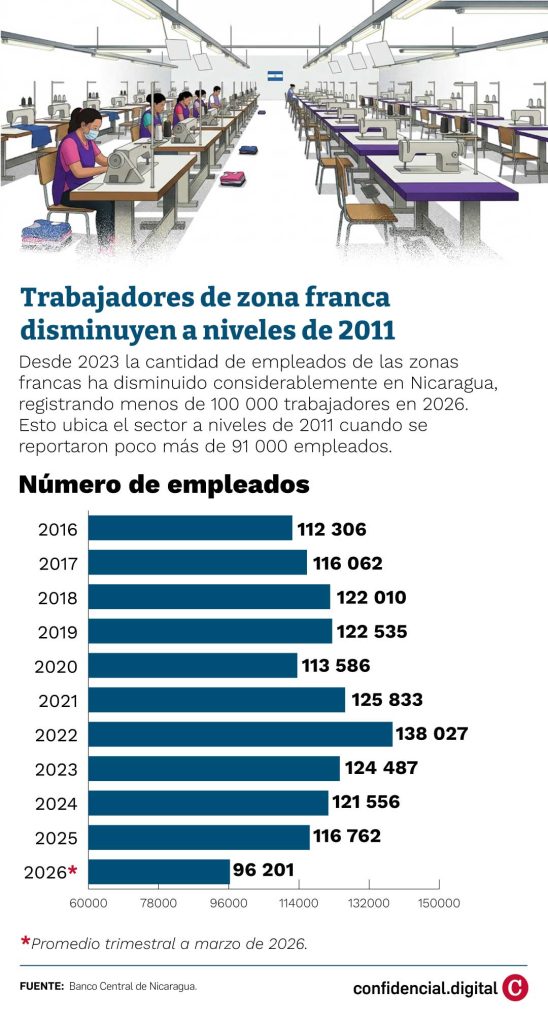
The annual average number of free zone workers in 2025 was 116,762 employees and in the first quarter of 2026 the average dropped to 96,201 workers. That is, on average, more than 20,000 jobs have been lost.
However, when analyzing the figures from Banco Central of Nicaragua (BCN) In detail, the actual layoffs are greater. Until December 2024, there were 121,858 workers and until March 2026 the reported employees are 94,861. That is, between 2025 and 2026 the layoffs have been almost 27,000 people.
In the quarter of 2026 alone, 10,954 jobs have been lost in the 168 free zone companies registered in the country.
The increase in layoffs so far in 2026 is on track to approach the 16,043 layoffs recorded in all of 2025.
The drop in jobs in free zones occurs in a context in which more than 43,000 positions have been lost since 2023, according to official data.
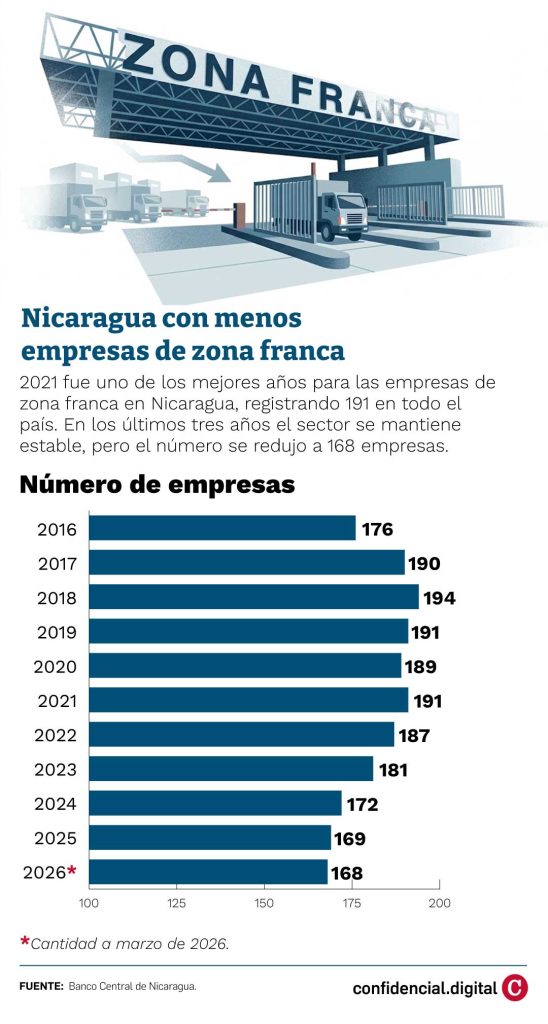
Regarding the number of active free zone companies, in the last three years the number has remained stable. Until March 2026 there were 168, one less compared to the end of 2025. However, the number is far from the 191 that operated in 2021.
Regime preaches with “optimism”
He executive director of the Free Zone Corporation (CZF), Fernando Sánchez, recognized in April 2026, the crisis in the sector, explaining that the “reciprocal” tariffs imposed by the United States in 2025, the decrease in work orders and the dependence on single clients caused the loss of those jobs.
“At the end of 2025, in the last quarter, as a result of the reciprocal tariffs that the United States government had imposed, many companies suffered from a lack of job orders (…) there were about 20 companies that were left without work, which resulted in a reduction in jobs of approximately 15%,” the official indicated.
Sánchez mentioned that the maquila sector, which constitutes approximately 50% or 60% of the total free zone sector, “was affected by a drop in work orders,” in addition to that many of the companies “moved some operations to El Salvador, Guatemala and Honduras.”
The official insisted that the “goal” at the end of 2026 is to have 120,000 jobs, but unemployment has continued to increase in the first half of the year.
“The brands that had stopped placing orders are now slowly placing them again. There were many companies that at the beginning of the year were reducing spaces in industrial parks,” said Sánchez.
Not paying taxes without impact?
On March 7, 2026, the regime of Daniel Ortega and Rosario Murillo, reformed the Law of Export Free Zones (Law 917), in force since 2015, so that companies that already operate in that tax regime obtain similar benefits – or better – to those that companies that operate based on Law 1264 will receive. Special Economic Zones Law of the Belt and Road, effective December 19, 2025.
The Special Economic Zones (EEZ), They offer ten extendable years of tax exemptionwhile the Free Export Zones (ZFE) offer 15 years of exemption, but only once. The changes ordered make that 15-year period extendable indefinitely.
The reform already in force, according to the executive director of the CZF, “will expand the benefits” and “motivate investors, existing companies and new ones, to work in Nicaragua.”
For Ameliawhen he heard that news he thought that perhaps the situation would improve for those who work in the free zones. “They said that investors would have it easier by not paying taxes and with those incentives being able to stay in Nicaragua, they talked about job growth, but none of that has turned out to be true for now,” he says.
This woman who works as a supervisor in a free trade zone in the south of the country, points out that “production continues to decline” and the company where she works “continues laying off staff.”
“Many colleagues who had been working for years were called to human resources and came out with a dismissal letter. Some were single mothers, others supported entire families and no one is doing anything for all those people,” he laments.
A “general fear” is the atmosphere that exists every day in the free zones in recent months, describes Douglaswho has been working in various manufacturing companies for more than ten years.
“People who had little time to work have been fired, but also people who had been in the free zones for years and it is painful. We all know that we could be the next ones to run, there is no guarantee of job stability,” he mentions.
“Companies can continue to enjoy tax breaks for years, while workers continue to face temporary contracts, uncertainty and the permanent risk of being made redundant,” he insists. Douglas.
One of the main changes for workers who were not fired is that, in some free zone companies, they included a new night shift.
“They were left with fewer workers, but those of us who remain have to produce more, even if that means more tiring and poorly paid days,” he says. Joshuaan operator in a free zone in Masatepe.