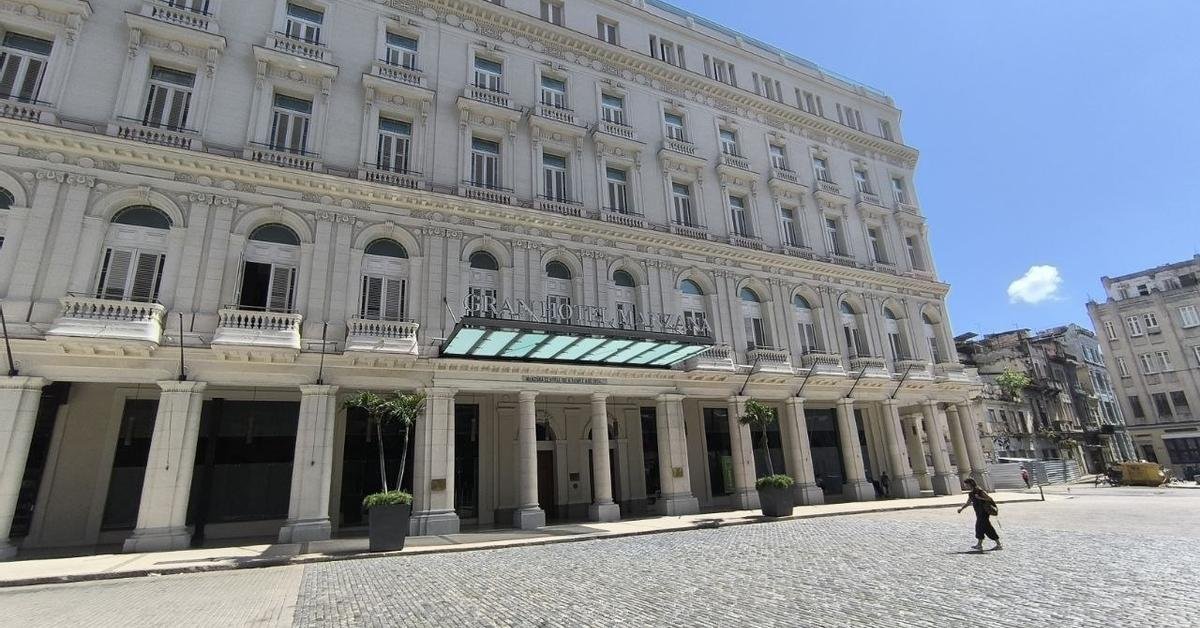
Madrid/Kempinski, the German-Swiss luxury hotel chain, maintains total silence but its charismatic Manzana hotel remains firmly closed at this time, as confirmed 14ymedio. Opened in 2017 as the first “high standard” Cuban hotel, the establishment, located in the Central Park, in front of the Capitol and in one of the most important tourist areas of Havana, does not allow reservations until at least August 1, as can be seen on its website when trying to do so.
The Gran Hotel Manzana Kempinski belongs to Gaviota, the tourism company of the Gaesa military conglomerate, like the other two that the European company once managed on the Island. The Cayo Guillermo Resort Kempinski, in the northern keys, was returned to Gaviota and is now called Hotel Playa Luxury Cayo Guillermo. The other establishment managed by the firm was the Bristol, that in August 2025 It passed into the hands of Meliá. On June 3, when the Spanish hotel company announced its separation from 15 establishments it managed, it included Bristol on the list.
The silence and the message that it is not possible to reserve the Gran Hotel Manzana until August leaves several unknowns about the future of the emblematic venue, but that the sector is mortally wounded – for the moment – is a fact. Tourism data for May They have just been published and they reveal the catastrophe. In the fifth month of the year, only 30,883 visitors came to the Island, although paradoxically, there were 332 more than in April. So far this year, Cuba has received 359,491 international travelers, 58.4% less than in 2025 for the same dates.

/ 14ymedio
Furthermore, of this very poor total, the vast majority arrived in January, 184,833, which, being a fateful amount for a date in which up to half a million tourists traditionally arrived, could still be considered decent. With the announcement of the end of refueling for international flights, most airlines evacuated their nationals and ended up canceling unsustainable journeys. For this reason, February still held up, with very bad figures (77,663 travelers), but not yet ruinous. March is the turning point.
The National Office of Statistics and Information (Onei) also publishes this Monday the balance of the corresponding sector to the first quarter of the yearwhere you can see in more detail other numbers that reveal the debacle caused by the latest measures of the US Government. Tourism in Cuba had not raised its head since the pandemic and its data, after a noticeable improvement in 2022 and 2023, announced an unmitigated crisis. But the energy blockade, which has caused the paralysis of most flights, and the sanctions on Gaesa, have ended one of the few sources of foreign currency not only for the State, but for hundreds of thousands of people who live in the sector in private businesses, from restaurants to craft and commerce stores or simple street sales.
The first quarter report is devastating. This beginning of the year, only 1.3 of every 10 rooms were filled in Cuba, visitors fell by 48% – 298,057 compared to 573,363 last year –, overnight stays also sank by half – 1.8 million compared to 3.6 million – and gross income fell from nearly 35,000 million (52 million dollars, according to the informal exchange rate of 670 per 1) about 20,000 million. And all this taking into account that January was still considered a “normal” month.
The losses are not just for hotels. The Onei report, which adds income in other sectors quarterly, leaves enormous falls in all of them. The variation has been from 48.4 billion to 27.9 billion pesos, but broken down the biggest loser is gastronomy, which loses almost half – from 19 to only 10. They are followed by accommodation, which goes from 14,000 to 8,000 million, transportation – from 5.7 to 3.9 – and retail trade – from 2.1 to 1.5.
In addition, this report contains data on tourists by nationality who arrived only in the month of March, where the catastrophe that can only be sensed when looking at what has accumulated is seen with greater perspective. For example, in March 2025, 98,714 Canadians arrived in Cuba, while a year later only 512 did so: the drop is 95.5%, the largest collapse of all. It is worth remembering that no Canadian company – the largest source of tourists to the Island for decades – currently maintains flights with Cuba.
/ 14ymedio
They also categorically suspended routes from Russia that same February, leaving that market dry, which was destined to be the miracle that reactivated Cuban tourism, especially after the invasion of Ukraine in 2022 and the sanctions that banned its planes from European airspace. In March 2025, although the strategy was already trading downward, 11,135 Russians arrived on the Island, compared to 250 the same month this year: a loss of more than 97%.
They are the most significant falls, although there is no country that escapes collapses that are mostly around 60% or 70%. There are only two origins that resist and they are almost one: the United States. The Cuban community abroad contributed 11,256 travelers that month, half as many as a year ago, while the Americans reached 5,243, almost a third compared to 2025 but not so bad if you look at the comparison with the rest of the travelers.
In the midst of this shipwreck, the Cubanacán Group held a summer tourist fair this weekend on the boulevard of the Comodoro hotel that has generated much criticism among the population. State agencies have tried to promote offers in destinations such as Varadero, Viñales and the Ciénaga de Zapata, with total free for children. But the national tourist is not ready to travel and the international tourist, whose possibilities have been limited to a minimum, needs to have almost a personal incentive to now choose Cuba as a destination, when most of the foreign services in the world advise against it.
Last Friday, when Miguel Díaz-Canel convinced the international press of some reforms that were neither so big nor so newmentioned that “new actors in tourism” will be included. It was, in fact, the only real novelty, but as soon as it was stated no one knows what it could mean, because trying to get emigrants to invest in the sector has already been going on for a long time and has fallen on deaf ears. That the United States manages to get hold of the long-awaited control of hotels It continues to be the bet of many experts, but we will have to wait to know if the regime gives up the key piece.