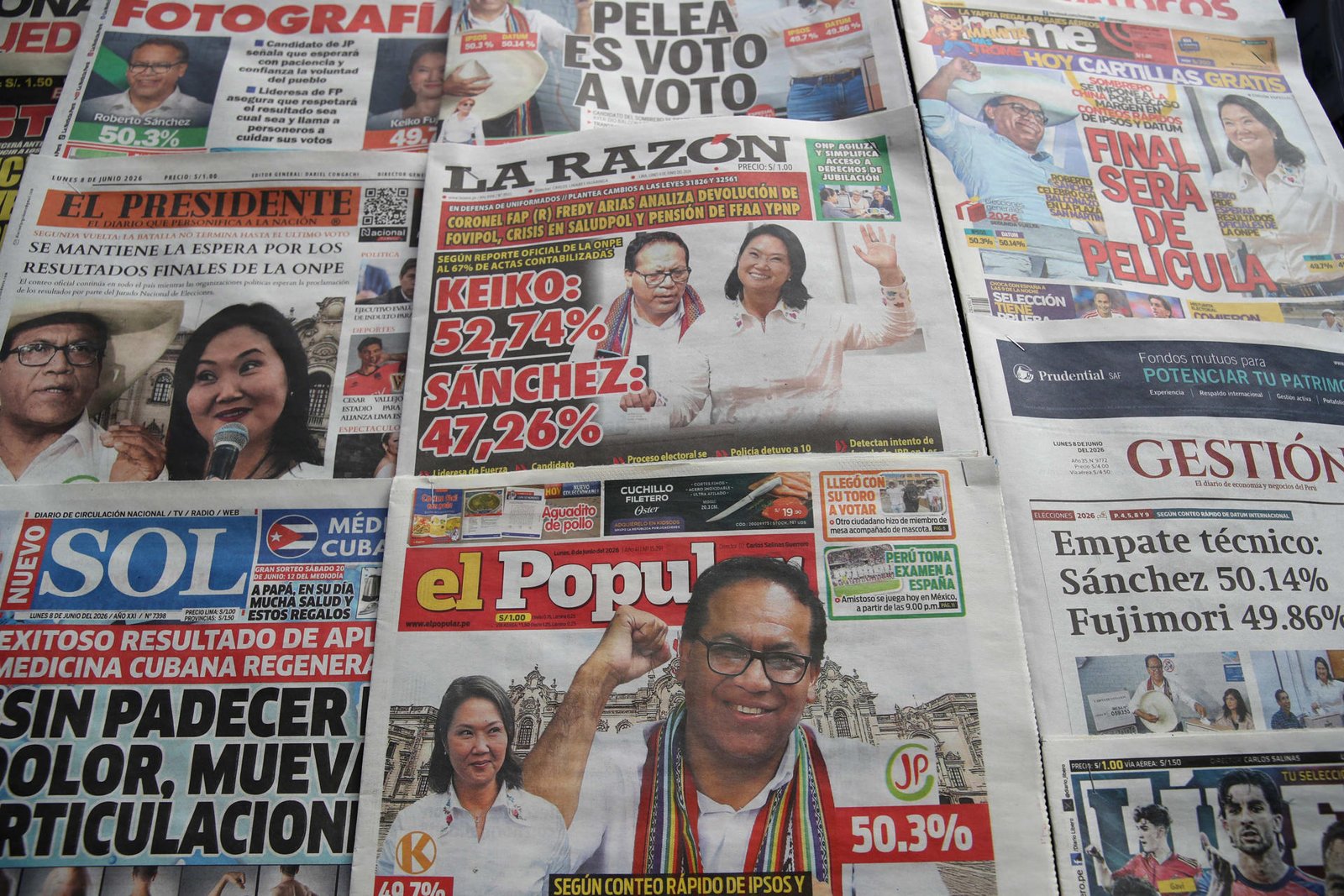
Elections usually fulfill an essential function in democracy: to peacefully resolve political conflicts through voting. However, there are times when elections do not close disputes but rather deepen them. Peru seems to be heading precisely towards one of those moments.
At 9:00 pm on June 9, with 96.43% of the votes counted, Roberto Sánchez, candidate of the leftist party Together for Peru, maintains an advantage of around 41,000 votes over the candidate of the right-wing political force Keiko Fujimori.
The result remains open and could vary again as the pending minutes are received, especially those from abroad, and the 1,544 observed minutes that have been referred to the Special Electoral Juries are reviewed.
Under normal circumstances, an advantage of this magnitude would allow us to begin to glimpse an outcome. But Peru is not going through normal times.
The electoral justice itself has warned that the process could last up to a month before the new president can be officially proclaimed.
The narrowness of the result, the review of the minutes observed and the possibility of challenges and appeals by the campaigns anticipate a long, complex and highly judicialized scrutiny.
And that is precisely where the risks begin.
In recent hours, disturbing signs have appeared that the electoral dispute is beginning to move from the polls to the streets. Leaders of Together for Peru have called for mobilizations to defend what they consider the popular will expressed at the polls and have denounced alleged attempts to ignore the results. On the other hand, sectors linked to Fuerza Popular insist that the pending minutes and the external vote could reverse Sánchez’s advantage.
The combination of an extremely close result, prolonged institutional uncertainty, a deeply polarized and distrustful society, and electoral authorities with a low level of credibility constitute fertile ground for political confrontation.
Indeed, Peru reaches this juncture with a particularly weakened political system. In the last decade the country has had a succession of 8 presidents, institutional crises, impeachment processes, massive protests, confrontations between powers of the State and a growing erosion of citizen trust in institutions. The presidential election does not occur on stable ground; It develops on an accumulation of still open fractures.
Therefore, the challenge facing Peru is much deeper than determining who got the most votes.
The real test will be to verify whether electoral institutions manage to administer an extraordinarily sensitive process with independence, transparency and strict adherence to the law; if political actors accept the rules of the democratic game; and if the leaders of both camps are capable of preventing the dispute over the result from leading to a governance crisis.
Because a victory by a minimal margin can grant legality, but not necessarily sufficient political legitimacy to govern such a fragmented country.
For years, Peru has demonstrated remarkable economic resilience in the face of political instability: the theory of parallel strings. However, this capacity for resistance is not infinite. Each new institutional crisis erodes public trust a little more and reduces the margins for building basic agreements.
That is why I am less concerned about who ends up occupying the Government Palace and more about what may happen after the proclamation.
If the logic of permanent confrontation, cross-complaints, extreme judicialization and street mobilization as a mechanism of political pressure prevails, Peru runs the risk of entering a new stage of prolonged conflict. A stage in which no actor considers himself completely defeated, but in which there is no winner with sufficient authority to stabilize the system.
I hope I’m wrong.
But the signs we are observing—a heart-stopping runoff, a scrutiny that could last a month, calls for mobilization—suggest that the real challenge for Peru does not begin when the counting ends.
It begins precisely when the final result is known.
And I fear that that day could mark the beginning of some particularly tough times for Peruvian democracy.
*This article was originally published in the Author substack.