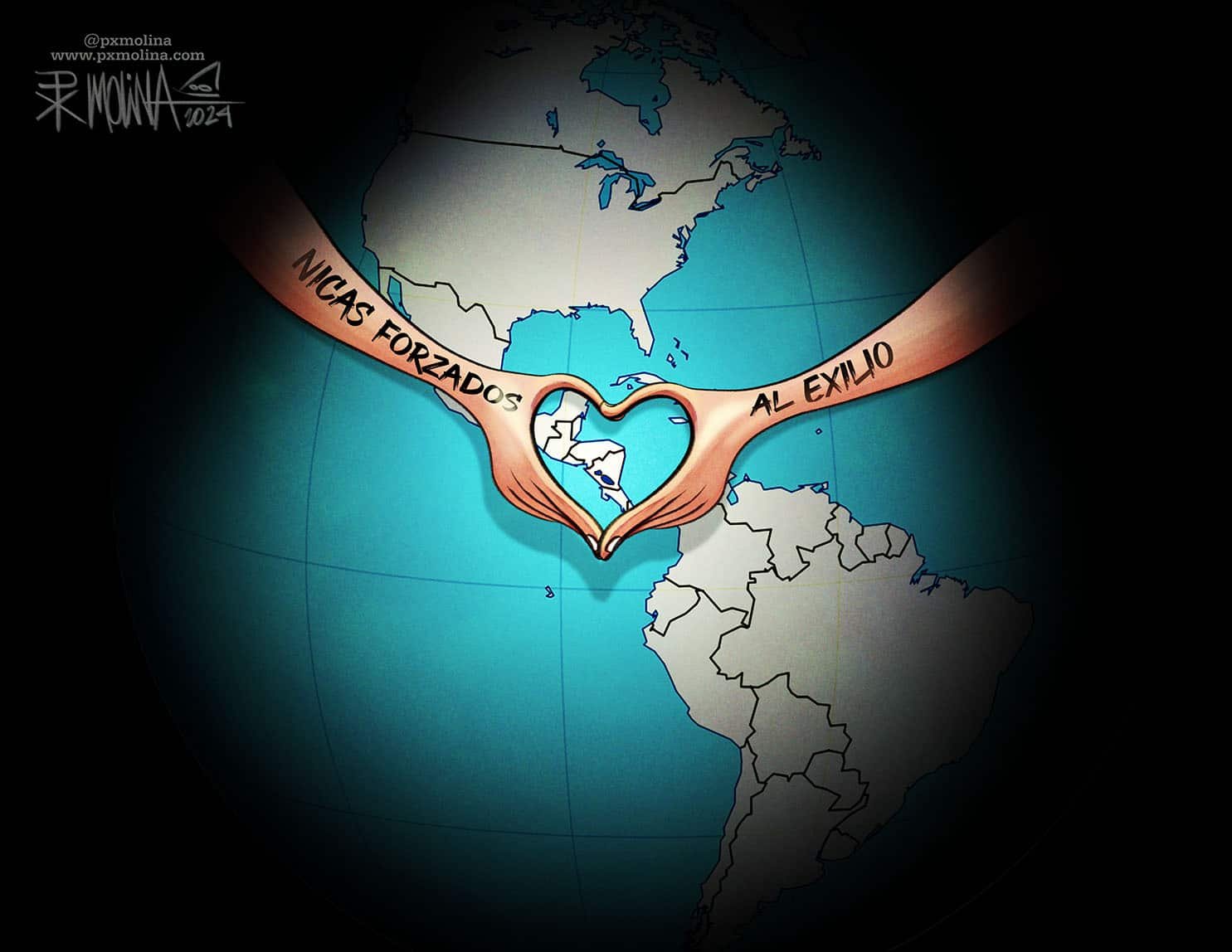
“Sadness is not the end, happiness is the same“, these verses taken from “A felicite”, the sweet and melancholic song by Vinicius de Moraes and Antonio Carlos Jobim serve to describe in a clear and unequivocal way the question posed above: is exile infinite, it never ends, as Clara Obligado stated, or is it finite and ends at some precise moment, as I believe?
Clara’s question, asked in Clarín (5/5/26) occurred in the context of the last International Book Fair (FIL), in Buenos Aires, where she traveled to present her latest and accomplished work, “Exilio” (Páginas de Espuma), magnificently illustrated by Agustín Comoto.
Coincidences of life, or not so much, at that same moment I was also in Buenos Aires to present my most recent book “Military coup and dictatorship in Argentina (1976 – 1983). South, wall and after…” (Books of the Waterfall).
And I say that perhaps there was not such a coincidence in that geographical and chronological coincidence because this entire story surrounding exile and the repercussions of the 1976 military coup is a direct consequence of the commemoration of the 50th anniversary of its outbreak. Do not forget that that barracks of unfortunate memory was at the origin of the bloodiest dictatorship that Argentina has known in all its national development.
It was then, in 1976, due to the evolution of repression, when both Clara and I (who belong to the same generation), and like thousands of other compatriots, had to undertake the difficult path of exile. An exile that while it lasted would mean pain and suffering, in short, a lot of uprooting. And it was now, in 2026, when both Clara and I, forced by different motivations, were led to write about various issues related to those events and their subsequent development.
Now, my main starting point is that there is no exile, in the abstract and with a capital letter, but that there are as many exiles as there are exiles.
Each exile is unique, it is an individual and non-transferable experience whose result depends on multiple factors, starting with one’s own personal history, the moment and the circumstances that forced the departure (which despite being set in the same situation may not respond to the same motivations) and also the conditions of installation in the destination place (how easy or how complex and traumatic the landing was).
From that perspective, my situation was quite fortunate, having family help that allowed me to finish my history studies in Madrid and dedicate myself to an academic career without great hardships. My early connection with the Complutense University of Madrid (UCM) provided me with contacts and friendships and also served to open numerous doors for me that otherwise would have taken much longer to do so.
At first nothing was like at home, since many of the codes and passwords, and even some manifestations of the language, were different. One of the problems of exile is that when you leave your country of origin you leave your personal history there, a whole world of relationships and connections, family, personal and work, to arrive naked in the new host country.
Unlike Clara, I believe that exile is not infinite, and that it has at least both a beginning (always) and an end. This means the existence of a time in which exile ends, even if it is in different ways and with different rhythms and cadences.
The beginning is always clear and coincides with the moment in which the exile, forced to leave his country, begins to go through a journey of uprooting, more or less prolonged depending on the circumstances. But there is also an end, marked by the precise moment, assuming it can be fixed, in which the causes that caused the departure begin to be left behind.
This occurs when the person who left can return to their country of origin or can make the determination to remain where they are, which means stopping being an exile and becoming an immigrant. In any case, it is an individual decision and, above all, much freer than that of the game, where on numerous occasions one’s own existence or that of the family is usually at stake.
That said, what is indisputable is that once exile is overcome, what does not end, what remains, is the pain or its memory, the uprooting and its perception.
As Clara points out, alluding to her own experience: “I always have the feeling of being locked outside.” Proof of this is that there were several cases of Argentine exiles, at least in Spain, who, after their exile and after a more or less prolonged time after their return to the country, returned to the point of departure.
Some even, in a somewhat more complicated zigzag, changed their destination on more than one occasion, without finding themselves at peace on one side or the other. The feeling of an absolute lack of roots prevailed in them, the idea of not belonging anywhere or being able to identify with any of the environments that surrounded them.
*This article was originally published in Clarion.