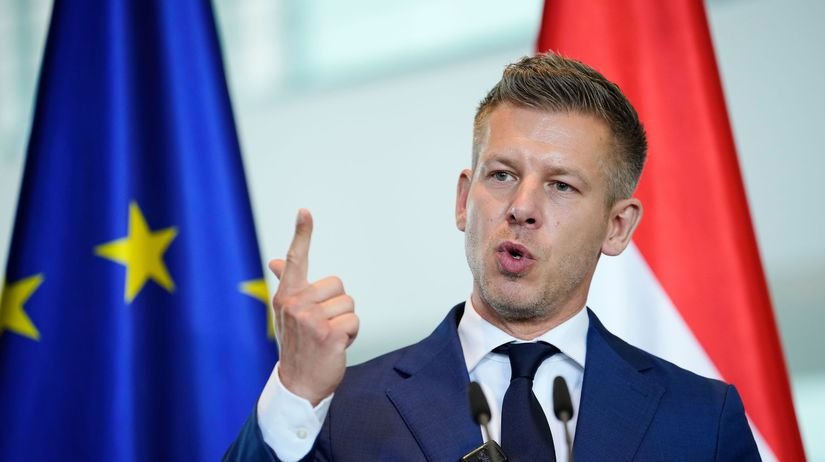
Do you know what Péter Magyar and Viktor Orbán have in common despite not hating each other? In enforcing the rights of members of the Hungarian minority in the surrounding states. In the case of Ukraine, it looks as if the new Hungarian prime minister has, so to speak, taken over the political legacy of eleven demands from his predecessor at the head of the government. These relate to what Budapest expects politicians in Kyiv to accomplish. The latest developments seem optimistic, but…

Photo: SITA/AP, Ebrahim Noroozi
Hungarian Prime Minister Péter Magyar.
First an update: Magyar has announced that it has officially reached an agreement with Ukraine to protect cultural, linguistic, political and educational rights. He has not yet published the content of the text. “In a few weeks, they managed to solve a problem that Orbán’s government could not solve in ten years,” Magyar wrote on the social network Facebook.
The agreement between Budapest and Kyiv is important from Ukraine’s point of view in that, thanks to it, Magyar will stop using Orbán’s veto to start accession talks with the European Union. Specifically, this means that Ukrainians can open the first cluster (bundle of chapters) in Brussels already on Monday, June 15.
What should be paid attention to after Magyar’s announcement? Where can there be political landmines, and has it really been possible to eliminate all disputes between Hungary and Ukraine? Let us recall that during Orbán’s rule, bilateral relations cooled to such an extent that one could even speak of mutual open hostility.
In January 2024, the Orbáns submitted 11 demands to Kyiv, which, according to them, should improve the position of the Hungarian national minority. Ethnic Hungarians live mainly in the Transcarpathian region, that is, in the region that borders Slovakia. The public learned the details of the eleven points in April 2024. The Ekonomicheskaya Pravda server reported on them, citing unnamed sources in the Kyiv government: “Half of the requirements relate to education in the Hungarian language.”
According to the available information, after recently winning the parliamentary elections, Magyar did not miss anything from Orbán’s list. Despite the fact that his predecessor staea blocked Ukraine’s rapprochement with the EU, in Kyiv they pointed out that they had continuously fulfilled much of what Orbán expected from them.
Even before Magyar came to power, Ukrainian deputy Yulia Hryshchenko said that several disputes had already been overcome. “Some of these issues have already been resolved or compromise solutions have been found. This includes, for example, the use of the Hungarian language in education,” she was quoted as saying by the Evropejskaja pravda server at the beginning of May. It indirectly follows from her words that Magyar is not entirely right when he claims that the problems of the Hungarian minority were eliminated only after Orbán left the post of prime minister.
Several media claim that only one of the eleven points remains unresolved. This can be described as purely political: it is a request from Budapest that ethnic Hungarians have permanent representation in the Ukrainian parliament.
It is the point at which Ukrainian President Volodymyr Zelenskyy refused to accommodate Orbán. “He wanted to implement in Ukraine the model that works in Hungary, where representatives of several national minorities are legally guaranteed representation in parliament,” wrote Evropejskaja Pravda in June 2024. Let us add that these minority representatives in the Hungarian legislature are called parliamentary speakers.
Slovak legislation does not recognize this concept. Ethnic Hungarians were last represented in the NR SR in the period 2006-2010. It was the political party Most-Híd, which was ethnically mixed, in which Hungarians predominated over Slovaks. Let us add that this party also took part in the executive power, because it was in the coalition government together with Smer and the Slovak National Party.
Did Magyar move the last eleventh point of contention somewhere closer to being resolved? Not yet. “This issue has now been postponed. Hungary and Ukraine have agreed to ask the Council of Europe and the Organization for Security and Cooperation in Europe to clarify how this could be implemented,” Suspilne TV reported, citing its sources in the Ukrainian government.
 Read more Is “soft” Fidesz succeeding Fidesz? Who’s who in the new Hungarian government
If Kyiv and Budapest were to receive a recommendation to which they would agree, their compromise would quickly become impossible to implement. Why? The Ukrainian constitution requires a referendum in the case of amendments to the parliament. If it is valid, only then can the constitutions be amended. However, during the state of war, which has lasted continuously since the invasion of the Russian army in February 2022, the legislation prohibits the holding of a popular vote. Based on the constitution, the same applies to the impossibility of calling presidential and parliamentary elections during wartime.
In conclusion, let’s add that despite the fact that Ukraine has received the green light to open accession negotiations with the EU, Hungary will probably continue to observe it with the greatest attention. Magyar made it clear that if Zelenskyy did not fulfill his promises, he could turn his back on him: “The European Commission and the European Council will monitor the fulfillment of Ukraine’s obligations. If Kyiv does not comply with its obligations regarding the rights of minorities, Budapest will block Ukraine’s further progress in the process of accession to the EU,” the RBK-Ukraine server paraphrased Magyar.