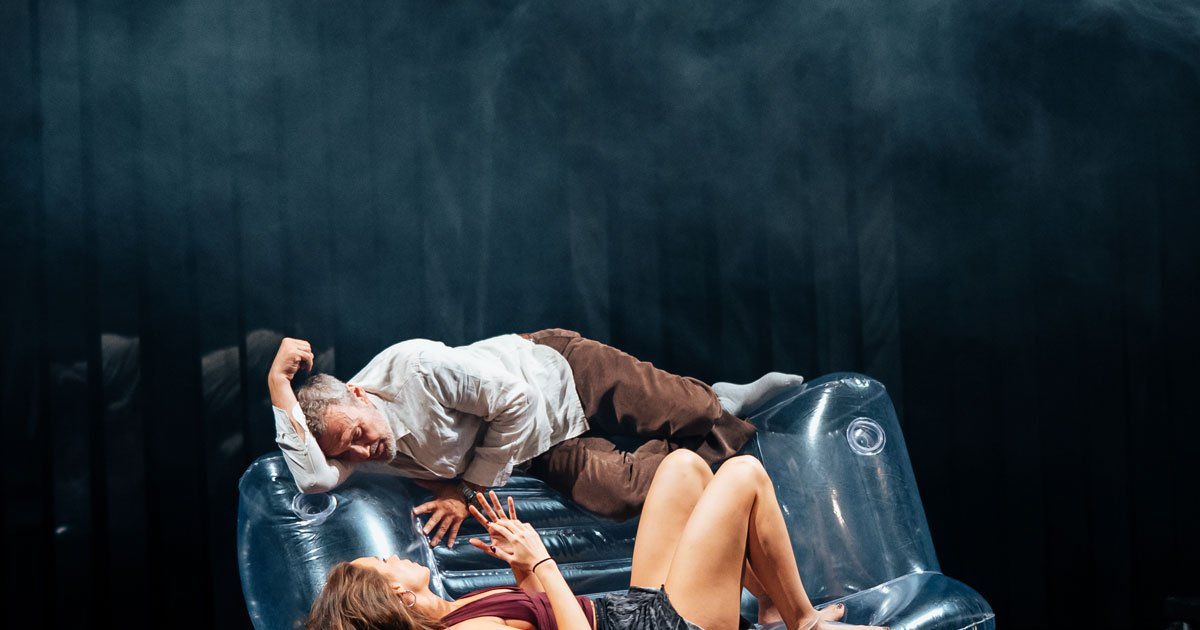
BANJALUKA – The play “Una”, for which the text was written by Stevan Koprivica based on the motifs of Moma Kapor’s novel, and directed by Dejan Projkovski, was performed by the Zvezdara Theater ensemble from Belgrade on the Great Stage of the National Theater of the Republika Srpska on Saturday evening, June 6, the third competition night of the 28th “Petar Kočić” Theater Fest.
The novel “Una”, which was published in 1981, is one of Moma Kapor’s most read works, not only because of the intriguing love story around which the story unfolds, but also because of the way the author managed to evoke the spirit of a time.
As Ana Kapor, Moma’s daughter, wrote in the foreword of the book, “Una” is a love novel, but the love story in it is the least important – much more important is everything that accompanies it, which is rather a story about the essential human need for freedom, which, at the time the book was written, was paid for dearly.
“A person takes as much freedom as the capacity of his lungs. No one will tell you: ‘Be a little more free’. You have to risk it yourself and pay the price you are ready for,” Kapor once said, and this is a thought that, among others, can be heard in the first minutes of playing the piece and runs through its entire course.
This dedication to forbidden love and the right to freedom of choice also had its film version directed by Miloš Radivojević, with Radeta Šerbedžija and Sonja Savić in the lead roles, and as Koprivica stated, the theatrical reading had to escape from the cinematic and even the literary template and look for new outcomes in the “fatal attraction” of the once-charismatic professor and the self-possessed and eruptive student.

As in the novel on which the drama was based, as well as in the film, the central figures of the play are the middle-aged media sociology professor Mišel Babić (Nikola Ristanovski) and the young media sociology student Una Vojvodić (Magdalena Mijatović), but the context is transferred to modern times, i.e. a time when social changes are everyday and freedom is a questionable category.
In the play, we also recognize a certain social and political context: the turmoil at the University of Belgrade, the influence of political affiliations on career development, the manipulative nature of the mass media, the limitations of democracy…
At the center of the story is Una, whose motivation cannot be reduced only to a love story – a character Mijatović’s play is not only looking for romance, but a way out of a predefined world of roles.
She refuses to be reduced to the expectations imposed on her by her age, environment or other people’s interpretations of her life, she fights for the right to freedom of thought, freedom of speech, creativity, she is looking for freedom, but it seems that she does not know exactly where to look for it – whether inside herself or outside.

Unlike her, Professor Babić is a man who also tries to find his own version of freedom, but within the framework of time that overtakes and limits him – however, his freedom often manifests itself as an escape from the past, while Una’s freedom is directed towards the future, towards the possibility of life just beginning.
This year’s Theater Fest is held under the slogan “From play to safe house – and something more than that”. and focuses on the position of women in various life roles, and in this context the play acquires additional meaning.
This space from-to is not only a social zone of risk, but also a space in which female autonomy is shaped – “Una” in this context raises the question of more subtle forms of restriction – those that do not come from the outside as a ban, but from internal and external pressure to constantly justify freedom.
In this framework, Una’s need for freedom becomes the key to understanding her character because she does not seek safety as a final destination, nor does she accept being defined solely through her relationship with a man.
Nevertheless, the play simultaneously shows the limitations of this resistance: the freedom that Una seeks is not simple or without consequences, but a constant negotiation between desire and the price that desire carries.
The character of Olga Babić (Sena Đorović), the professor’s wife, represents another form of female experience – a life within stability, accepted rules and socially confirmed choices.

But even this space of safety is not shown as completely liberating, but as another kind of restriction, and between Una and Olga, a silent line of female experience is established in which freedom is not measured only through rebellion, but also through the question of what is accepted for the sake of peace.
Dukić (Marko Gvero) is the vice chancellor who, on behalf of the political party to which he belongs, wants Una’s “help” or, as he says, a small favor (which is actually blackmail by suspending the process against her father and receiving a prestigious Fulbright scholarship) to find out which side Professor Babić is on, the left or the right, and through his character we can learn that freedom is a category that a person must win, but not at a small price.
The greatest quality of the play is found in the acting ensemble.
Nikola Ristanovski builds Professor Mišel Babić, in whom there is a great desire for freedom, but freedom without responsibility – his character is neither a romantic hero nor a moral criminal, but a man caught between experience and the desire to once again believe in the possibility of turning his life around.
Opposite him, Magdalena Mijatović plays Una as an energy that disturbs the established order, but not as a symbol of youth, but as a woman of flesh and blood, with all the contradictions that such a position entails.

Sena Đorović skilfully built the character of a woman who fails to understand first of all the man she lives with, and in that sense she is very tolerant, patient, but also clears her way to freedom without any kind of animosity towards the young woman with whom her husband is in a love relationship. Marko Gvero is up to the task and represents the political level of this play and a man who is pragmatic, on the “line” and defends his views.
In certain segments, the play loses its dramaturgical sharpness, relying more on the atmosphere than on a clearly managed conflict, which occasionally slows down the very rhythm of the play, but does not violate the basic idea – that it is a play that deals with the internal, not external states of the characters.
The stage space and visual atmosphere, which is in charge of Valentin Svetozarev, support the idea of a closed, but emotionally charged world, while the space acts as a framework in which freedom is constantly re-examined, never fully realized, and the music, composed by Goran Trajkoski, follows the inner states of the characters.

In the final impression, “Una” cannot be viewed only as a love story or an adaptation of a literary work – it functions as a stage study of a woman’s need to find her own freedom, even when that freedom is not easily attainable or defined.
Her ambition is to examine what it means today to love, remember and choose freedom, and that is precisely why this production leaves the impression of a work that does not end with the lowering of the curtain after the performance of the piece, but continues in conversations after the performance – is freedom a choice without consequences or does it have a price?
Read more: