“We thought we would include a few children. In reality, we are raising up an entire generation.”
What a class teaches everyone a school : Educational inclusion does not begin in a legal text. It begins when a child with a disability takes the same path, goes through the same door and shares the same class as other students in their neighborhood.
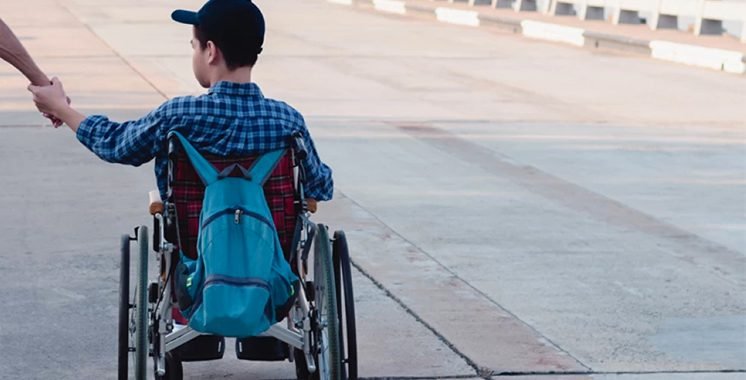
In the morning, on a street in Meknes, there is a boy walking towards school. The same route as its neighbors. The same satchel that’s a little too heavy, the same yard waiting for him, the same friends who shout his name from afar. Nothing in this scene should surprise you. And yet, there was a time, not so long ago, when this simple path to the local school was almost a miracle.
This boy’s name is Anass. He is fourteen years old. Anass has Down syndrome, trisomy 21. An extra chromosome. A little something extra, as the now famous film would say. And for a long time, in our country as in many others, this extra chromosome resulted in a cruel subtraction: fewer rights.
But before being a diagnosis, Anass is a child. A child who likes going to school, who likes to draw, set up projects with his teacher, participate in activities, raise his hand. Just like all the other children.
You have to imagine what life was like, just yesterday, for families like Anass’s. Having a child with a disability is an obstacle course. Find an establishment that agrees to welcome him. Sometimes finding him on the other side of town, sometimes dozens of kilometers away. Pay, often, for lack of free. Bloody yourself to offer your child what should go without saying: a place at school.
Behind every child out of school, there were exhausted parents, and a question that remained without a worthy answer: why doesn’t mine have the right to learn like the others?
Because inclusion does not begin in a legal text. It starts there, very concretely: having the same rights, making the same journey, going through the same door as the next door neighbor.
Today, Anass attends a pioneering college in Meknes. An establishment which has opened an inclusive class, with a teacher specially trained to support and instruct children with disabilities, each according to their needs, at their own pace, without renouncing the requirements.
The idea is simple and revolutionary at the same time: these children do not have to go anywhere else. It’s the neighborhood school that opens up to them. The same courtyard, the same corridors, the same comrades.
This inclusive class doesn’t just change the lives of Anass and his classmates. It changes that of the entire school. The other students, by encountering difference every day, learn something that no textbook teaches: respect, acceptance, living together, openness to others.
We thought it included a few children. In reality, we are raising an entire generation. Anass learns to read and count; his comrades learn to look at a child without reducing him to what sets him apart. It’s hard to say who gets the most.
Inclusion in education is not a favor that we grant. It is a societal choice, a collective responsibility: to decide that no child will be left behind. Because a society that places some of its children on the margins prepares its own fractures.
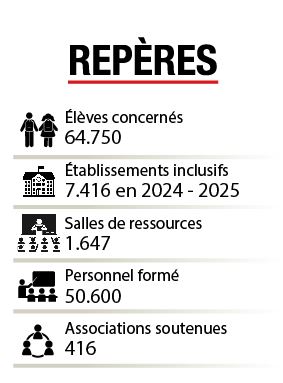
Anass is one of 64,750 students with disabilities attending school in Morocco in 2024-2025. A number that says nothing until we put it into perspective: inclusive establishments increased from 3,012 in 2021-2022 to 7,416 in 2024-2025. More than double in three years.
Behind these two figures, a mechanism is in motion: 1,647 resource and rehabilitation rooms created, more than 6,000 establishments equipped for accessibility, 50,600 staff trained in inclusive education, and examination methods adapted for 36,167 students, because equal opportunities are also at stake on the day of the test. Without forgetting the 416 associations supported, which supervise nearly 28,000 children each year.
But let’s be honest: 64,750 children in school is immense and it is insufficient at the same time. There are still classes to open, teachers to train, families still waiting for their turn, attitudes to change. The network is expanding, it must continue to expand for a long time, until the term “inclusive establishment” disappears, as it still has no meaning. The day all schools are inclusive will simply be normal.