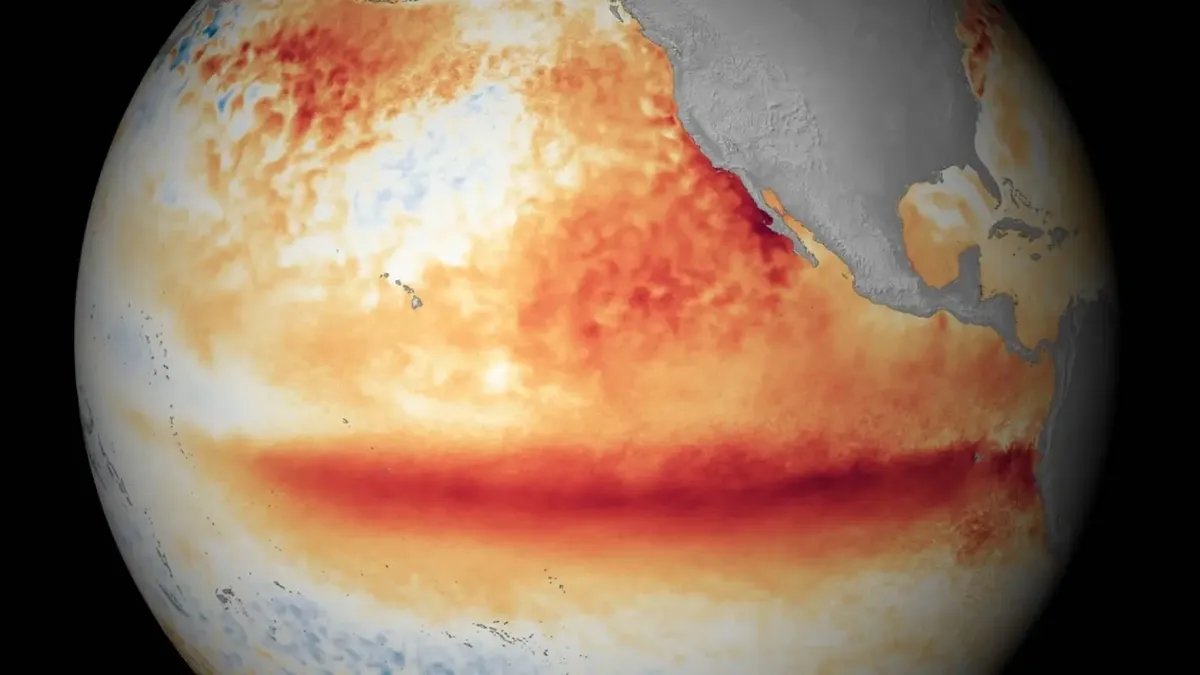
The US National Oceanic and Atmospheric Administration (NOAA) confirmed this Thursday the official start of the climate phenomenon The Child 2026-2027after detecting oceanic and atmospheric conditions consistent with the development of the event in the equatorial Pacific Ocean, according to Metsul.
The US climate agency noted that During the last month, the warming of the surface waters of the central and eastern Pacific consolidatedaccompanied by changes in winds, rain and cloudiness, typical characteristics of the phenomenon.
According to NOAA, international climate models indicate that El Niño will continue to strengthen in the coming months and there is a probability of 63% of it reaching a very strong intensity between November 2026 and January 2027.
If this scenario comes to fruition, the episode could be among the most intense recorded since modern measurements began in 1950.
What is El Niño and why does it concern meteorologists?
El Niño is a large-scale climate phenomenon that occurs when the surface waters of the equatorial Pacific Ocean have temperatures above normal for several months.
However, for the phenomenon to be officially declared, warming of the ocean is not enough. It is also necessary for the atmosphere to respond to this change through modifications in wind circulation and precipitation patterns, a process known as “ocean-atmosphere coupling.” According to NOAA, that process is already underway.
https://www.bbc.com/mundo/articles/cvgz4dx1yeno

The agency indicated that large volumes of warm water that had been accumulated in the western Pacific began to move towards the coasts of South America, rapidly raising sea temperatures.
The warming is especially marked off Peru and Ecuador, where an episode of The Coastal Boywith areas where the water temperature is up to eight degrees above usual values.
Risk of a “Super El Niño”
The climate models analyzed by different meteorological centers agree that the event could intensify during the second half of the year and reach levels compatible with what is informally known as a “Super El Niño”.
Some scenarios even project that it could surpass in intensity the historical events of 1982-1983 and 1997-1998considered among the strongest of the last century.
Specialists clarify, however, that there is still uncertainty about the maximum magnitude that the phenomenon will reach.
Traditionally, the peak intensity of El Niño usually occurs towards the end of the year in which it develops, generally between October and December.
https://www.bbc.com/mundo/articles/cvgz4dx1yeno

What happened during the last episode
The last El Niño phenomenon developed between May 2023 and April 2024 and was associated with numerous extreme events in different regions of the planet.
One of the most serious cases occurred in May 2024, when the Brazilian state of Rio Grande do Sul suffered the largest flood in its history. The disaster affected millions of people and caused damage in more than 400 municipalities.
Experts warn that, although an intense event increases the probability of extreme phenomena, there is no direct relationship between the strength of El Niño and the magnitude of disasters that may occur in a specific region.
The south of Brazil appears among the highest risk areas
NOAA and different meteorological organizations agree that southern Brazil will be one of the most sensitive regions to the development of the phenomenon.
Historically, El Niño events there have been associated with a significant increase in rainfall, river flooding, flooding and severe storms.
Specialists consider that the period of greatest risk will be concentrated between the end of winter and spring of 2026, although extreme events could also be recorded during the summer and autumn of 2027.
In any case, meteorologists emphasize that it is still too early to accurately anticipate what the specific impacts of the phenomenon will be in each country and remember that the consequences depend on multiple atmospheric factors that can only be evaluated with greater certainty through short-term forecasts.