It is Thursday morning around half past twelve when the heavy, oppressive heat of the Johan Adolf Pengel International Airport at Zanderij makes way for a completely different reality than usual. A gray transport plane is waiting on the runway: the C-2 Greyhound. This is not a comfortable scheduled flight. This is the beginning of a military adventure. A delegation of ministers Uraiqit Ramsaran (Defence), Harish Monorath (Justice and Police) and Patrick Brunings (Oil and Gas), army commander Mitchell Labadie, several senior officers and two journalists are preparing for a historic meeting on the Atlantic Ocean.
Text and image Ivan Cairo
When boarding through the tailgate, it is immediately clear that all civilian luxury has been left at home. There is a penetrating, almost suffocating smell of kerosene and hydraulic oil in the cabin. Chairs are arranged backwards, a necessary construction to absorb the forces of the landing. Everyone is lashed down twice: a thick belt around the waist and heavy belts over the shoulders. You can’t go anywhere. With a helmet on their head, sturdy hearing protectors over their ears, goggles on their nose and an inflatable life jacket strapped to their chest, the members of the delegation turn into temporary crew members.
Controlled crash at sea
When the engines come to life with a deep, rumbling roar, the entire aircraft vibrates. The flight towards the open sea takes about half an hour. Outside the sun beats down mercilessly on the metal hull, inside the tension rises. The ocean below is an endless deep blue plain, until suddenly a gray dot appears on the horizon. It’s the USS Nimitz (CVN-68), a sailing legend.
Landing on an aircraft carrier is an experience that cuts through to the bone. It’s basically a controlled crash. The plane starts its descent at brutal speed, the pilots paradoxically give full throttle just before hitting the deck to be able to fly away if the landing fails. Then comes the blow. The C-2’s arresting hook grabs one of the thick steel brake cables on the deck with pinpoint precision. Within a fraction of three seconds, the aircraft is brought from more than 240 kilometers per hour to a complete, shocking stop. The belts cut into the shoulders, the breath catches in the throat. We’re here. The stomach contents just remained inside.
Cameras and mobile phones of the Surinamese guests click on the assembly line. Everyone wants to capture this moment: ministerial selfies against the backdrop of shiny gray military metal.
When the rear hatch opens, the reality of the USS Nimitz rushes in. The reception is military strict, but extremely warm. The Surinamese delegation is officially welcomed by Rear Admiral Cassidy Norman, commander of the Fourth Fleet mission, and Captain Joseph Furco, commander of the ship itself. They radiate the tranquility of professionals in charge of a sailing city with around 6,000 people on board.

The impressive dimensions of the USS Nimitz are best described by her sheer size and power. With a length of no less than 333 meters of pure steel construction, this iconic vessel is an imposing appearance on the world’s oceans. The ship is powered by two nuclear reactors, allowing it to operate for decades without ever having to bunker. There is a complete sailing city on board, with more than 5,000 to 6,000 crew members on active duty to ensure the operations run smoothly. Although the Nimitz was put into service in 1975 and is currently the oldest active aircraft carrier in the world, she now shows her strength one last time during her historic farewell voyage, the Southern Seas 2026-mission.
Roaring engines on stormy deck
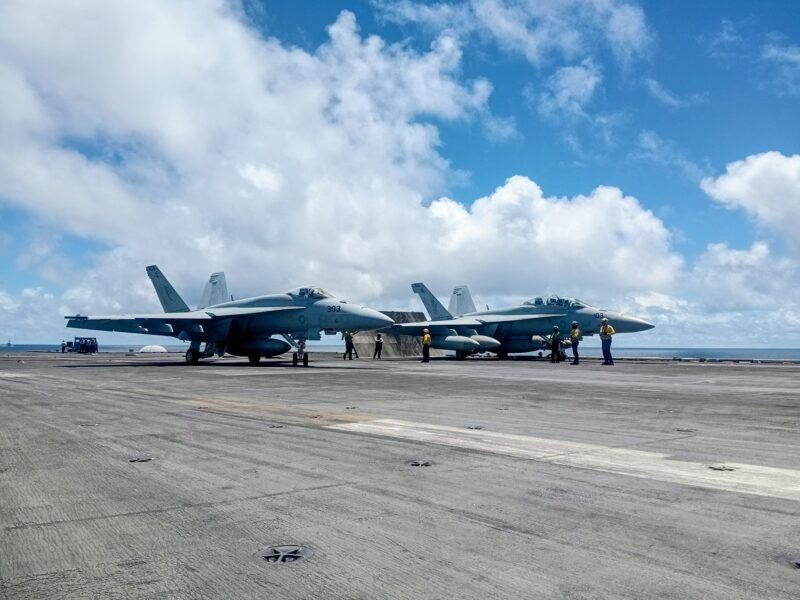
After the formal introduction, the delegation steps onto the flight deck. The transition is overwhelming. There’s a steady, howling wind blowing across the bow — an “artificial” storm necessary to give the fighters enough lift on takeoff. You literally have to stand firm on your feet and almost lean forward to avoid being blown over. Once again that recognizable, sharp smell of JP-5 kerosene penetrates the nostrils.
On the huge deck are the F-18 Super Hornets already in the starting blocks for a breathtaking demonstration. Some aircraft are already vibrating on their wheels with roaring engines. The tension is really palpable; the heat from the exhausts distorts the air above the deck. Cameras and mobile phones of the Surinamese guests click on the assembly line. Everyone wants to capture this moment: ministerial selfies against the backdrop of shiny gray military metal.
During this closing, Admiral Norman emphasizes that the United States views Suriname as a crucial regional partner.
Then the spectacle begins. One by one, the fighter planes take to the air in a deafening display of power. The sound can not only be heard, it can be felt in the stomach area and vibrates through the bones. The aircraft shoot up, climb steeply and disappear into the clouds, only to pass just past or over the ship in a tight formation. With a loud bang they break the sound barrier over the Atlantic Ocean, with a visual condensation cloud briefly forming around the wings.
Through the speakers on deck, the crew explains the terrifying capabilities of these machines. But the show is broader: a helicopter also performs maneuvers just above the water surface and a short distance away the USS Gridley, the ultra-modern destroyer that accompanies the Nimitz on this journey, shows its impressive sailing skills.
A city under steel
After the demonstration, the group moves to the interior of the huge steel colossus. Below deck, in the immense hangar, which is comparable in size to many factory halls, Captain Furco gives a tour. Here the logistical performance of the ship really becomes clear. Rows of dozens of refrigerated containers full of provisions and spare parts are neatly arranged. Forklift trucks are neatly parked at the rear. The aircraft are kept in the hangar serviced and repaired. There is food for months. The USS Nimitz is a small, self-sustaining enclave.

Then a physical challenge begins: the delegation must climb no fewer than eight steep, narrow ship’s stairs to the wheelhouse (the ‘island’ of the aircraft carrier). From this command post the view over the extensive flight deck and the ocean is phenomenal. Here officers explain how to maneuver a 333 meter long ship.
After the presentation in the wheelhouse, the party descends two more flights of stairs to the formal office of Rear Admiral Norman. Amid maritime memorabilia and historic photographs, the visit concludes with a modest cocktail reception. Here gifts are exchanged and the visit also takes on a deeper, strategic meaning.
Friendship and farewell
During this closing, Admiral Norman emphasizes that the United States views Suriname as a crucial regional partner. The Southern Seas 2026mission, which takes in fifteen countries in Central and South America, is indeed the farewell tour of the fifty-one-year-old Nimitz before she is finally taken out of service in March 2027, but it is above all an investment in the future. Norman speaks enthusiastically about cooperation in air interception and looks forward to the major regional military exercise Tradewinds 2027which will be held in Suriname. He even invites the National Army to send officers on American missions in the future to build long-term relationships.
The engines roar, the brakes release and the plane is launched off the deck with a brutal, almost alien acceleration. You are pressed deeply into the backward seat as the ship sinks beneath you.
Around three o’clock in the afternoon it is time for the return journey. The C-2 Greyhound is ready on the catapult. As an untrained passenger you don’t know that you will be shot from zero to 250 kilometers per hour in two seconds.

The engines roar, the brakes release and the plane is launched off the deck with a brutal, almost alien acceleration. You are pressed deeply into the backward seat as the ship sinks beneath you.
When the C-2 safely puts its wheels back on the ground at Zanderij half an hour later, the Surinamese delegation steps outside. Me, a little sea and air sick from the extreme physical forces, but with a deep sense of satisfaction. We have just experienced with our own eyes the history and awesome dynamics of the USS Nimitz, just off our own Surinamese coast.-.