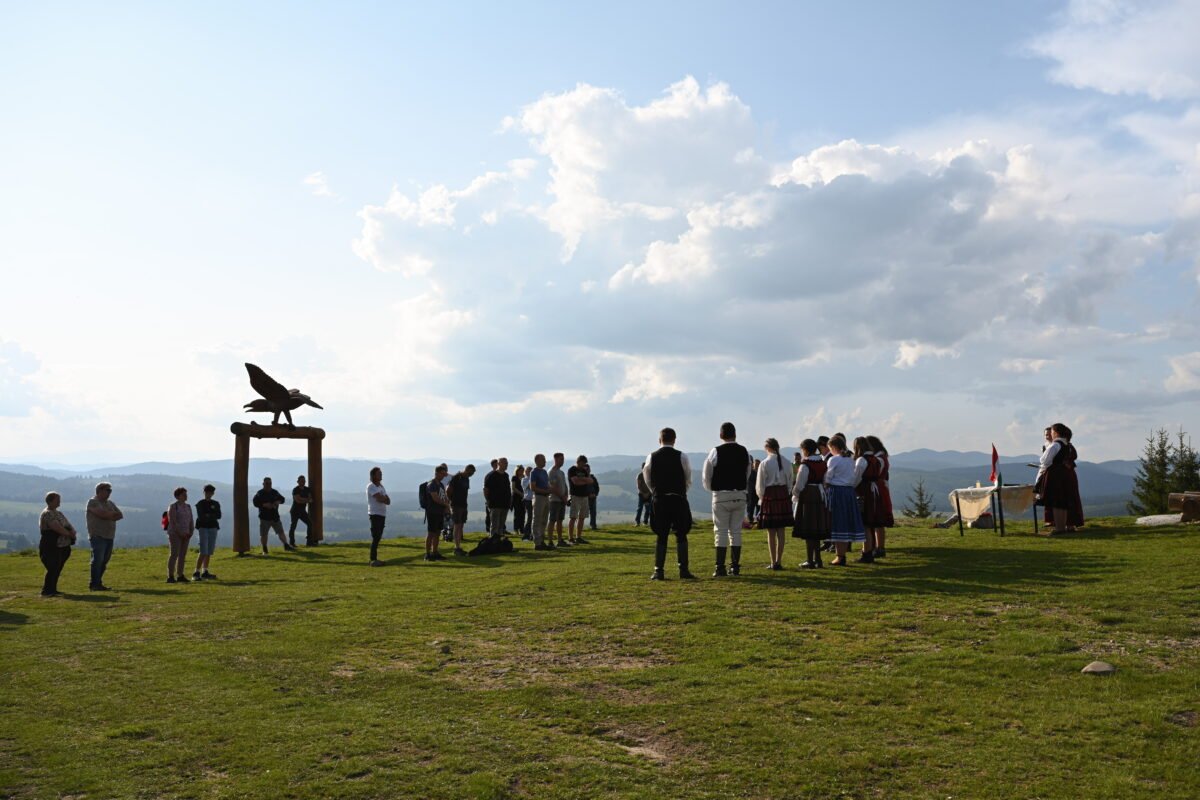

Participants in the commemoration ceremony marking the Day of National Unity at the Monument to Hungarian Heritage in Transylvania in 2025
Every year on June 4, Hungary marks the Day of National Unity, an occasion of deep importance to the Hungarian people. On this day, we honor and remember that Hungarians everywhere belong to one shared national community that reaches beyond the country’s borders.
On May 31, 2010, the Hungarian Parliament declared June 4—the day the Treaty of Trianon, which ended World War I, was signed—as the Day of National Unity. The relevant law states:
Every member and every community of the Hungarian people, who are subject to the rule of several states, is part of the unified Hungarian nation, whose unity across national borders is both a reality and a defining element of the personal and communal identity of Hungarians.”
The terms of the Treaty of Trianon were established at the Paris Peace Conference of 1919–20 without Hungarian participation, where the victorious powers decided on the new order of Europe. Albert Apponyi, the head of the Hungarian delegation, was not able to present the Hungarian position until January 16, 1920, at which time he used documents and maps to illustrate the demographic situation and put forward historical and legal arguments—to no avail. The terms of peace were communicated to the Hungarian delegation in May 1920; after reviewing them, the delegation rejected them.

Map of the territorial division of Austria-Hungary according to the Paris Treaties. Photo: commons.wikimedia.org/AlphaCentauri
The treaty was subsequently signed on the afternoon of June 4, 1920, at the Grand Trianon Palace in Versailles by Ágost Benárd, Minister of Public Welfare and Labor, and Alfréd Drasche-Lázár, Extraordinary Envoy and Minister Plenipotentiary. In a gesture of protest, Benárd signed the document while standing.

The Hungarian signatories of the treaty, delegation head Ágost Benárd (left, holding a top hat) and Extraordinary Envoy and Minister Plenipotentiary Alfréd Drasche-Lázár (behind Benárd), leave the hall after the signing. Photo: commons.wikimedia.org/Agence de presse Mondial Photo-Presse
At 10 a.m.—the scheduled time of the signing—bells rang in Hungary, factory sirens sounded, a moment of silence was observed in schools and government offices, flags were lowered to half-mast, traffic came to a standstill for ten minutes, and shops closed.
The treaty declared the country’s independence and established its borders; as a result, Hungary’s territory (excluding Croatia) shrank from 283,000 square kilometers to 93,000 square kilometers, and the population fell from 18.2 million to 7.6 million. Ultimately, Hungary lost about two-thirds of its territory, 38% of its industry, and 67% of its national income.
The Treaty of Trianon took into account neither the ethnic composition nor the data from the 1910 census, so that approximately 3.2 million Hungarians—one-third of the Hungarian population—ended up outside the new borders, half of them in contiguous areas along the borders. Following the referendum held from December 14 to 16, 1921, Sopron and its surroundings remained part of the country, and in the north, Somoskő and its surroundings (with the exception of the castle in Somoskőújfalu) were returned in 1923.
Numerous commemorative events take place on National Unity Day.
Once again, the commemorations focus on the power of community, the strengthening of national identity, and the cross-border unity of Hungarians.
The events begin early in the morning and continue late into the evening, with parallel events taking place in numerous towns and villages involving schools and civil society organizations.

The Hungarian flag, accompanied by a military salute, raised ceremoniously on Kossuth Lajos Square in front of the Parliament Building on June 4, 2026, to mark National Unity Day. Photo: MTI/Máthé Zoltán
In the capital, the day began traditionally with a solemn flag ceremony, a military honor guard, and the presence of church representatives. Subsequently, wreath-laying ceremonies take place at several memorial sites, where public figures, historians, and civil society organizations lay flowers in remembrance.
In a Facebook post, President Tamás Sulyok commemorated National Unity Day with a quote from poet Mihály Babits: “The foundation of human self-awareness is memory; that of national self-awareness is historical memory.”
Our history spanning over a thousand years, our mother tongue, our rich traditions, and our shared values unite us Hungarians both within and beyond our borders. Let us preserve and protect one another and our Hungarian identity!”
the president stated in his message.

Via infostart.hu, Magyar Nemzet; Featured image: MTI/Kátai Edit