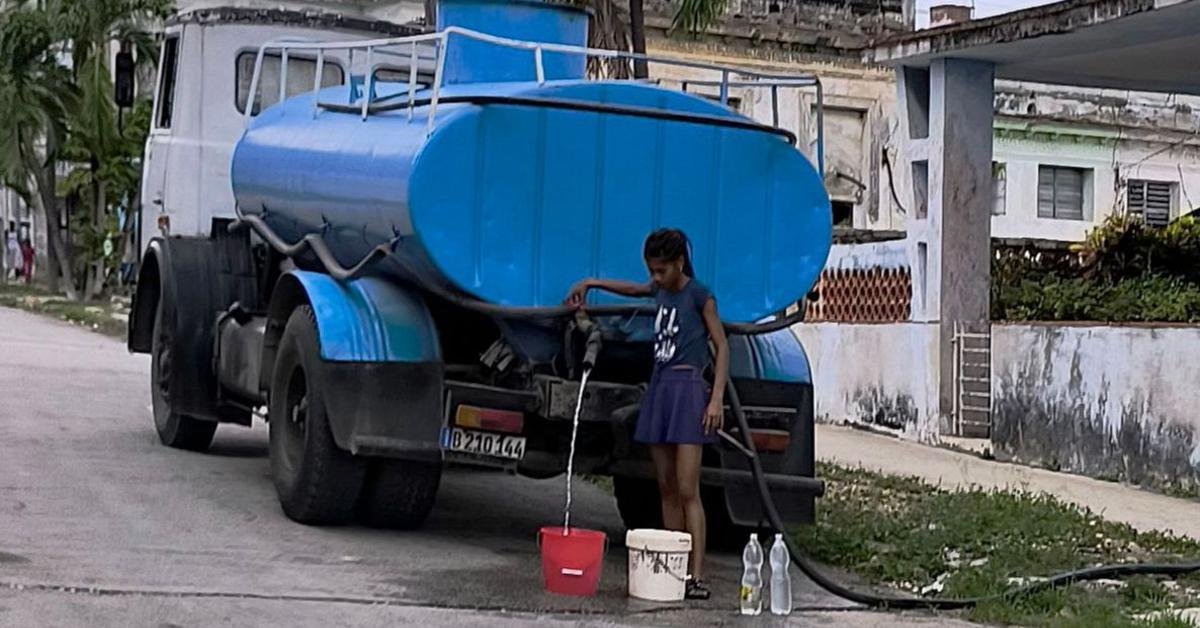
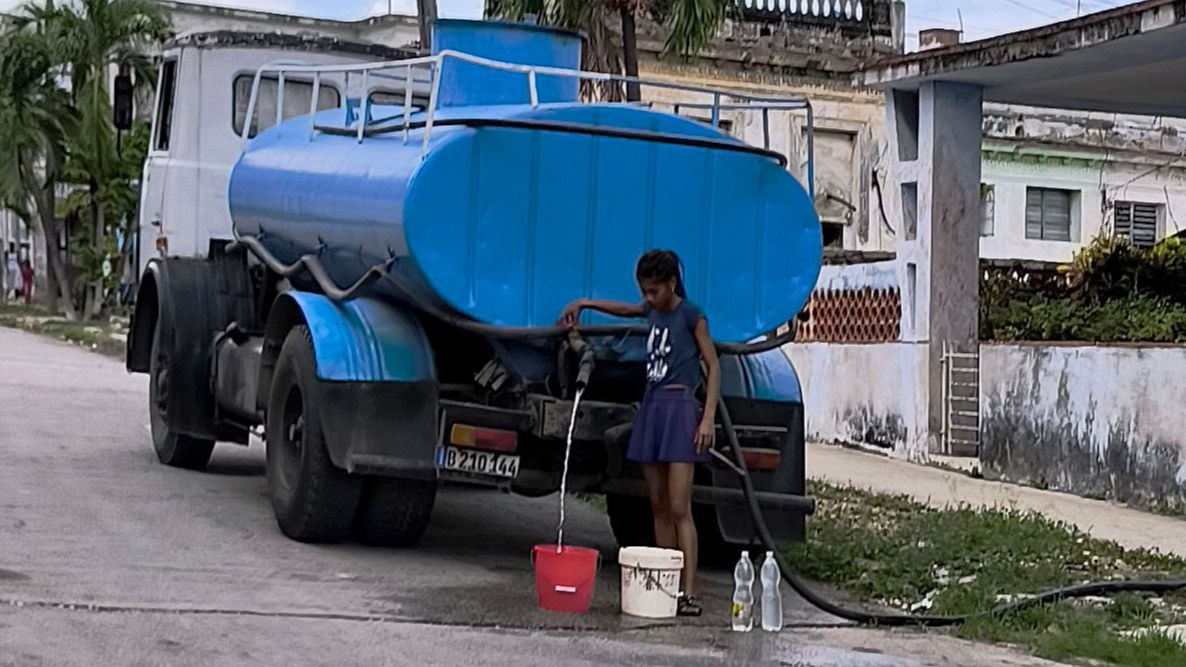
Havana/A group of residents of Luyanó, in the Havana municipality of Diez de Octubre, managed this week to get the authorities to send them a water pipe, after days and days without a drop of service. “Only when they appeared at the government did they send it to them,” says a young resident of the place, who describes 14ymedio the sufferings of the area.
“When I put the dog down there were some neighbors a few blocks up arguing over a pipe,” he continued. “If we continue without service, this is going to get intense: people tolerate blackouts more than the lack of water.”
The Aguas de La Habana company announced on April 18 a break in a 48-inch conduit from the Cuenca Sur supply source, which forced pumping to be interrupted since dawn, which has harmed large areas of the Plaza de la Revolución, Cerro, Diez de Octubre and Boyeros municipalities. As a consequence of the breakdown, in Central Havana and Old Havana the service became regulated.
The damage has been suffered in the neighborhoods closest to government offices, such as in Nuevo Vedado, in the Plaza de la Revolución municipality, where the same editorial office 14ymedio has suffered the consequences, reaching only a few hours a day of water supply.
If we continue without service, this is going to get intense: people tolerate blackouts more than the lack of water
On Reina Street, in Central Havana, residents have been forced to decide between washing clothes or washing dishes, given the impossibility of doing both with the limited supply of water available. The situation has even forced the temporary closure of food sales businesses in the area, which cannot function without supply.
On April 17, the official media They had recognized in a press conference a “complex situation in the capital’s water supply.” The official figures presented by directors of Aguas de La Habana place the affected Havana residents at around 200,000, which is equivalent to 11% of the capital’s population, “a damage perhaps not so alarming in absolutely numerical terms,” he writes. Havana Tribune“but very complex and stressful.”
On social networks, residents of Central Havana also denounce the seriousness of the situation. “It’s already been 25 days without water,” wrote this Monday a resident identified as Haila Barani, who reported that a tanker truck refused to sell her the service, claiming that it was intended “only for vulnerable cases.” “I can’t clean myself, I can’t drink water, I can’t cook,” he lamented. The woman claims that she has had to settle for just three buckets of water.
I ask Aguas de La Habana, if they have invented something to be able to survive without water
In neighborhoods like Luyanó, the consequences of these interruptions deteriorate a previous situation that was already unsustainable. The lack of transparency in information about distribution cycles and the lack of effective alternatives, such as supply through pipes, make residents impatient, who on more than one occasion have expressed their indignation at middle of protests. “I ask Aguas de La Habana, if they have invented something to be able to survive without water,” a resident of Guanabacoa questioned yesterday. in a comment on Facebook.
State authorities admit that in several territories delivery cycles have been unsustainably lengthened, to the point that in areas such as Aldabó, in the municipality of Boyeros, residents can go nearly a month without receiving water.
“The effects practically cover all Havana localities, except Plaza, Marianao and Centro Habana, ultimately not so exceptional exceptions, while in some neighborhoods or specific areas of these territories there is instability in deliveries,” the general management of Acueducto de Aguas de La Habana admitted at a press conference.
The reactions to the official note published reveal situations that the authorities do not communicate, or ignore completely: “Guanabacoa is not mentioned and water has not arrived in the high areas for more than 15 days,” writes one commentator.
The day they put in the water, they turn off the electricity and you can’t pump to fill the tanks.
“It is very serious, since to the breakage problems in Cuenca Sur and Palatino we add that the day they put in the water, they turn off the electricity and it cannot be pumped to fill the tanks” says another, and adds: “In Víbora Grande the water enters every three days according to plan and it has not been fulfilled in these months several times consecutively.”
In the official appearance it has been described that the effects include everything from total shortages to increasingly longer distribution cycles or recurring service failures. Among the causes identified, breakdowns in pumping equipment stand out, responsible for 40% of the interruptions, closely followed by blackouts, with 39%, and to a lesser extent by breaks in conductors and leaks.
Hydraulic system managers have insisted that any improvement will depend largely on the stability of the electricity supply. They promise the installation of new pumps and generator sets in various parts of the city, and the repair of equipment, without specific deadlines and provoking the same skepticism in a desperate population.
The severity of the water supply crisis in Havana has reached a climax that is already making the population impatient. The recent breakdowns only reveal the dysfunctionality of a hydraulic infrastructure that has suffered years of deterioration and lack of maintenance.
The enthusiastic promotion that Aguas de La Habana spread yesterday, Monday, about the digitalization of its services with online payment as a “modern” technological advance “to minimize stress,” seems to ignore that the population faces a more urgent difficulty today: the need to access the most basic resource to exist.