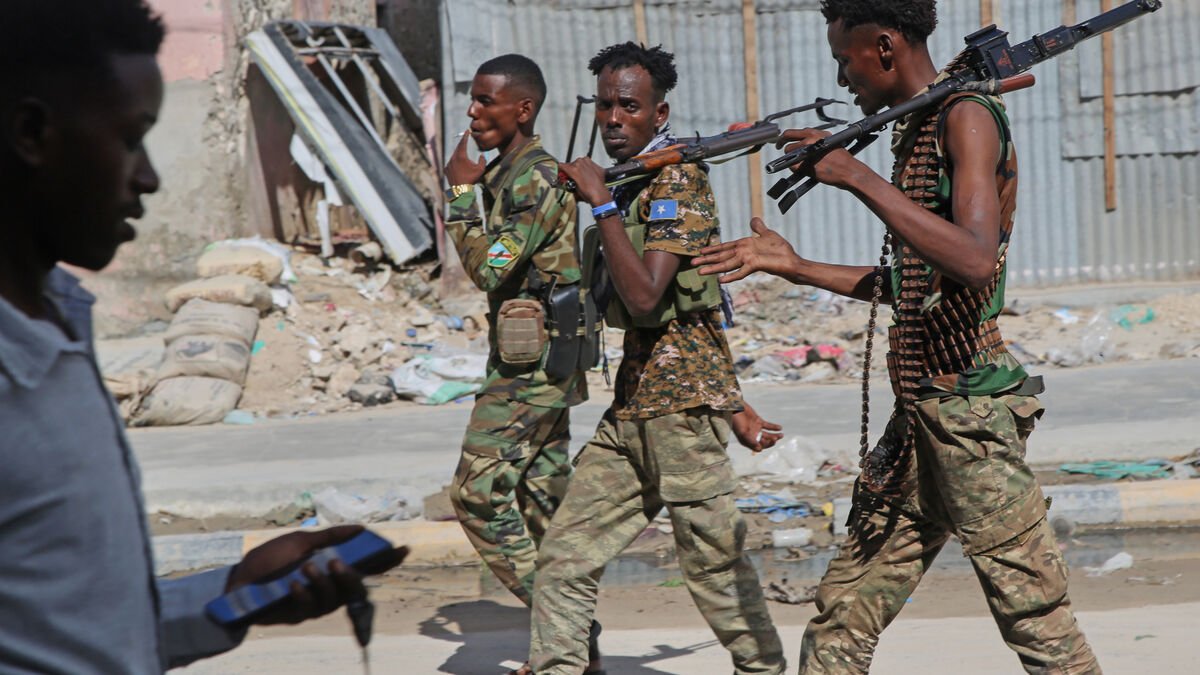
Smoke has been rising over the Indian Ocean city since Wednesday. Heavily armed security forces patrol the streets.
“We heard heavy weapons being fired and people were fleeing their homes. Many families are leaving the area in search of safer places,” Abdullahi Mohamed, a resident of the Howlwadaag district of Mogadishu, told the AP.
Information about what is happening is contradictory. Police say a major operation against “heavily armed militias” that have threatened stability in the capital is underway, the AP reports.
Former Prime Minister Hassan Ali Khaire instead claims that President Hassan Sheikh Mohamud sent armed forces against the opposition ahead of planned protests against Mohamud’s rule.
Constitution amended
“This evening, repeated attacks were directed at the residence of former President Sharif Sheikh Ahmed in Mogadishu by forces acting on the orders of Hassan Sheikh Mohamud,” Khaire wrote on X late Wednesday, continuing:
“Now he is mobilizing state forces to silence those who oppose his unconstitutional hold on power.”
The Horn of Africa country was due to hold elections in May, but in March the president extended his own mandate through a constitutional amendment. Mohamud himself claims that he is trying to move the country towards democratic elections and replace the current clan-based system, where large clans have far-reaching influence. The opposition sees it as a way to concentrate all power around the president.
Humanitarian crisis
According to Khaire, the flare-up of fighting has claimed lives.
“Heavy weapons that are more associated with the battlefield than densely populated urban areas, including anti-tank weapons, drones and more, have been directed at us,” he wrote on X on Thursday.
The US embassy in Mogadishu called the violence “reckless” and warned that Somali leaders on all sides have a responsibility to preserve stability, it wrote on X.
“Actions taken in the coming hours and days could have long-term consequences for Somalia’s security, unity and future.”
Somalia has long been hit hard by political crises and conflicts between clans, the Islamist group al-Shabab and weak governments. Combined with a prolonged drought, this has created one of the world’s largest humanitarian crises.