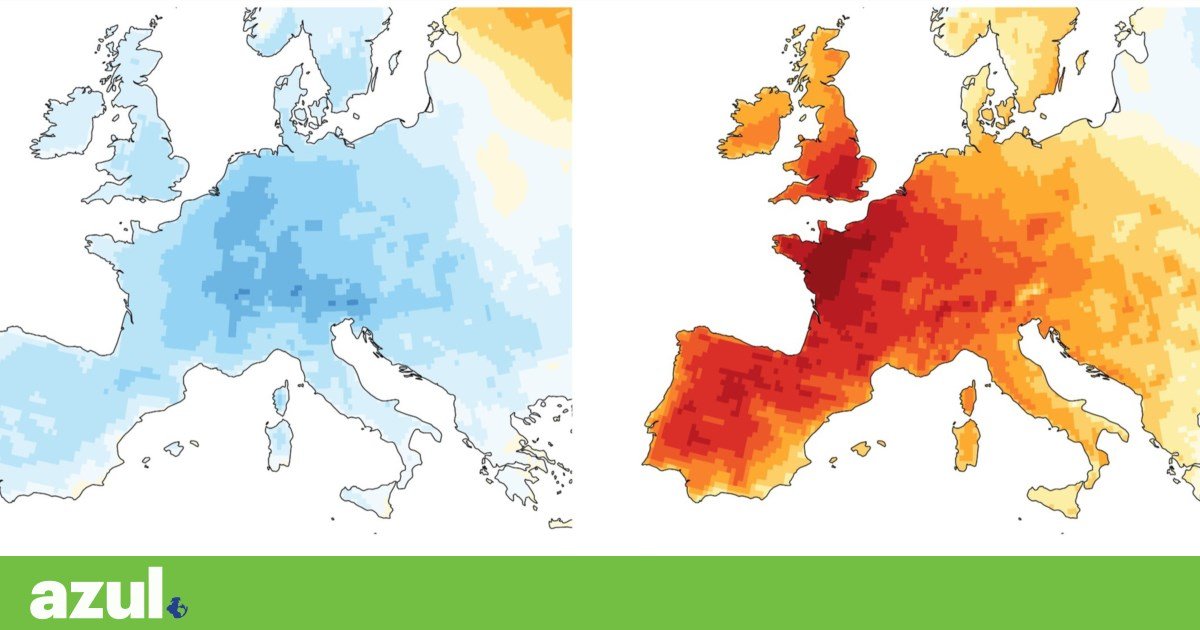
The calendar did not yet indicate the beginning of summer, but in much of Europe it arrived earlier and with an intensity that was impossible to ignore. May 2026 was the second hottest on record on a global scale and was marked by a heat wave early and exceptionally intense outbreak that swept across Western Europe, including Portugal.
According to a press release from the European monitoring program for climate Copernicus, “May 2026 was the second hottest ever recorded on a global scale, on land and at sea”.
The month was also notable for unusual oceanic conditions, with “exceptionally high sea surface temperatures in the tropical Pacific”, in a context of transition to a new episode of El Niño.
Speaking of El Niño…
Regarding the phenomenon El Niñothe Portuguese Institute of the Sea and Atmosphere (IPMA) released this Tuesday a update noting that, “as of June 1, monthly updated information on ocean surface temperature (SST) in the equatorial Pacific reveals that the ENSO index – El Niño–Southern Oscillation – is still in the neutral phase”, with a value 0.5°C higher than the average.
The same note states that, “in the coming weeks, current forecasts from several seasonal forecast models point to a transition from the neutral phase to the El Niño (probability of 82%), between the months of June and July 2026, persisting until the end of 2026 (probability greater than 90%)”.
Expecting a moderate to strong manifestation of this natural phenomenon that occurs in the Pacific and influences climate patterns on a global scale (with an impact that should be amplified due to the climate crisis), IPMA notes that “its effects in Portugal are not direct or simply predictable, so it will continue to monitor its evolution and publish updates whenever necessary”.
A sudden change
Returning to the heat of May in Europe, according to Copernicus scientists, “the month was marked by a rapid transition from conditions much colder than average to one of the most intense heat waves ever observed so early in the year in Western Europe”. In just a few days, the continent went from a relatively cool environment to temperatures typical of midsummer.
In Portugalsuch as in France, United Kingdom and Ireland, the heat sent thermometers soaring much higher than usual for the season. At the beginning of June, IPMA had already announced that the heat wave that began on May 20th was the third longest on record in terms of duration (9.3 days).
The Copernicus press release notes that “numerous temperature records were broken in May”, with some countries recording “particularly severe conditions”. In several regions, the thermal sensation reached unusual values, with “temperatures felt between 35°C and 40°C”.
More than the intensity, what surprised experts was the speed of the change. Copernicus highlights that “the rapid transition likely increased impacts on populations, leaving little time for people — or cultures and ecosystems — to adapt.” The change occurred around May 20th and caught populations and natural systems off guard, at a crucial time in Spring.
A trend and contrasts
This episode is part of an accelerated warming trend. As Samantha Burgess, from the European Center for Medium-Range Weather Forecasts (ECMWF), highlights, “May 2026 was the second hottest May ever recorded globally, prolonging the exceptional heat”. Quoted in the press release Copernicusthe expert reinforces an already known warning: “An unusually early and intense heat wave demonstrates how climate extremes are quickly becoming the new normal, rather than the exception.”
You global data indicate that the average temperature reached 15.81°C, “0.55°C above the 1991-2020 average”, already standing around 1.42°C above pre-industrial levels.
In the oceans, the panorama is equally worrying. The Copernicus note states that “the average sea surface temperature was the second highest ever recorded for the month of May”, with “exceptionally” high values in the tropical Pacific.
This evolution is associated with the prediction that “the equatorial Pacific continues its transition to conditions of El Niñoexpected to develop in the coming months”, a context that tends to intensify extreme phenomena.
The average sea surface temperature (SST) reached 20.90°C, very close to the previous record of May 2024 (20.93°C).
At the same time, Europe experienced a sharp contrast between regions. While “large areas of Western, Central and Eastern Europe — including Italy and Spain — experienced drier than average conditions”, others faced the opposite scenario: “widespread flooding in Turkey, Bulgaria and Moldova”, with above-normal rainfall in other parts of the continent.
This asymmetry reflects an increasingly frequent pattern in a changing climate: the simultaneous occurrence of opposite extremes.
The spring of 2026 has already gone down in history as one of the hottest, with Copernicus noting that “Europe experienced its third hottest spring (March to May)” since records have been recorded.