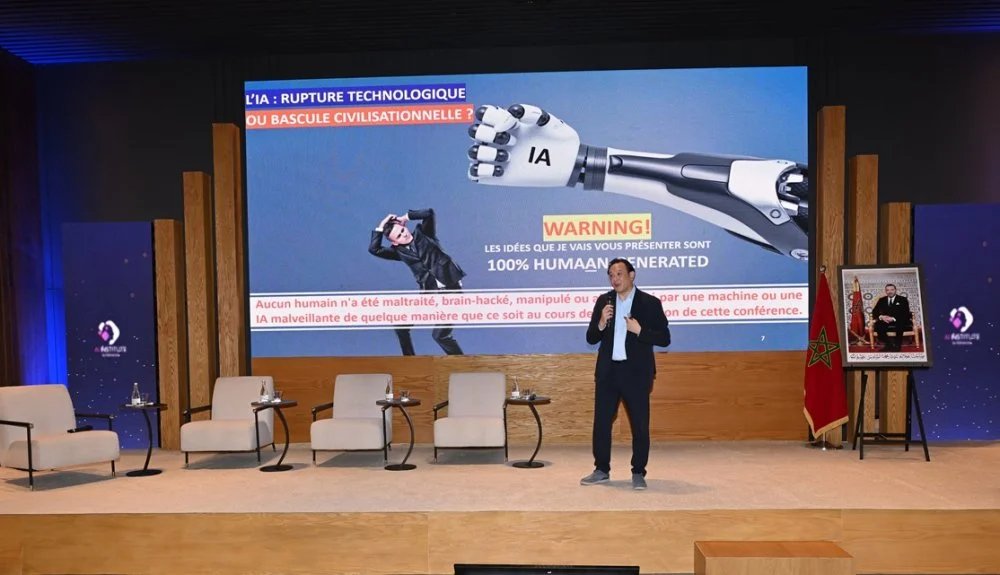
It is this reading that crossed the 3rd edition of the AIConference of the AI Institute by Holmarcom, organized this Tuesday in Casablanca around the theme “AI, technological breakthrough or civilizational shift?” “It’s a consciousness-raising conference,” said Karim Chiouar, Managing Director of the Holmarcom Group. “The topic is no longer just how to write faster, automate tasks or improve productivity. It’s about understanding how artificial intelligence changes the way you run a business, protect your data, train your teams, innovate and create value,” he explained. For the manager, this reflection directly involves Moroccan companies, called not to submit to models designed elsewhere, but to build uses capable of serving their own economic, organizational and strategic priorities.
Big Tech, data and dependence, the real risk for Moroccan companies
Guest of honor of this edition, Không-Lô Pham, expert in strategy, leadership and artificial intelligence, gave the debate its most critical dimension by refusing to lock AI into the comfortable register of productivity gains. “I think we need to reverse the terms of the chosen theme. What we are experiencing is not a technological shift and a civilizational shift…It is a technological shift and a civilizational shift,” he declared. In other words, the main shock does not come only from the power of the algorithms, but from the way in which these tools modify human behaviorlearning, idea production, corporate memory and decision-making.
For the expert, AI no longer only automates repetitive or technical tasks. It is now involved in activities which until now fell within the scope of human intelligence, such as writing a report, preparing an analysis, making a recommendation, summarizing a meeting, producing a strategic note or helping to arbitrate a decision. This development forces managers to look at AI as an organizational subject and not as a simple IT tool, because a company is not only valuable by the speed of its processes, but by the quality of its collective judgment, the depth of its expertise and the capacity of its teams to produce useful ideas.
It is precisely on this point that Không-Lô Pham warns against the illusion of understanding that AI produces. “An AI cannot have consciousness,” he recalled, while emphasizing that it remains “a simulacrum of conscience”. The machine can generate a fluent response, a well-structured note, or a seemingly compelling analysis, but it doesn’t understand the human, economic and social context in which this production will be used. According to the expert, the danger is that this ability to produce credible answers creates excessive confidence in systems which bear neither responsibility, nor judgment, nor experience in the field. A company can then end up confusing a relevant answer with a correct decisionwhile the second requires an understanding of the context, risks, objectives and impacts that no model can assume in place of a human.
The expert’s strongest warning concerns the ability of employees to continue to think for themselves in an environment where automatic response becomes permanently available. “The greatest danger for humanity is not technological or economic, but that humans lose his ability to generate ideas on his own“, he warned. In the company, this risk appears when employees get into the habit of asking the AI to search, write, summarize, compare or argue for them, with an immediate saving of time but a possible loss of critical thinking, memory, creativity and intellectual effort.
The expert describes this phenomenon as “cognitive defeat”. The expression is harsh, but it highlights a risk that companies may underestimate. An organization can produce more documents, accelerate its deliverables and streamline its presentations, while gradually weakening the quality of the thinking that informs its decisions. The texts become cleaner, the summaries faster, the analyzes more homogeneous, but the ideas can lose their singularity, their grounding and their capacity to open up real strategic options. AI then becomes an intellectual shortcut instead of being a tool for improving skills, he summarizes.
This warning joins the paradox that the expert summarizes with the formula “high adoption, low transformation”. Many companies are adopting AI, increasing tests, equipping teams and communicating about their uses, without always transforming their model in depth. For Moroccan managers, the question is therefore not how many employees use AI, but what these uses really change in the quality of service, cost control, risk management, innovation, customer knowledge, compliance and decision-making capacity. “A company does not transform because it uses AI, but when it improves a profession, strengthens a skill or creates measurable value,” he recalls.
Morocco faces the risk of remaining a client of the intelligence of others
“Tomorrow’s order is data”, said the expert, making data control the heart of the battle for businesses. The same generative tools will be accessible to everyone, but not all companies will have the same data, the same know-how, the same business memory or the same ability to transform these assets into operational intelligence. A bank, an insurance company, a factory, a distribution group, a media or a service company can use the same AI models, but the difference will be in their ability to transform their own data into value, he explains.
This question takes on a geopolitical significance when Không-Lô Pham recalls that “AI is being played out without us” and that it remains concentrated in the hands of “a handful of Big Tech”. Speaking of Morocco, the expert believes that the risk for national companies is not only to use tools designed elsewhere, but to become dependent on platforms that control models, infrastructures, standards, costs and part of the value produced by the data. For him, building clean uses does not mean competing with global giants, but building solutions adapted to businesses, languages, customers, risks and local constraints.
“The real rupture will therefore not be between those who love AI and those who hate it, because she is already therein the present and in the future of the economic world. It will be played out between companies which will remain clients of the intelligence of others and those which will have the courage to build their own,” concludes the Vietnamese expert.