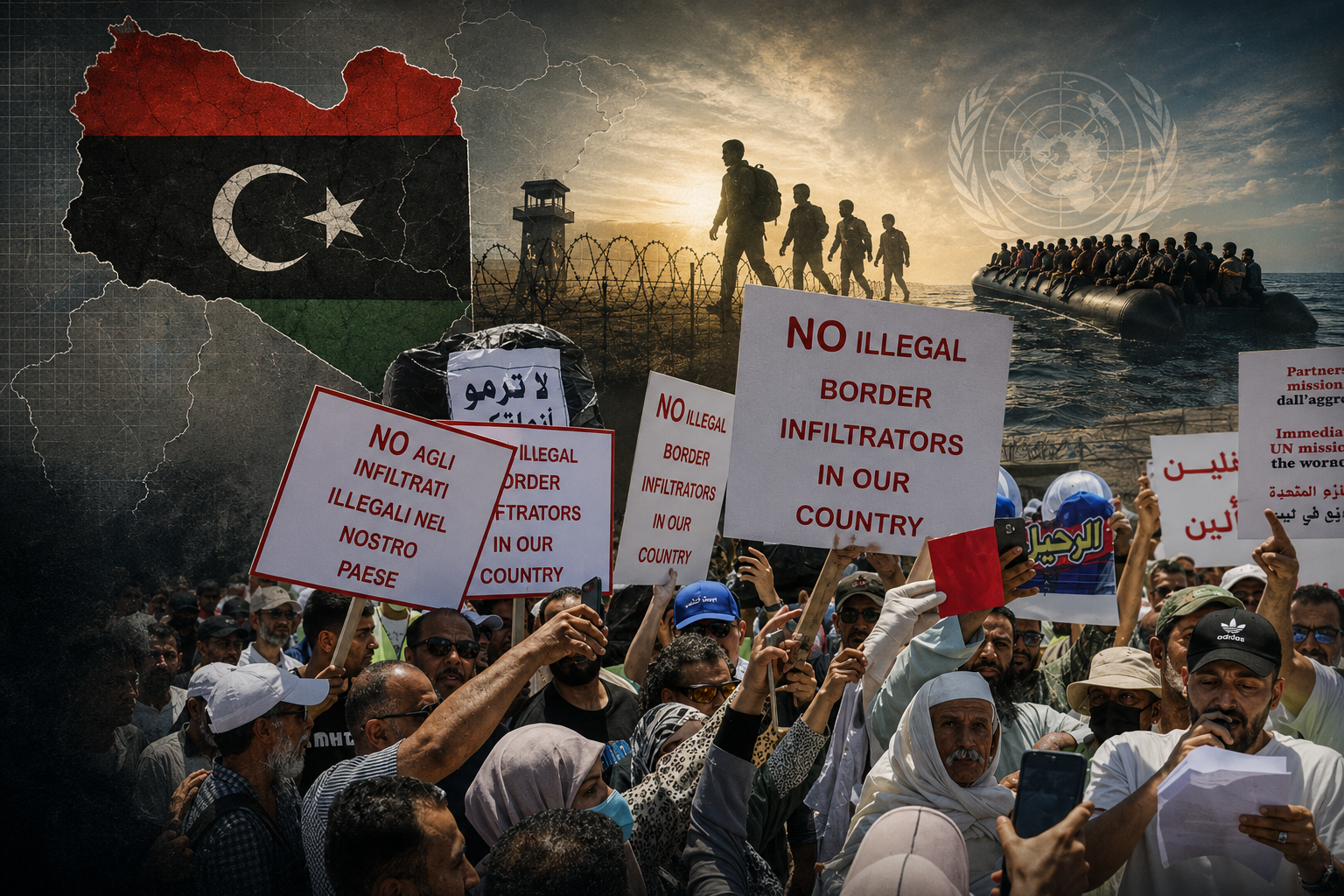
The images emerging from Tripoli in early June appeared straightforward enough. Protesters gathered outside the offices of international organizations, carried banners rejecting settlement projects, and demanded the closure of institutions they accused of facilitating the long-term presence of migrants in Libya. The slogans were simple: no to settlement, no to demographic change, and no to turning Libya into a destination for migrants. Yet the protests that unfolded in the capital were about far more than migration.
At their core, they reflected a deeper anxiety that has been building across Libya for months: the fear that the country is gradually losing control over one of the most fundamental functions of any sovereign state; the ability to determine who enters its territory, who remains within its borders, and what demographic future awaits its people.
This anxiety did not emerge suddenly. Nor was it created solely by recent events. Rather, it is the product of a long accumulation of frustrations linked to state weakness, political division, uncontrolled borders, regional instability, and declining trust in institutions.
Migration merely became the vessel through which these broader fears found expression.
The demonstrations that erupted in June represent the latest chapter in a debate that has gradually moved from the margins of Libyan politics to its very center. What began as discussions about border security and human trafficking has evolved into a broader conversation about sovereignty, identity, demographics, and the future of the Libyan state itself.
Understanding the current moment therefore requires moving beyond the slogans and examining the different fears, perceptions, and political realities that have converged to produce one of the most emotionally charged debates Libya has witnessed in recent years.
The three streams of anger
Although the demonstrations appeared united under the banner of rejecting settlement, they were in fact driven by three separate but increasingly interconnected concerns.
The first concerns the settlement of foreigners in Libya more broadly.
For many Libyans, the issue is not limited to migration statistics or humanitarian policy. It touches directly upon questions of identity, national cohesion, and the country’s long-term demographic balance. In a state whose population remains relatively small compared to its vast geography, demographic questions have historically carried political sensitivity. As migrant communities became more visible across major cities over the past year, concerns regarding permanent demographic transformation became increasingly common within public discourse.
The second and more prominent stream focuses on the settlement of illegal migrants. Here, terminology itself becomes politically significant.
International organizations generally describe the phenomenon through terms such as migrants, refugees, asylum seekers, and irregular migrants. Many Libyans reject this language and instead describe the situation as illegal migration, arguing that large numbers of migrants entered Libya through unauthorized border crossings facilitated by smuggling and trafficking networks operating across southern borders with Chad, Sudan, Niger, and other neighboring states.
For these citizens, the issue is not primarily humanitarian. It is fundamentally a question of sovereignty.
The distinction matters because it reflects two different understandings of the same reality. International organizations tend to focus on protection and humanitarian obligations. Large segments of Libyan society focus on border control and state authority. As a result, the two sides often speak past one another.
The third stream emerged from outside Libya entirely. The war in Gaza reignited fears throughout the Arab world regarding possible scenarios involving the displacement of Palestinians from their homeland. Although no official proposal involving Libya has emerged, discussions surrounding population transfers, humanitarian corridors, and post-war arrangements generated widespread concern across the region.
Within Libya, these fears merged with existing anxieties regarding migration and demographic change.
Consequently, many protesters came to view migration, settlement, and Palestinian displacement through a common lens: the fear that demographic changes could be imposed from outside, regardless of the wishes of the populations affected.
What makes the current protests politically significant is not the existence of these three concerns individually. Each has existed in some form for months.
What is new is that they have fused into a single narrative.
Within that narrative, illegal migration, international organizations, European migration policies, Palestinian displacement, and foreign influence are increasingly viewed as interconnected components of the same challenge.
Whether that perception accurately reflects reality is a separate question.
Politically, what matters is that a growing number of Libyans believe it does.
How the settlement narrative emerged
To understand why this narrative gained such traction, it is necessary to examine the sequence of developments that gradually transformed migration from a policy issue into a national political cause.
The process accelerated during the summer of 2025. Migration had long been present in Libya, but public discussion increasingly shifted from questions of border management toward broader concerns regarding demographics and identity. As migrant populations became more visible in urban areas, concerns regarding the state’s ability to regulate entry, residency, and employment became more pronounced.
At roughly the same time, European migration policies were receiving growing attention inside Libya.
Cooperation between European governments and Libyan authorities regarding migration management, border control, and Mediterranean crossings reinforced a perception among many Libyans that Europe was primarily interested in preventing migrants from reaching European shores.
This perception gradually evolved into a broader suspicion. Many citizens began asking whether Libya was being transformed into a buffer zone protecting Europe from migration flows originating elsewhere.
Whether justified or not, this perception became increasingly influential. The Gaza war introduced an entirely new dimension.
As discussions spread across the region regarding possible displacement scenarios involving Palestinians, fears emerged that Arab countries could eventually be asked to absorb populations displaced by conflict. Although no official plan involving Libya materialized, the broader regional atmosphere contributed to the growth of demographic anxieties already present inside the country.
Then came the controversy surrounding discussions in the United States regarding third-country deportation arrangements.
Reports that Libya had been considered among potential destinations for deported migrants generated widespread backlash across Libyan political and social circles. Although Libyan authorities rejected such proposals and no arrangement was implemented, the controversy proved politically significant.
For many citizens, the issue was not whether a deal actually existed. The issue was that Libya’s name could even appear in such discussions.
To many, this reinforced a perception that foreign powers viewed Libya not as a sovereign state capable of determining its own migration policies, but as a space available for the relocation of unwanted populations.
The symbolism of the controversy proved more powerful than its practical implications.
By early 2026, migration had become one of the most discussed issues across Libyan social media platforms.
Videos, demographic projections, allegations concerning international organizations, discussions about European migration policies, and fears regarding settlement spread rapidly across Facebook, TikTok, Telegram, and other platforms.
Some of these discussions were grounded in documented developments. Others relied upon speculation. Still others consisted of misinformation or unverified claims. Yet together they produced the same outcome: migration became emotionally charged.
The distinction between documented facts, political fears, rumors, and conspiracy theories gradually became blurred.
When demonstrations finally erupted in June 2026, they represented not the beginning of a political movement but the culmination of one.
The streets simply gave physical form to a conversation that had already been unfolding online for months.
Why the narrative became powerful
The most important analytical question is not why migration became controversial. Migration has been controversial in Libya for years. The more important question is why this particular narrative became so powerful now.
The answer lies in the convergence of several crises at the same moment. The first is a crisis of trust.
After years of political division, competing governments, institutional fragmentation, and unfulfilled promises, public confidence in official institutions has eroded significantly. When trust declines, official statements lose much of their persuasive power.
This helps explain why repeated denials from international organizations regarding alleged settlement projects have failed to calm public concerns.
The issue is no longer information. The issue is credibility.
The second is a crisis of sovereignty. For many Libyans, migration has become a symbol of a larger problem.
Every unauthorized border crossing, every smuggling route, every report concerning migrant arrivals is interpreted through the lens of state weakness.
Migration therefore functions as a visible reminder of the state’s inability to exercise full control over its territory.
The third is a crisis of identity. Libya’s relatively small population, vast territory, and prolonged political instability have made demographic questions particularly sensitive. As migration becomes more visible, questions regarding national identity, social cohesion, and the country’s future demographic composition become increasingly prominent.
These concerns are emotional rather than statistical. That is precisely why they possess such political power. Finally, there is a crisis of state capacity.
The migration debate increasingly exposes the absence of a comprehensive national migration strategy capable of balancing border security, labor market needs, humanitarian obligations, and national sovereignty.
In the absence of such a framework, migration becomes a vacuum into which fears, rumors, political agendas, and genuine public concerns are all projected simultaneously.
This is why the current protests cannot be understood simply as a reaction to migrants.
Nor can they be dismissed as the product of misinformation alone. They are better understood as a manifestation of deeper anxieties concerning the state itself.
Migration became the trigger. The underlying concerns were already there. Thus, until those concerns are addressed, the controversy surrounding settlement, migration, and demographic change is likely to remain one of the defining political issues shaping Libya’s next phase.
The battle over language
One of the most overlooked aspects of the current controversy is that it is not merely a dispute over migration. It is also a dispute over language.
The words used to describe the phenomenon have themselves become part of the political battle.
International organizations generally rely on terms such as “migrants,” “refugees,” “asylum seekers,” and “irregular migrants.” These classifications are rooted in international law and humanitarian frameworks designed to distinguish between different categories of people on the move.
Many Libyans, however, reject this terminology.
For a growing segment of public opinion, the phrase “irregular migration” appears disconnected from the reality they observe on the ground. They argue that large numbers of migrants entered Libya through unauthorized border crossings facilitated by organized smuggling and trafficking networks operating across vast stretches of largely uncontrolled territory.
From this perspective, the issue is not primarily administrative or humanitarian. It is legal and sovereign.
This disagreement over terminology reveals a deeper disagreement over the nature of the problem itself.
International organizations often approach migration through the lens of protection, humanitarian assistance, and human rights obligations.
Many Libyans approach it through the lens of border control, state authority, national security, and demographic stability.
Both perspectives contain elements of truth. Libya is simultaneously a country confronting large-scale unauthorized migration and a country hosting individuals who may be victims of war, persecution, trafficking, poverty, or displacement.
The challenge is that public debate increasingly leaves little room for nuance. As polarization grows, competing sides often reduce a complex reality into simplified narratives.
On one side, all migrants become victims. On the other, all migrants become threats. Neither description accurately reflects reality.
The battle over terminology therefore matters because it shapes how the public understands the issue and how policymakers respond to it.
Words are not merely descriptive. They influence political outcomes.
Who is driving the debate?
The speed with which the anti-settlement movement expanded raises an important question: who is driving the debate?
The answer is more complicated than many assume. The first driver is ordinary public anxiety.
A common mistake in political analysis is to assume that every mass movement must originate from organized political manipulation.
While political actors may seek to benefit from the current protests, there is little doubt that genuine concerns exist among large segments of the population.
Migration has become increasingly visible. Public trust in institutions remains weak. Economic conditions remain challenging. Border security remains fragile. These realities create fertile ground for public mobilization even without centralized direction.
The second driver is political opportunism. Migration possesses characteristics that make it particularly attractive to political actors.
Unlike constitutional disputes, budget negotiations, or institutional reforms, migration can be understood instantly by a broad audience.
It is emotional. It is visual. It is easily connected to questions of identity and sovereignty.
Consequently, political actors across the spectrum may find it advantageous to position themselves as defenders of national interests against perceived external threats.
This does not necessarily mean they created the movement. It means they may seek to capitalize on it.
The third driver is social media. The current mobilization illustrates how political narratives increasingly develop outside traditional institutions.
Facebook pages, Telegram channels, TikTok videos, online campaigns, and viral content have become central mechanisms for shaping public opinion.
In many cases, social media did not simply report the migration debate. It accelerated it.
Content designed to provoke fear, anger, or outrage often spreads more rapidly than nuanced analysis or verified information.
As a result, emotional narratives frequently gain visibility faster than factual corrections.
The fourth driver is regional instability. The war in Sudan, instability across the Sahel region, persistent migration pressures across North Africa, and the continuing consequences of the Gaza conflict have all contributed to an environment in which migration occupies a central place within public debate.
These developments are external to Libya. Yet their effects are felt within Libya’s borders.
Finally, international organizations themselves have become actors within the debate, even if unintentionally.
UN agencies, humanitarian organizations, and international institutions operate within a political environment characterized by deep mistrust.
Consequently, even activities intended as humanitarian interventions are frequently interpreted through a political lens.
The issue is not merely what these organizations do. It is how their actions are perceived.
In highly polarized environments, perception can become politically as significant as reality.
Separating facts, fears, and rumors
No serious analysis of the current crisis can avoid a difficult but necessary task: distinguishing between what is known, what is feared, and what remains unproven.
The first category consists of established facts. There is little dispute that Libya faces significant migration pressures.
According to the International Organization for Migration, more than 900,000 migrants were present in Libya during the first months of 2026.
There is also little dispute that many migrants enter Libya through unauthorized routes facilitated by smuggling networks operating across southern borders.
Nor is there serious dispute that Europe has invested considerable resources in migration management and border-control cooperation designed to reduce Mediterranean crossings. These realities are documented and widely acknowledged.
The second category consists of legitimate fears. Many Libyans genuinely worry about the long-term implications of uncontrolled migration for security, labor markets, public services, social cohesion, and demographic stability.
These concerns should not be dismissed simply because they are difficult to quantify. Political realities are often shaped as much by perceptions as by statistics. A fear does not become illegitimate merely because it cannot be measured precisely.
At the same time, fears are not automatically evidence. This distinction is essential. The third category consists of claims that remain unproven.
The most prominent example concerns allegations that international organizations are implementing a deliberate project aimed at permanently settling migrants inside Libya.
Despite the widespread circulation of such claims, publicly available evidence supporting the existence of such a policy remains limited.
International organizations have repeatedly denied that any settlement project exists, arguing that their activities focus on humanitarian assistance, voluntary return programs, evacuation initiatives, and protection mechanisms.
Whether these explanations satisfy public concerns is a separate question. Analytically, however, the distinction between documented policy and public suspicion must be maintained.
The same applies to claims concerning the relocation of Palestinians to Libya. Although fears regarding displacement intensified following the Gaza war, no publicly documented plan involving Palestinian resettlement in Libya has emerged.
Again, this does not eliminate public concern. It simply places it within the category of fear rather than established fact.
The challenge facing Libya today is that these three categories; facts, fears, and rumors; are increasingly merging within public discourse.
Migration statistics become mixed with demographic projections. Documented developments become intertwined with speculation. Legitimate concerns become combined with unverified claims.
Once these boundaries disappear, rational debate becomes increasingly difficult. This may ultimately be one of the most important lessons of the current crisis. The issue confronting Libya is not merely migration.
It is the difficulty of conducting a national conversation in an environment where trust is low, information is contested, and emotions often move faster than evidence.
Understanding this reality does not resolve the controversy. But it does provide a clearer framework for understanding why the controversy has become so powerful.
The contradiction nobody discusses
For all the intensity surrounding the migration debate, one aspect of the issue is rarely discussed openly.
Libya fears migration. Libya also depends on migrants. Both statements are true.
Over the past decade, migrant labor has become deeply embedded within important sectors of the Libyan economy. Construction sites, agricultural projects, transportation services, cleaning companies, workshops, retail businesses, and countless informal economic activities rely heavily on migrant workers.
In many cities, migrants perform jobs that would be difficult to fill quickly through the domestic labor market alone. This reality creates a fundamental contradiction.
Public discourse increasingly portrays migration as a threat, while significant parts of the economy continue to benefit from migrant labor.
Political actors condemn illegal migration, while businesses continue to employ migrants.
The state speaks of border control, while the informal economy absorbs large numbers of migrant workers. The contradiction extends beyond Libya.
European countries that seek to reduce migration flows also depend on migrant labor across numerous sectors of their own economies. Throughout the Mediterranean region, governments attempt to manage migration while simultaneously benefiting from the economic contributions of migrants already present.
Libya is not unique in this regard. What makes the Libyan case different is the weakness of the institutions responsible for managing the phenomenon.
In countries with functioning migration systems, governments establish clear distinctions between legal employment, border enforcement, residency regulations, labor-market needs, and asylum procedures.
Libya lacks many of these mechanisms. As a result, migration is often discussed as a single issue when it is, in reality, several different issues unfolding simultaneously.
This distinction matters because effective policy cannot be built upon slogans alone.
Rejecting illegal migration is one question. Managing labor-market realities is another.
The current debate often merges both into a single conversation, making practical solutions more difficult to identify.
When sovereignty fears become social hostility
Every migration debate contains a danger. The danger emerges when opposition to policies becomes opposition to people.
Throughout modern history, periods of heightened anxiety surrounding migration have often produced a shift from political disagreement to social hostility. What begins as a discussion about borders, laws, and state policy gradually evolves into suspicion directed at individuals.
Libya now faces that risk. The vast majority of protesters appear motivated by concerns relating to sovereignty, demographics, security, and migration policy.
Yet alongside these concerns, a more troubling phenomenon has begun to emerge. Reports of harassment, intimidation, forced evictions, arbitrary actions against migrants, and inflammatory rhetoric targeting African communities have increased in recent weeks. Human rights organizations have documented incidents involving physical assaults, verbal abuse, and collective hostility directed at migrants solely because of their nationality or appearance.
Such developments reveal an important distinction that must be preserved. A state may oppose illegal migration. A society may debate immigration policy. Citizens may criticize international organizations.
None of these positions inherently require hostility toward migrants themselves. The challenge arises when complex structural problems become personalized.
Migration is driven by factors extending far beyond Libya’s borders: conflict, poverty, political instability, trafficking networks, environmental pressures, and economic disparities stretching across multiple regions.
Individual migrants did not create Libya’s migration policy. Nor did they create the institutional weaknesses that allowed the current situation to emerge.
When public anger shifts from institutions toward vulnerable individuals, the debate enters dangerous territory. This is particularly sensitive in Libya because much of the current hostility has been directed toward African migrants.
The racial dimension of the debate risks creating divisions that extend far beyond migration itself. A discussion that begins with sovereignty can gradually transform into one involving race, identity, and social exclusion.
Such transformations rarely strengthen states. More often, they deepen instability and weaken social cohesion. This does not mean public concerns should be ignored.
Quite the opposite. Legitimate concerns are best addressed through law, institutions, and policy.
When concerns are not addressed through these channels, they often reappear in more emotional and potentially more destructive forms.
The challenge facing Libya is therefore not simply how to manage migration. It is how to prevent a migration debate from becoming a broader social conflict.
The missing state
At the center of the current controversy lies a reality that receives far less attention than migrants, international organizations, or social media campaigns.
The central issue is the state itself. Migration is not the root cause of Libya’s current crisis. Migration is the symptom.
The controversy surrounding settlement, demographics, and sovereignty has become so powerful because it exposes a deeper problem that has remained unresolved for years: the absence of a strong, trusted, and effective state capable of managing competing pressures.
Strong states experience migration. Weak states become consumed by migration. The difference lies not in geography or demographics, but in institutional capacity.
A functioning state knows who enters its territory. It knows who resides within its borders. It knows who is employed, who requires protection, who violates immigration laws, and which policies serve national interests.
Most importantly, it possesses the legitimacy required to convince citizens that these issues are being managed responsibly.
Libya continues to struggle with many of these challenges. Border management remains fragmented. Migration policy remains inconsistent. Institutional responsibilities overlap. Reliable demographic data remains limited. Political divisions complicate implementation. Public trust remains fragile. In such an environment, migration becomes more than a migration issue. It becomes a symbol. Every migrant crossing becomes a symbol of weak borders. Every trafficking network becomes a symbol of weak institutions. Every controversy involving international organizations becomes a symbol of lost sovereignty. Every rumor becomes a reflection of public mistrust.
This helps explain why migration has acquired such extraordinary political significance. The debate is not solely about migrants. It is about what migrants represent.
For many Libyans, they have come to symbolize broader anxieties concerning governance, sovereignty, accountability, and state authority.
Viewed through this lens, the current protests become easier to understand. Citizens are not only expressing concerns about migration.
They are expressing concerns about whether the state remains capable of performing its most basic functions.
This is why migration continues to reappear in public debate despite years of political discussions focused on constitutions, elections, budgets, governments, and institutions.
Migration is visible. State weakness is visible through migration. And until the underlying issue of state capacity is addressed, migration will continue to serve as a mirror reflecting Libya’s deeper political challenges. The controversy may appear to concern migrants. The deeper story concerns the state that is supposed to manage them.
What happens next?
The demonstrations that erupted in June 2026 may eventually fade from the streets. Protest camps may disappear. Social media campaigns may lose momentum. Public attention may shift toward another crisis. That does not necessarily mean the issue itself will disappear.
The forces that produced the current movement are deeper than the protests themselves. Questions surrounding migration, sovereignty, demographics, border control, and state authority are likely to remain part of Libya’s political landscape for years to come.
The important question is therefore not whether the controversy will continue. The question is how it will evolve. Several scenarios are possible.
Scenario I: Containment and institutional management
The most stable outcome would involve transforming the current controversy from a street movement into a policy debate.
Under this scenario, Libyan authorities would seek to address public concerns through a clearer migration strategy, improved border management, greater transparency regarding international agreements, and more effective communication with citizens.
International organizations would also face pressure to explain their activities more clearly and engage more directly with public concerns regarding migration and sovereignty.
The debate would remain intense. But it would increasingly take place within institutional frameworks rather than through mobilization and confrontation. This would not eliminate disagreement.
It would simply channel disagreement into more predictable political processes. For Libya, this would represent the least disruptive path forward.
Scenario II: Permanent political mobilization
A second possibility is that migration becomes a permanent organizing issue within Libyan politics. Under this scenario, anti-settlement campaigns evolve from a temporary protest movement into a lasting political current.
Migration would increasingly influence political alliances, public discourse, and government decision-making.
Every new migrant arrival, every European migration initiative, every statement by international organizations, and every regional crisis would be interpreted through the lens of migration and demographic change.
In this environment, migration would cease to be a policy issue and become a defining political identity issue. Frankly; this scenario appears increasingly plausible.
Many countries around the world have witnessed migration evolve from a technical policy challenge into one of the central questions shaping national politics. Libya may be moving in a similar direction.
Scenario III: Escalation and polarization
The most dangerous outcome would involve further escalation. Under this scenario, public frustration increasingly targets migrants themselves rather than the policies being debated.
Violence becomes more frequent. Collective blame becomes normalized. Social divisions deepen. International criticism intensifies.
The migration issue gradually transforms from a political controversy into a broader social and security challenge.
Such a development would carry serious consequences not only for migrants but also for Libya itself. Polarization rarely resolves underlying problems. More often, it obscures them.
The danger is that emotional mobilization may create the appearance of action while leaving the structural causes of the crisis untouched.
Migration flow; smuggling networks, institutional weaknesses may continue. The anger grows. The underlying problem remains.
Reality will probably not follow any single scenario exactly. Elements of all three may emerge simultaneously. Some institutional reforms may occur. Political actors may continue mobilizing around migration. Periods of escalation may be followed by periods of calm.
The issue is unlikely to disappear because the conditions that produced it remain unresolved.
As long as these conditions persist, migration will remain one of the most politically sensitive subjects in Libya.
The current protests may therefore be less important as an isolated event than as a signal of broader political trends that are still unfolding.
Libya and the unfinished state
At first glance, the protests in early June 2026 appeared to be about migrants. Protesters spoke about settlement. They spoke about demographics and sovereignty, as well as international organizations.
Yet reducing the movement to migration alone risks missing its deeper significance.
The demonstrations revealed something larger. They revealed a society attempting to answer questions that have remained unresolved for more than a decade.
Who controls Libya’s borders? Who defines Libya’s national interests? Who decides which international arrangements are acceptable.. and who possesses the authority and legitimacy to speak on behalf of the state?
Migration became the issue through which these questions surfaced. But migration is not their source. The source lies in the unfinished project of state-building itself.
For years, Libya’s political debate has revolved around rival governments, delayed elections, unfinished constitution, split institutions, and power-sharing arrangements.
The migration controversy demonstrates that beneath these discussions lies a more fundamental concern. Many citizens are not simply searching for policies. They are searching for reassurance.
They want evidence that the state is capable of protecting its borders, enforcing its laws, managing external pressures, and determining its own future. This helps explain why migration has become such a powerful political symbol.
The danger here is that migration may become a substitute for addressing deeper structural problems. It is easier to debate migrants than to reform institutions. It is easier to mobilize around fears than to build policy. Yet Libya’s future will ultimately depend on its ability to address those causes.
The current protests may therefore be remembered as more than a migration controversy. They may come to represent a moment in which a debate about borders evolved into a debate about the state itself.
Because beneath the arguments over settlement, migration, demographics, and international organizations lies a simpler question; one that has shaped much of Libya’s post-2011 history.
Can Libya build a state that its citizens trust?
Until that question is answered, migration will remain not only a policy challenge, but a mirror reflecting Libya’s larger struggle with sovereignty, legitimacy, and statehood.