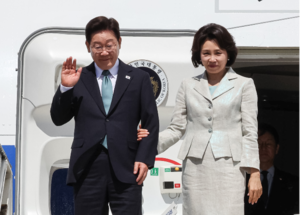
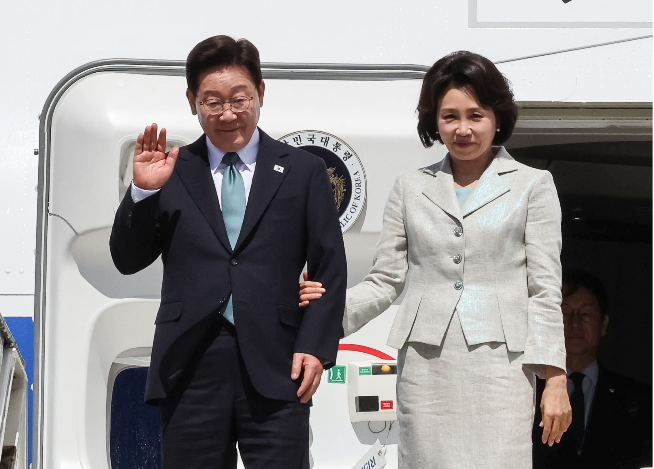
President Lee Jae Myung and Belgian Prime Minister Bart De Wever agreed Wednesday to deepen bilateral cooperation in strategic industries, trade and investment, with a particular focus on battery materials, energy and small and medium-sized enterprises, as the two countries mark their 125th anniversary of diplomatic relations, South Korea’s presidential office said.
During their summit in Brussels, Lee said it was particularly meaningful to visit Belgium in the milestone anniversary year during his first European tour since taking office, presidential spokesperson Kang Yu-jung said in an afternoon briefing. De Wever, in turn, said he was pleased to welcome Lee as the two countries celebrate more than a century of friendship.
According to Kang, the two leaders also positively assessed the 15th anniversary of the South Korea-European Union Free Trade Agreement and agreed to further strengthen economic and trade cooperation.
The two sides pledged to encourage greater investment by companies from both countries, particularly in battery materials and the energy sector, while seeking to elevate such cooperation into strategic industries.
They also welcomed the signing of a memorandum of understanding on cooperation between SMEs and startups during Lee’s visit. The agreement is intended to strengthen communication and collaboration between SMEs while allowing South Korea and Belgium to serve as mutually supportive gateways for each other’s businesses entering overseas markets.
The leaders further agreed to explore ways to resume direct flights between South Korea and Belgium in an effort to facilitate people-to-people exchanges.
Lee highlighted that more than 120 South Korean researchers are currently working with Imec, Belgium’s world-renowned semiconductor research institute, on nano-semiconductor technologies, expressing hope that bilateral research cooperation would continue to expand so that both countries could jointly benefit from future advances in semiconductor technology.
De Wever replied that closer cooperation with South Korea, home to some of the world’s leading semiconductor companies, would benefit Belgium, as he pledged to support stronger collaboration.
Lee also expressed gratitude for Belgium’s contribution during the 1950-53 Korean War, noting that the country’s deployment of combat troops in defense of freedom and peace helped lay the foundation for South Korea’s rise into one of the world’s leading economies. De Wever responded that the historical bond forged between the two countries remains a solid basis for bilateral relations and reaffirmed Belgium’s commitment to contributing to peace and stability on the Korean Peninsula.
Kang described the meeting as “a meaningful opportunity to build rapport between the two leaders and share a long-term vision for bilateral cooperation” on the occasion of the 125th anniversary. She added that the summit was expected to “lay the groundwork for expanded economic cooperation and mutual market access with Belgium, a key logistics hub in Europe, and create new momentum for bilateral relations.”
The Belgium summit marked the first summit-level engagement between the Lee administration and the Belgian government and formed part of Lee’s 10-day European tour ahead of the Group of Seven summit in France.
Later Wednesday, Lee was scheduled to hold summit talks with European Council President Antonio Costa and European Commission President Ursula von der Leyen during the first bilateral visit by a South Korean president to the European Union headquarters in eight years.
According to Kang, the EU summit was to cover cooperation in security and defense, trade, climate policy, renewable energy, digital technologies and advanced science, as well as regional issues including developments on the Korean Peninsula and in the Middle East.
She said Seoul planned to convey its position that EU regulatory measures, including steel tariff quotas and the Carbon Border Adjustment Mechanism, “should not become trade barriers” despite their stated objectives of enhancing competitiveness and addressing climate change, while seeking close consultations with Brussels on those issues.
The two sides were additionally expected to reaffirm the importance of a rules-based international order, multilateralism and free trade amid growing geopolitical uncertainty and discuss ways to strengthen coordination as like-minded partners.
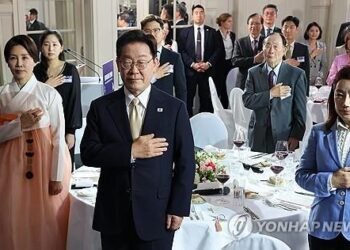
Shortly after arriving in Brussels, Lee had dinner with members of the South Korean community in Belgium, whereupon he stressed the importance of restoring the country’s international standing.
“People often become more patriotic when they live abroad,” Lee said. “They pay closer attention to issues back home, and because they are inevitably compared with others, the way they are treated often depends on their home country’s standing and credibility.”
“You have probably felt this very acutely over the past two or three years,” he continued. “That is why the home country must do well. I believe overseas Koreans should be able to take pride in South Korea.”
His remarks appeared to reference the political turmoil South Korea experienced over the past several years, including the declaration of martial law in December 2024 under the previous administration, the impeachment of former President Yoon Suk Yeol and the subsequent launch of a new government.
Lee pledged continued support for overseas Koreans, saying the government would help them achieve their goals through policy measures.
Belgium is home to roughly 5,000 South Korean nationals and people of Korean descent, according to the presidential office. The visit coincides with the 125th anniversary of diplomatic relations between South Korea and Belgium.
mkjung@heraldcorp.com