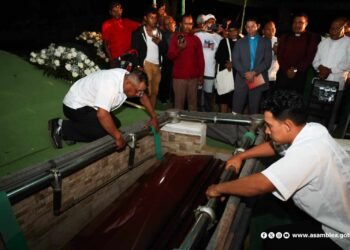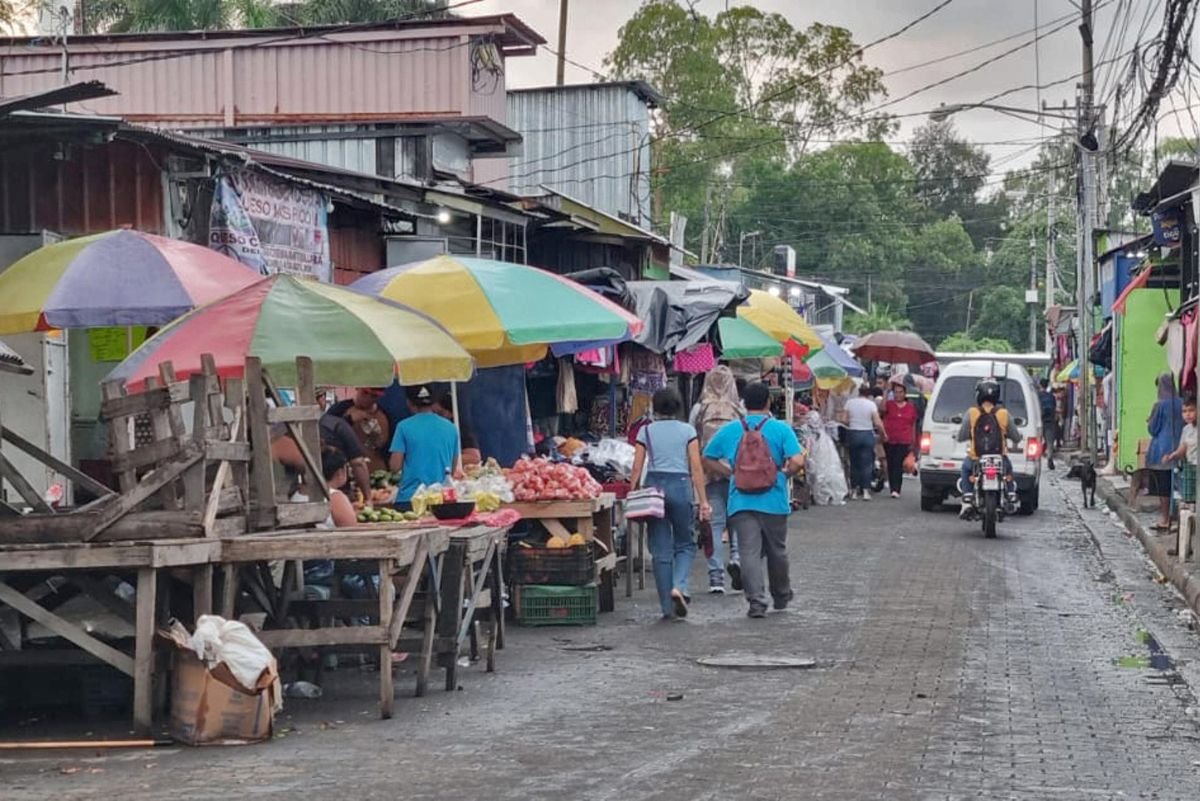
The cruel death of Brooklyn Rivera, a missing political prisoner, raises a debate between information and truth that denounces the banality of evil, and the force of censorship and misinformation that tries to blind a generation that sees more on one side than the other: a reality that, for them, may be more important than ‘the political’ and that, at least, resolves their existential anxieties on a daily basis.
However, there are ways to come back to reality and reflect.
The banality of evil under Murillo
There is a mixture of censorship and ignorance, perhaps a convenient or primordial disinterest in the almost automatic preservation of life, and there is also indifference; It is undeniable no matter how much one wants to avoid saying it.
Conversations with ordinary people are a mixture of dissonant exchanges, without consensus, and the conclusion is that there is little information input and little capacity for interpretation. The taxi driver tells me,
– “How are you?”
— “Here, terrible with the death of Brooklyn,” I tell him,
— “Ah, yes, I saw something…”, meanwhile, another tells me:
— “No one knows that he died, only that he is bedridden.”
Another who works for an ‘independent’ channel tells me,
— “Yes, I noticed,”
— “Terrible how they killed him,” I tell him. And he answers me:
— “How so? If he left because he was old.”
I pass on the international and Confidencial news and 100%…no response. Silence—you are afraid that your own coworkers will notice that you are reading news on your phone.
Another who is informed through various sources tells me:
— “Yes, we saw, this is out of control,” while another tells me:
— “The story they are selling here is that he died of old age, and was going to die of cirrhosis.”
Self-censorship predominates and there is no clarity about the facts either.
People fall on a spectrum of limited information, misinformation, and political risk for those who try to get well informed.
People face the banality of evil, a situation in which the evildoer normalizes his actions, manufacturing an everyday world while hiding the horrors of his torture, while Rosario Murillo maintains a country cornered by cruelty and poverty.
Some people in Nicaragua do not notice the news, or they know little about what is happening in the country, censorship limits the possibility of obtaining information, or they have to make a great effort to read, at their own risk and expense.
The mixture of lack of access to information, censorship and ‘miseducation’ has become a lethal weapon of the dictatorship against political resistance in the country.
The challenges of knowing what is happening
Certainly, one lives with half or no knowledge. There is not a single piece of information that everyone views with the same agreement, as truthful: if so-and-so is dead, injured or dancing, or if so-and-so is out of the country, kidnapped or in nothing. The same thing happens with the cost of living and employment: people believe that only they are wrong.
Furthermore, few want to know about politics, and there are three reasons to highlight in Nicaragua.
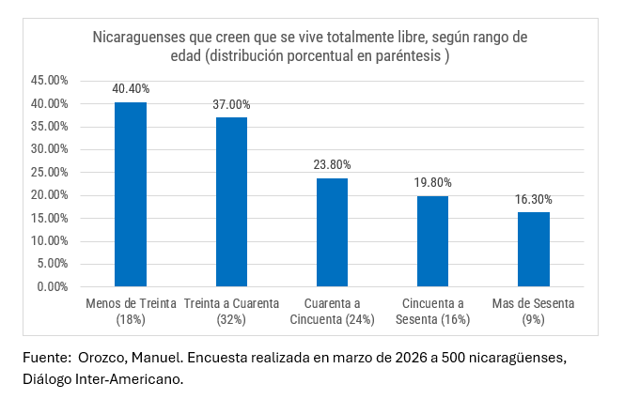
First, it is the generational factor. About 51% of Nicaraguans are under 26 years of age. They have been exposed to the absence of investigative journalism, censorship and miseducation (schools and universities closed, with a drop in university enrollment from 240,000 people in 2018 to 82,000 in 2026). They grow up under information filters, in the hands of censorship and State propaganda.
Furthermore, they belong to a different subculture, which does not prioritize politics or the news (they read little or only scroll through one page after another on Facebook or TikTok), something that is not unique to Nicaragua, but a global phenomenon. In this current era, the idea has been established that showing the personal as a spectacle is essential for its improvement, almost as a replacement for the notion of ‘materialism’, of ‘needing things’, with ‘I need to be seen’. And interest in the news wanes.
This is about integrating work and professional success. The statement is based on a combination of the physical image (almost sexualized) and a scrap of self-help messages a la TikTok or Instagram, with the purpose of presenting yourself as if everything is fine, even though you are screwed.
And there is also the social pressure that you have to be present everywhere, which in English is known as FOMO (Fear Of Missing Out), or fear of missing out on being ‘everywhere’.
The problem is that the value system of the 20th century that reinforced self-esteem fell behind and competed against the speed of change. The generation of the 21st century has found it very difficult to balance certain values (solidarity, tolerance, responsibility, equity, trust, freedom) with the fact of being seen as an independent and self-sustaining individual. They carry so many things, the cost of living and the personal day-to-day responsibilities, that they are five times greater than three decades ago.
Second, there are those who have a general distrust of information, so one chooses their source, regardless of its reputation or validity. It’s also a global trend: less than a third believe the media is important.
Furthermore, there is a wide veil of ignorance of what is happening outside their environment and in the absence of a reliable information filter, they gravitate between the little they find out and disconnecting from the world and what is news. Asking this segment if they know what is happening in Iran, in Costa Rica, or within the country, is like debating the immortality of the crab.
The official media and its propagandists inundate people with false information, such as saying: “Brooklyn died of cirrhosis; sooner or later it was her number.”
And those who are informed are not willing to take a political risk, they realize that there are not many like them who share similar opinions, and it is almost certain that they are taking a risk from someone who can expose them.
Third is the fear and the need to distance oneself from contact with the news as a precaution against attack and repression—that a ‘toad’ blows the whistle that they are being informed. The one who is afraid is that person who has an idea of what Nicaragua is politically and cannot expose himself to having his opinion realized. There is one in three Nicaraguans who is clear about what is happening, and a third more who do not feel completely free to express themselves.
This age group is over 40 years old and has learned to adapt to the police system. But the fear among them is not that of the Police behind them, but that of the neighbor and co-worker, of the salesman who passes by the house, who hears about something inappropriate that is not to the taste of “comrade Rosario.”
The result is a society that is in free fall without knowing it, either because there is a combination of social pressure to appear successful that has them absorbed in a ‘virtual’ life, because they distrust the media and what to do with it, or because of fear itself.
Thus it is difficult to do politics and, even less, to do political resistance.
Even the followers of Sandinismo are afraid to open their mouths because they don’t know what the “chayo” will like.
Is it possible to resist and oppose?
For the political activist in Nicaragua, there are concrete challenges of survival in the face of repression and persecution, of remaining active and in communication with the exiled leadership, and of having political tools at hand to continue in the fight.
For the average Nicaraguan, the challenge is to get them the news that their daily problems are a consequence of the Murillo regime, and to draw its consequences. In conversations with people on the street, they say, “yes, this is the dictatorship’s fault, but I can’t do much alone.” In general, when you add things like toxic, threatening or overwhelming, you end up disconnecting, especially among young people.
The starting point is to improve communication with people and combat the politics of indifference, which constitutes the main victory of the banality of evil. Indifference has two faces: that which calculates the cost-benefit of political sacrifice and that of those who are distracted by the search for an audience. In both cases, political work begins by motivating people to read, inform themselves and distinguish between a legitimate and truthful source and a false one, to help them confront a situation of denial.
It also involves working methodically to show the link between her daily life and the way the dictatorship affects her.
More than seventy percent of Nicaraguans believe that people do not live in freedom in the country or live partially without freedom. Knowing that they are the majority allows them to learn to face that reality. This empowers them, unites them.
But the work is more arduous among the youngest, many who believe that they live in freedom because they have prioritized the life of the show and somehow avoid knowing about politics. With them, we must address their material and emotional reality in relation to politics, to defeat the banality of evil.