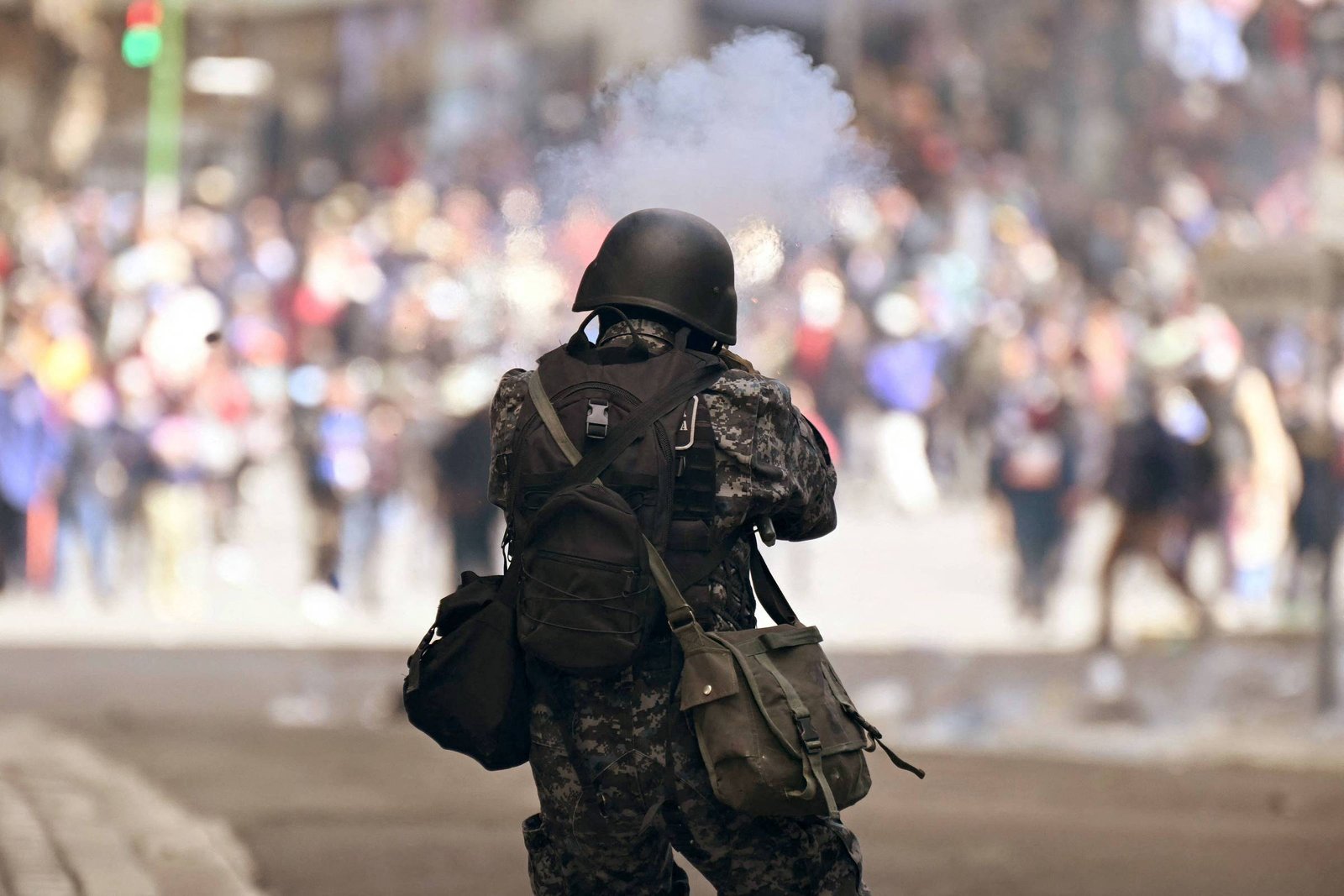
The Congress of Bolivia approved, this Sunday (7), a law that authorizes the president Rodrigo Pazcenter-right, to use the military to unblock controlled roads more than a month ago protesters demanding his resignation.
The Chamber of Deputies approved the text, which had already passed through the Senate, after a 15-hour session. “This law is sanctioned and referred to the Executive Branch for constitutional purposes”, said the President of the House, Roberto Castro.
Peace evaluates declaring a state of exceptiona measure that would expand the government’s powers to employ the Armed Forces and allow restrictions on rights such as freedom of assembly and mobilization, fundamental to the protests. So far, military action has been limited, while police riot police remain on the front line of road clearing operations.
Peasants, miners, transport professionals and other workers are protesting with road blockades across the country amid the worst economic crisis Bolivia has faced in four decades. In response, the president announced the cut your own salary and government ministers.
You lockdowns caused food shortages, medicines and fuels in La Paz, El Alto and other cities. According to the Public Defender’s Office, ten people died as a result of the acts, including some due to lack of medical care caused by the obstructions.
On Saturday (6), riot police officers confronted protesters in the town of San Julián, in the Santa Cruz region, in operation to unlock a strategic route for supplying the country. Agents threw tear gas bombs, and the Protesters responded with sticks and stones.
The confrontation injured more than 20 peopleincluding six police officers, four of whom were shot. Hours later, the local police station was invaded and set on fire. The road was partially cleared, but protesters blocked it again.
One of the articles of the approved law indicates that the military, during the state of exception, “will enjoy the presumption of legality” and that the government must assume its legal defense — a measure that aims to dispel the fear of trials for the use of force in conflict situations.
The most recent precedent dates back to the government of the former right-wing president Jeanine Áñez (2019-2020). At the time, several military commanders were tried and arrested for their role in clashes with civilians after Evo Morales left power. The episodes left more than 30 people dead.
Peace, whose victory at the polls in October 2025 put an end to decades of left-wing dominance in Bolivian politics, faces pressure on multiple fronts. Three ministers — from the Labor, Defense and Education portfolios — left office since the protests began.
At the same time, attempts at dialogue mediated by the Catholic Church, the Public Defender’s Office and Vice President Edmand Lara Montaño failed.
The government holds the former president Evo Morales (2006-2019) for the demonstrations. Evo, hiding in his coca-growing stronghold in Chapare to avoid an order for his capture by accusation of alleged trafficking of a minor —which he denies—, he told the AFP news agency that the protests are a rebellion against a government subordinate to the United States.