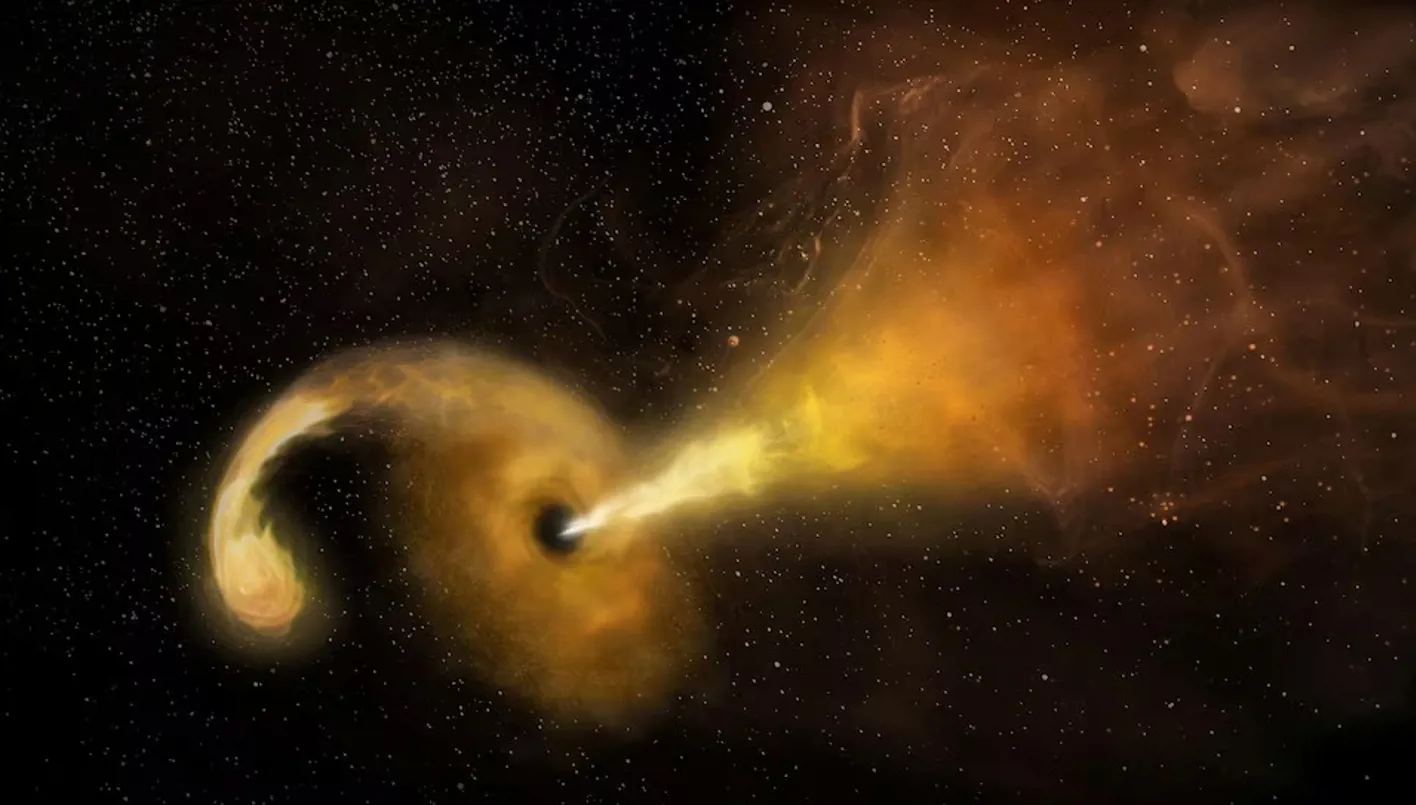
After five decades of attempts, scientists have discovered… Astronomy Finally, the winds emanating from the supermassive black hole located in the center of our galaxy (the Milky Way), although it turned out to be closer to a gentle breeze than a hurricane.
Using data from the ALMA telescope in Chile and the FAA’s Chandra X-ray Observatoryouter space American (NASA), researchers monitored the region surrounding the black hole in space, called Sagittarius A.
Scientists observed a massive conical cavity filled with hot, electrically charged gas next to the black hole, and concluded that it was formed by winds emanating from it that displaced or heated the cold gas that was filling the area. They said that the energy needed to form such a cavity could only be issued by a supermassive black hole.
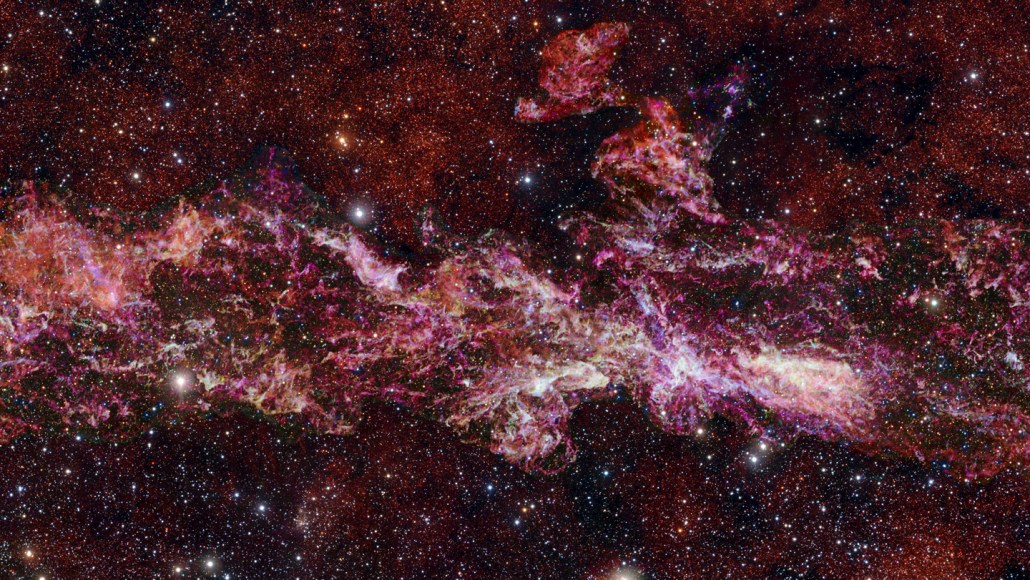
Image published by the ALMA Observatory.
Black holes are ultra-dense objects with such enormous gravity that even light cannot escape from them. Galaxies usually contain a supermassive black hole at their center that attracts gas and other matter around it.
Scientists have assumed for decades that any active supermassive black hole would, by its physical nature, eject some gases and other materials into space, either in the form of outward winds or in the form of a concentrated jet stream. They have subsequently observed this behavior in a number of supermassive black holes in other galaxies, but have not yet been able to prove that Sagittarius A does this as well.
Lena Morchikova, a professor of physics and astronomy at Northwestern University in Illinois, participated in preparing the study, which was published this week in the journal (Astrophysics Letters). “This discovery solves a mystery that has lasted half a century,” she said.
Sagittarius A is about four million times the mass of our Sun, and is located about 26,000 light-years from Earth. A light year is the distance that light travels in one year, i.e. 9.5 trillion kilometers. It is not as massive as some of its counterparts in other galaxies, and scientists said that it is in a stage of relative rest.
The tip of the conical cavity originates from the immediate vicinity of the arch (A) and extends outward. While researchers are still unsure of the cavity’s size because it exceeds their observation range, Murchikova said it may extend to about 6.5 light-years.
Because of Sagittarius A’s current state of rest, the winds it generates are not as intense as those observed with other supermassive black holes.
As it enters a spiral path towards the black hole, the speed of gas and other materials reaches a speed close to the speed of light, which generates enough energy and pressure to throw some of it out.