
The Moldovan authorities are preparing a program for the development of modern and competitive postal services for 2026–2029. According to the Ministry of Economy’s project, it should help create a modern, competitive and accessible postal sector that can support the digital economy, e-commerce and regional development. NM tells why traditional postal services are being reduced, what is happening with the state-owned enterprise Post of Moldova, what measures are proposed by the authorities and how much the implementation of the program will cost.
The market is changing
Authors project write that the postal sector of Moldova is going through a period of transition. It is affected by digitalization, the development of e-commerce, the reduction of traditional postal services and internal structural problems. Among the main challenges, the document cites the decline in traditional postal traffic, dependence on international incoming mail and insufficient availability of modern postal and digital services, especially in villages and among older people.
According to data provided in the program, in 2024 the total volume of postal items in Moldova decreased by 5.7% to 42.9 million. Domestic traffic decreased by 13.5%, international outgoing mail by 66.3%, and international outgoing correspondence by 74.4%.
At the same time, market income, on the contrary, increased: in 2024 they increased by 35.4% and reached 638.2 million lei. The paper explains this as a change in demand. People and businesses are using traditional mail less and less, but they are increasingly sending and receiving parcels. The volume of parcels and small packages in 2024 grew by 25.4% domestically and by 36.2% internationally.
Private operators are growing faster
The program states that the state-owned enterprise Post of Moldova, which is the provider of the universal postal service, remains the main player in the market. In 2024, it accounted for 87.7% of total mail traffic, and revenues grew by 13.9% to 281 million lei. At the same time, private operators are growing faster. For example, New Post International MLD in 2024 increased traffic by 218.3%, to 3.8 million items, and revenues by 120.7%, to 154.5 million lei.
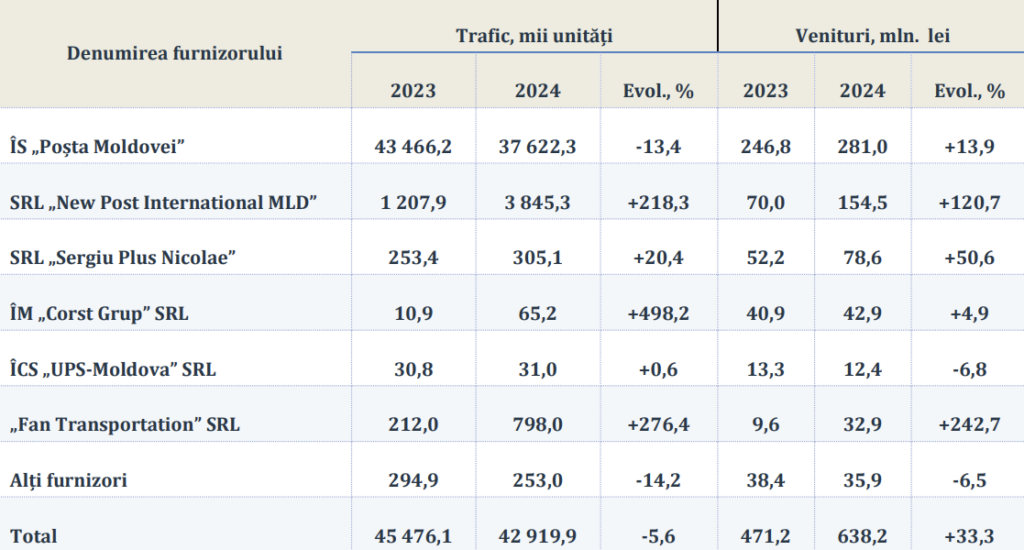
“Due to the sharp growth of cross-border e-commerce, which generates large flows of parcels, the postal sector has transformed and has actually been saved from the decline of traditional mail. Although the universal postal service provider has the largest network, it is rapidly losing market share and traffic volumes in lucrative segments – especially international parcels – to private providers that better meet the speed and tracking requirements of e-commerce,” the draft explanatory note says.
Another problem of the Moldova Post is the maintenance of unprofitable branches in rural areas with a small population. Because of this, the state-owned enterprise resorts to cross-subsidization and covers losses with income from other activities. The explanatory note notes that this model creates a risk of increasing tariffs for the universal postal service, and in the future they may become more expensive than the services of competitors. In addition, this forces the state-owned enterprise to reduce the number of branches in villages, which reduces the population’s access to postal services.
To reduce this “unfair burden,” the authors of the project propose to provide compensation for the net cost of the universal postal service, including through contributions from postal service providers and budget funds. However, to launch such a mechanism, the authorities must change the law on postal services.
What does the program provide?
One of the goals of the program, its authors call the transformation of the postal sector of Moldova into “an engine of economic and social development.” They place their main emphasis on modernizing logistics and developing services related to e-commerce.
By the end of 2029, the authorities want to launch the National Sorting Center and equip it with automatic sorting equipment. They plan to spend 80 million lei on the construction of the center, and another 60 million lei on equipment. In addition, 80 million lei were allocated for an integrated logistics management system. For online trading they want to create an e-fulfillment center – an operational center for processing orders. Its launch is also planned before the end of 2029, the cost is estimated at 50 million lei.
The program also provides for the development of fast delivery of domestic parcels within 24 hours. The authorities want to develop this service by the end of 2028. At the same time, they plan to optimize the internal delivery routes of Moldova Post.
What do they want to do in the villages?
A separate block of the program concerns access to postal services in rural areas. The document states that Moldova Post is incurring significant losses due to unprofitable branches in villages with a small population. If in 2024 the state-owned enterprise considered 500 branches unprofitable, then in the first nine months of 2025 their number increased to 610.
In 50 small villages they want to provide access to postal services through mobile branches. This measure is planned to be implemented by the end of 2029. Another direction is home delivery of pensions and other social benefits. The authorities want to develop this service by the end of 2027.
The program also provides for the digitalization of rural post offices. By the end of 2029, the authorities want to open 30 digital access points in villages, where residents will be able to receive electronic government services from central and local authorities.
In addition, the plan includes equipping rural branches with digital equipment, training employees to work with digital government services and integrating postal information systems with government platforms.
Ecology and business
The program also includes measures to reduce the environmental impact of the postal sector. By the end of 2029, the authorities want to introduce recyclable or biodegradable postal packaging into circulation. They also plan to digitalize operational documents to reduce paper consumption.
For businesses, the program included measures for the integration of small and medium-sized enterprises into e-commerce. In particular, the authorities want to train SMEs in e-commerce and the use of postal services to deliver orders, develop partnerships with local e-commerce platforms, and facilitate cross-border sales.
How much will all this cost?
The authors of the project estimate the cost of implementing the program at almost 383 million lei. Direct budget expenditures will amount to only 1.5 million lei, or 0.4% of the program budget. The authorities expect 42.8 million lei from partners. The contribution of the postal sector should amount to 118 million lei. In most cases we are talking about Moldova Post. At the same time, according to the program, some of the costs will be borne by other postal service providers – for example, to reduce packaging waste and paper consumption, as well as to develop partnerships with local e-commerce platforms.
Another 220 million lei of expenses have not yet been covered. Officials plan to find those funds later through partnerships and grants. All these expenses relate to one of the main specific goals of the program – modernization of the logistics infrastructure for the efficient processing of postal items.
Subscribe to our Telegram channel @newsmakerlive. Everything that is important to know right now about Moldova and the region quickly appears there.
Want to support what we do?
You can contribute to quality journalism by supporting us one-time through the E-commerce system from maib bank or by taking out a monthly subscription to Patreon! This way you will become part of changing Moldova for the better. Thanks to your support, we will be able to implement even more new and important projects and remain independent. No matter how you support us, you will receive a small gift. Follow the link to become our partner. It’s not difficult and even pleasant.