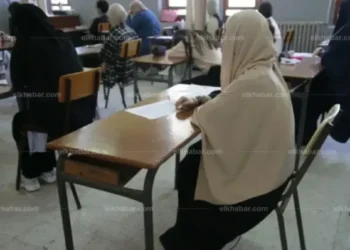
Tomorrow, 876,171 candidates will join approximately 3,000 examination centers across the various states of the country to pass the baccalaureate exam, amidst unprecedented organizational, procedural and security measures to secure this crucial date and ensure its integrity and transparency, just as the Minister of National Education confirmed the day before yesterday, when he stressed that the task undertaken by all those involved in organizing national school exams is “a lofty national task that requires the highest levels of vigilance, discipline and commitment.” The most prominent features of this course, according to ministry officials, are early and organized preparation and the promotion of digitization through electronic registration, electronic payment, reviewing information, and withdrawing summonses through official digital platforms.
In terms of numbers, the number of PAC 2026 candidates reached a total of 876,171 candidates, including 588,631 educated candidates, at a rate of 67.18 percent, and 287,540 free candidates, at a rate of 32.82 percent, in addition to 6,100 detainees distributed among 47 penal institutions across the country, which were equipped as procedure centers for this category.
In this context, the Ministry of National Education employed 227,278 supervisors in procedure centers, including 183,709 guards, 2,973 foremen, 29,401 general secretariat members, and 8,858 center vice presidents. The number of supervisors in collection and omission centers also reached 5,073 supervisors, distributed among 5,001 secretariat members, 54 deputies, and 18 center heads. And in correction centers; 52,044 supervisors were recruited, including 48,304 correcting professors, 3,352 secretariat members, 291 deputies, and 97 center heads.
On the eve of this fateful exam, for which various state agencies were recruited, the Minister of National Education, Mohamed Saghir Saadawi, stressed the need to strictly implement measures related to protecting the integrity of the baccalaureate exam for the 2026 session, stressing that preventing the introduction of mobile phones and all types of electronic means of communication into the procedure centers and halls is a basic measure that “cannot be tolerated, whether for the candidates or the supervisors and employees of the centres,” calling for all regulatory measures to be taken to ensure respect for this measure.
Saadawi was keen to recall the legal procedures in force related to combating cheating and disseminating exam topics through means of communication and social networking sites, stressing the importance of adhering to exam security procedures and implementing them with precision and responsibility, especially with regard to the readiness of surveillance cameras and equipment related to securing the exam, and enhancing vigilance and careful follow-up of all operations related to its administration.
The Minister called on the heads of the centers to ensure the provision of all the necessary material and organizational conditions for the examination to take place in the best conditions, by ensuring the readiness of the structures and equipment, monitoring the air conditioning and electrical systems, ensuring cleanliness and providing water and the necessary services for the candidates and supervisors, while ensuring good reception, guidance and sophisticated educational dealing with the candidates. He also stressed the necessity of better organizing the examination, by providing appropriate conditions and raising the level of performance, discipline and insurance, in a way that makes the 2026 session more enjoyable. Distinguished and more successful than its predecessors.
Within the framework of the Baccalaureate 2026 developments, the interests of the National Bureau for Examinations and Competitions approved new and strict measures to secure this session, as they stressed the application of the same conditions applied to the framing wires inside the procedure centers, and also assigned the first official in charge of the center to assume the succession of those in charge of guarding who are absent for emergency reasons, and to support communication agents at the hallway level, in addition to strengthening the guard teams charged with monitoring and inspecting candidates at the entrances to the centers and accompanying them to the centers. Bathrooms or places of worship when absolutely necessary, while staying with them until they return to their places.
In the same context, the day before yesterday, Thursday, the heads of the centers for conducting the “PAC 2026” exam met with the guards to read the guarding guide and urge them to fully adhere to what it stated under the penalty of administrative and penal penalties. Today, it also begins to transfer the exam question topics to the education directorates amid strict security measures to ensure equal opportunities for all candidates.
183 thousand guards to ensure the good conduct of the exam
The number of “PAC 2026” guards reached about 183,709 guards distributed among 2,973 examination centers. Their mission is to ensure the smooth conduct of this crucial exam, by applying the permitted and prohibited procedures throughout the procedure period, starting from the candidate’s entry into the examination hall, and ensuring that he sits in the place designated for him according to the approved seating plan.
The interests of the National Bureau for Examinations and Competitions obligated the guards to alert candidates to the necessity of depositing books and notebooks at the entrance to the center throughout the days of the exam, while verifying the identity of the candidate through the summons, ID card, clip, and answer sheet “gently and in a flexible manner.”
The guard professor, according to the guard guide, is responsible for everything that happens inside the hall, especially cases of cheating, subject to the disciplinary penalties stipulated by law in the event of a breach of his duties. He must come to the center at least an hour before the start of each test, accompanied by his identity card and summons, while any delay exceeding ten minutes is considered an absence.
In this context, the number of guards in each hall was determined during each exam, with one of them remaining constant throughout the exam days. It is also prohibited for guard professors to read the test text to the candidates or answer any related questions except on the basis of official instructions from the Central Follow-up Cell at the National Office for Examinations and Competitions, in addition to prohibiting the use of mobile phones, reading newspapers and books, or allowing any form of communication between candidates.
The guard must also ensure the strict implementation of what is stated in the guide to operating the procedure centers, especially with regard to preventing candidates from leaving during the test except for necessity, and subjecting them to a thorough inspection when they go to the bathrooms to ensure that they do not possess communication devices or documents that may be used for cheating.
Procedure centers open starting at 7:15 am
The Ministry of National Education had approved amendments to the timing for the 2026 baccalaureate, as the procedure centers will open their doors to candidates starting at seven-fifteen in the morning instead of eight, and from one and forty-five in the afternoon instead of two, until two-thirty in the afternoon, with an emphasis on the necessity of strict adherence to the regulatory instructions for this crucial exam.
The Ministry confirmed that the examination calendar remains unchanged, stressing the necessity of handing over mobile phones and all electronic communication devices or storing and retrieving information to members of the reception cell upon entering the center, in order to avoid the penalties resulting from violating these rules.
She called on everyone to adhere to these regulatory procedures and adhere to the rules in force within the procedure centers, ensuring the smooth conduct of the exam and providing appropriate conditions for passing it in calm, discipline, transparency, and equal opportunities for all candidates.
Accompaniment and psychological support for baccalaureate candidates
In the same context, the Ministry of National Education ordered psychological accompaniment and support for students about to take the baccalaureate exam in the 2026 session, according to Instruction No. 351.
The Ministry emphasized providing psychological and educational support and mental health care to candidates by accompanying, guiding and providing them with the necessary skills to deal positively with exam anxiety, enhancing self-confidence and organizing time and effort, in a way that helps them pass this academic eligibility in the best conditions.
It also called for this process to be given the utmost care and attention to achieve its educational and psychological goals, and contribute to providing the necessary support to the candidates, with care being taken to embody it in the field effectively, and to submit a detailed report after the end of the exam on the course of the process.
This is the schedule for baccalaureate exams
The “PAC 2026” exams extend over five days, from June 7 to 11, and include subjects: Arts and Philosophy, Foreign Languages, Arts, Experimental Sciences, Mathematics, Sports Technology, and Management and Economics.
On the first day, candidates pass the Arabic language and literature test, with the hourly size varying according to the section, before they take the Islamic education test in the evening. As for the second day; The mathematics test is allocated in the morning for all classes according to different time sizes, while the English language subject is conducted during the evening period.
On the third day, candidates pass the tests for each section’s basic subjects, in addition to the French language. The fourth day is devoted to tests of history, geography, and the Amazigh language for different people.
On the last day, foreign language candidates pass the third foreign language test, while experimental sciences, mathematics, and sports technology candidates pass the physical sciences and philosophy tests, management and economics candidates pass the economics, management, and philosophy subjects, while arts candidates conclude their exams with an arts subject test.
Judicial councils across the country are carrying out sensitization and awareness campaigns to secure the exam
As part of the preparatory procedures for the exam, judicial councils across the various states of the country organized meetings and study days on combating crimes committed on the occasion of final exams, as part of efforts aimed at protecting the integrity of the educational system and ensuring equal opportunities.
In this context, the investigating judge of the Court of Honor, Kwesi Walid, revealed a significant decline in crimes of cheating in official exams since the implementation of Law 20-06 related to protecting the integrity of exams and competitions. He explained that some candidates resort to illegal means to ensure success, which necessitated the intervention of the criminal law to confront these behaviors that are contrary to society’s morals and values.
He pointed out that the Algerian legislator created, under the aforementioned law, a special chapter within the Penal Code for crimes affecting the integrity of exams and competitions, which prohibits publishing or leaking topics, impersonating a candidate, or taking the place of others while passing exams.
The penalties range according to the seriousness of the acts committed. Minor misdemeanors are punished with imprisonment from one to three years and a fine of 100,000 to 300,000 dinars, while penalties rise to between five and ten years in prison and fines of up to one million dinars in the event that the acts are committed by persons in charge or using modern means of communication.
As for acts that lead to the complete cancellation of the exam or competition, they are classified as felonies, and their perpetrators are punished with temporary imprisonment from seven to fifteen years, in addition to financial fines ranging from 700,000 to 1,500,000 dinars.
The Ministry of Education is reassured about the topics of the questions
Regarding the nature of the subjects, the Ministry of National Education reassured the candidates and their parents that the baccalaureate questions will, as usual, be at the core of the official program that the student receives within the department throughout the school year.
She stressed that the student who followed his lessons regularly and reviewed in an organized manner would have every chance of dealing well with the subjects, noting that the inspection teams and education directorates followed up on the implementation of the study programs and ensured their completion. The Ministry also called for not to be led by rumors and expectations circulating on social media, and to focus instead on calm review and self-confidence. It stressed that what is required inside the exam hall is to be calm, read the subject well, organize time, and start answering the most obvious questions.
Sectoral coordination to take care of candidates outside the procedure centers
As part of sectoral coordination to take care of candidates outside the procedure centers, the Ministry of Religious Affairs and Endowments ordered its local officials to open the doors of mosques, women’s prayer halls, and Quranic schools located near the baccalaureate examination centers for candidates during the examination period to rest and review under the supervision of imams and religious guides.
For its part, the Ministry of Youth announced the use of youth hostels and youth homes across the national territory for the benefit of candidates, by providing suitable spaces for review, rest, and psychological and pedagogical support near the examination centers.
The various shelter structures affiliated with the sector, especially youth hostels and youth camps, were also recruited to receive and shelter the nominated students when needed, in addition to harnessing human and material capabilities and organizing accompanying and motivational activities supervised by the sector’s executives and listening cells and protecting youth health.
As for the National Union of Taxi Transporters, it announced its involvement in this national coordination by ensuring that candidates residing in areas with difficulties in transportation or a lack of transportation are transported free of charge to the examination centers, with the contribution and volunteering of taxi drivers across the various states of the country.