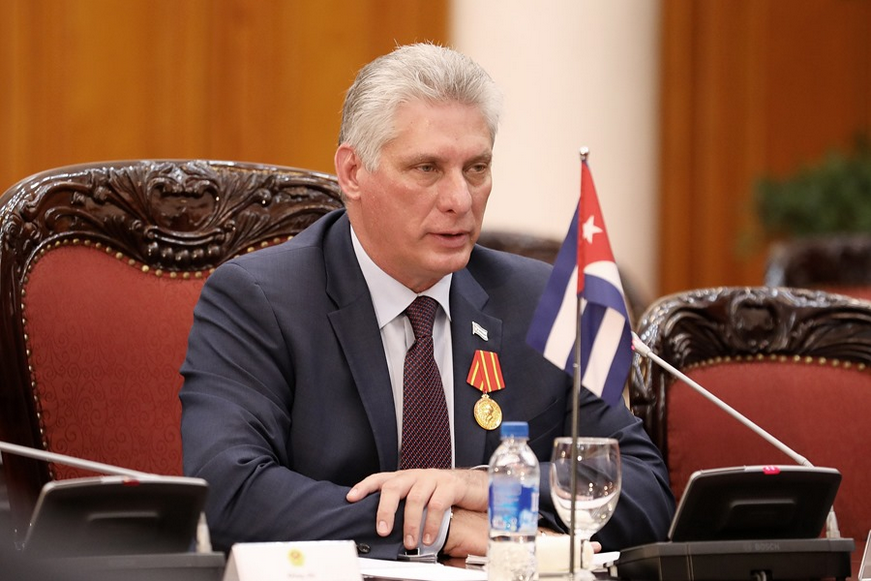
On Thursday, June 4, 2026, the United States Department of the Treasury imposed financial sanctions on the president of Cuba, Miguel Díaz-Canel, several of his relatives and Colonel Alejandro Castro Espín, son of former president Raúl Castro.
The Treasury included Lis Cuesta Peraza, Díaz-Canel’s wife, and Manuel Anido Cuesta, the president’s stepson, who resides in Madrid, on the sanctions list of the Office of Foreign Assets Control (OFAC).
Raúl Alejandro Castro Calis, grandson of Raúl Castro and son of Alejandro Castro Espín, was also sanctioned.
Other sanctions on Cuban entities
The Donald Trump Administration also imposed sanctions on the Cuban Ministry of the Armed Forces and the Committees for the Defense of the Revolution (CDR), a network of neighborhood committees created to articulate popular support for the communist revolution.
The list of sanctioned entities is completed with the Cuban Institute of Friendship with the People, the La Victoria mining company and the Amistur travel agency.
The sanctions imply the prohibition of carrying out financial and commercial transactions with designated persons and entities, whose assets under US jurisdiction are blocked.
This round of sanctions is part of the pressure strategy that the Trump Government exerts on Cuba to force economic and political changes on the island.
From the capture of Nicolás Maduro in January 2026, In a US military attack on Venezuela, Trump has imposed an oil blockade on Cuba that has worsened its economic crisis and has threatened on several occasions to “take control” of the island.
The Department of Justice also presented in May 2026 a accusation against Raúl Castro, former president and younger brother of Fidel Castro, for his alleged responsibility in the downing, in 1996, of two small planes belonging to a Cuban exile organization that caused the death of four people.
In this context, Washington and Havana have held discreet negotiations in which Raúl Guillermo Rodríguez Castro, one of Raúl Castro’s grandsons, known as “El Cangrejo”, would have served as one of the Cuban interlocutors.
The Government of Cuba insists that any change in the country must be decided by the Cuban people and denounces that the United States is preparing military aggression against the island.
Díaz Canel denounces sanctions
The president of Cuba, Miguel Díaz-Canel, denounced the latest “illegitimate list of sanctions” in which the United States Department of the Treasury included leaders (including himself), Cuban organizations and companies.
Díaz-Canel also described as “threatening” the recent statements by the President of the United States, Donald Trump, about Cuba.
“The president of the United States makes new threatening statements against Cuba; and the Treasury Department added new names of Cuban leaders, organizations and companies to an illegitimate sanctions list,” the president wrote on social networks.
He also stated that Washington’s sanctions on the island “are aimed at reinforcing the blockade measures and the conflict scenario between Cuba and the United States.”
“This political blindness adds to the coercive measures applied in recent weeks against our country, designed to harm the Cuban people,” he added.
He also assured that “the aggressiveness and perversion of the Yankee government,” in reference to Washington, will clash with Cuba’s decision “to face the worst scenarios and resist the imperial onslaught.”