Tegucigalpa, Honduras.
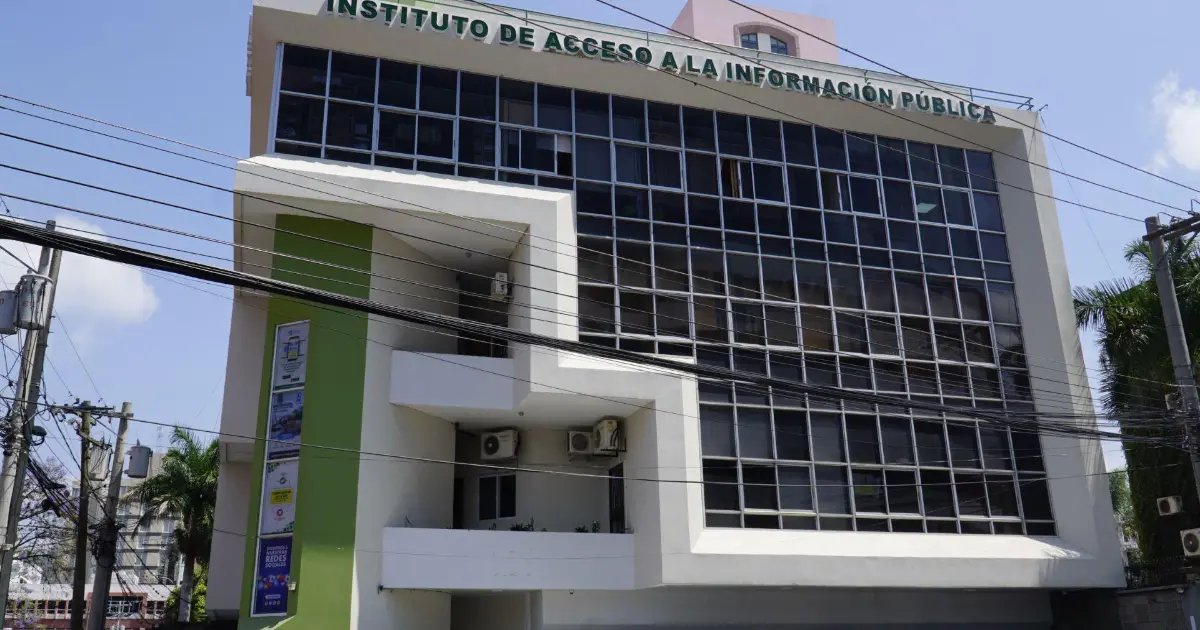
He reformulated budget for 2026 introduced a reduction in the allocation of Institute for Access to Public Information (IAIP), a key institution to guarantee access to state information constantly used by journalists, civil society organizations and citizens in general.
According to official data, its budget went from an initial proposal of L45 million in the project presented in September 2025 to an adjusted amount of L43.6 million, which represents a cut of approximately L1.4 million.
At the beginning of April, this medium learned that the IAIP intended to increase its budget to L100 million to promote its projects, but this did not happen.
Hermes Omar Moncada, president commissioner of the IAIP, pointed out that “we are dealing with and seeking the issue of transparency and accountability. With the government of President Nasry Asfura and the president of Congress, Tomás Zambrano, we feel and believe that the IAIP will truly have a greater budgetary injection.”
“That means being able to achieve a large number of objectives that we have set for ourselves. Above all, having that possibility of decentralization, as President Asfura says, which is one of the fundamental points of the President of the Republic and that is why we would like to reach the citizens of the interior with the fundamental right of public information,” Moncada added.
“We feel and firmly believe that this year is the year of the Institute for Access to Public Information, which will grow if our budget is increased. We have countless tools and we also have preliminary projects already built,” said the IAIP president commissioner.
The decrease in IAIP resources contrasts with the behavior of other institutions within the same budget document.
An example is the Superior Court of Accounts (TSC), which in the budget amounted to L955 million, exceeding the initial proposal of L503.7 million, which is equivalent to an approximate increase of 89.6%.
In addition, the Attorney General’s Office (PGR) also appears, which experienced an increase in its allocation, going from L322,462,939 in the original proposal to L385,175,068 in the reformulated 2026 budget.
These adjustments demonstrate a redistribution of resources in the budget reformulation, in which some entities saw their funds reduced while others registered significant increases, according to President Nasry Asfura’s government plan.
However, the reduction in the IAIP raises questions about the priorities of public spending, especially because in recent years the demand for transparency and accountability has been increasing.
Function
The IAIP is the entity in charge of guaranteeing compliance with the Law on Transparency and Access to Public Information, a mechanism through which investigative journalists, organizations and citizens request data on the use of public funds, contracting and government decisions.
Through these requests, irregularities, discretionary management of resources and key details for citizen control have been revealed.
A lower budget allocation to this institution could translate into operational limitations for the institution, affecting its ability to respond to requests for information, supervision of obligated entities, and promotion of transparency policies.
Experts consulted by this medium consider that the ideal would have been to strengthen the institution for greater transparency, because in practice processes of access to public data could be slowed down.
They also consider that weakening this type of institutions directly impacts democratic quality, since it restricts one of the main tools of social oversight.
However, others consider a transformation in the institution necessary, such as analyst and researcher Lester Ramírez.
The expert pointed out that entities such as the IAIP, the TSC and the specialized prosecutor’s offices of the Public Ministry must have clear budget management plans, as well as evaluation indicators and innovation capacity.
“They must have a plan of what they are going to do with the budgets and they must have indicators to evaluate them and also a capacity to innovate,” he stated.
In particular, the interviewee was critical of the performance of the IAIP, which he described as an institution “practically frozen in time,” pointing out that its transparency portals do not offer sufficient information for citizen decision-making.
In his analysis, this institutional weakness could explain the reduction of its budget, having failed to consolidate itself as a key actor in transparency.
“Look at what has happened to the TSC, they have doubled the budget because this Government is betting on concurrent audits, preventive audits and the work to accompany these emergency decrees, but IAIP being a collegiate entity, I think it should also show a little thinking outside the box,” he added.