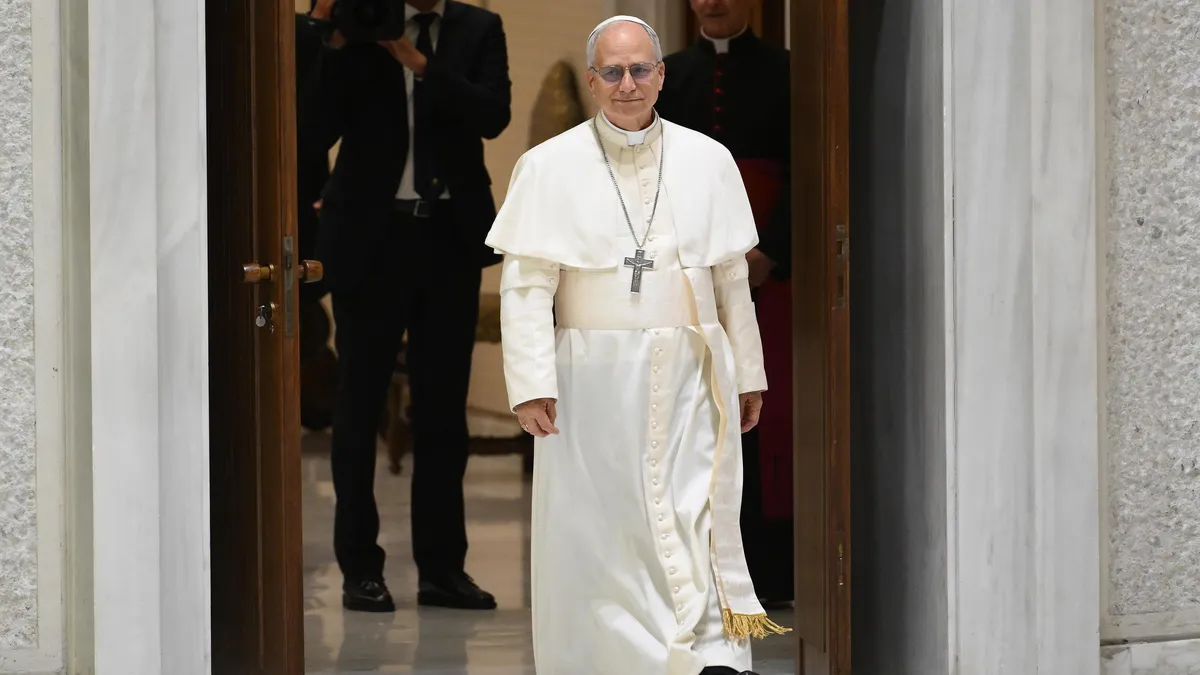
Leo XIV, born Robert Francis Prevost in Chicago, arrived at Barajas Airport from Rome, where he was greeted by Spain’s King Felipe VI and Queen Letizia.
Pope with American, Peruvian and Spanish roots
Leo XIV is the first American to head the Catholic Church in its nearly two thousand year history. He is also the first pope with dual citizenship – American and Peruvian, as well as the first pontiff from the Augustinian order.
The visit also has a personal character for him. The Pope’s mother comes from a Creole family in Louisiana with Dominican, French, African and Spanish roots, which adds extra significance to the visit.
21 events in six days
The program includes 21 official events. Up to 1.5 million people are expected to attend the Mass for Corpus Christi in Madrid’s Plaza Cibeles, and around 500,000 faithful will join the evening vigil in Plaza de Lima.
On June 8, the Pope will meet with the Prime Minister of Spain, after which he will deliver a speech to the deputies in the Spanish Parliament. This will be the first time a Pope has participated in such an event at the Congress of Deputies.
Later that day, he will pay homage to Our Lady of Almudena in Madrid’s cathedral and meet with representatives of the local church community at the Santiago Bernabeu stadium.
The following day, Leo XIV will travel to Barcelona, where he will celebrate Mass in the iconic Sagrada Familia Basilica.
First papal visit in 15 years
The last pope to visit Spain was Benedict XVI in 2010. Thus, Leo XIV’s visit is the first papal visit to the country in 15 years.
According to the Spanish Episcopal Conference, the pope’s stay will cost around 25 million euros, but is expected to bring an economic effect of more than 150 million euros thanks to the increased tourist flow.
The Booking.com platform is already reporting a rise in searches for accommodation on the Pope’s route, including an increase of 52% in Barcelona and 46% in Madrid.
The Vatican defines the visit as a sign that, despite the processes of secularization in Europe, the Pope continues to have an important role in the public debate on a number of topics both in Spain and on the continent.