SAN MARINO – The Republic of San Marino ends up at the center of an international investigation coordinated by the European Prosecutor’s Office of Bologna, which has unmasked an illicit mechanism for VAT evasion on luxury cars imported from Europe and destined for the Italian market.
According to what was reconstructed by the Guardia di Finanza, Porsche, Lamborghini, Ferrari and other prestigious cars from Germany, Austria, Belgium and Holland were sent through San Marino. Here, thanks to some non-existent companies and bilateral agreements with Italy, the suspects presented falsified documents certifying the payment of the San Marino single-phase tax, thus avoiding the payment of Italian VAT.
The investigations, which started from the complaint of a citizen of Prato, made it possible to reconstruct illicit sales flows involving over 1,700 vehicles, for a total tax evasion estimated at 42.8 million euros. In Italy alone, between seizures of cars, properties, land and bank accounts, the value of the assets subject to restrictions exceeds 11 million euros.
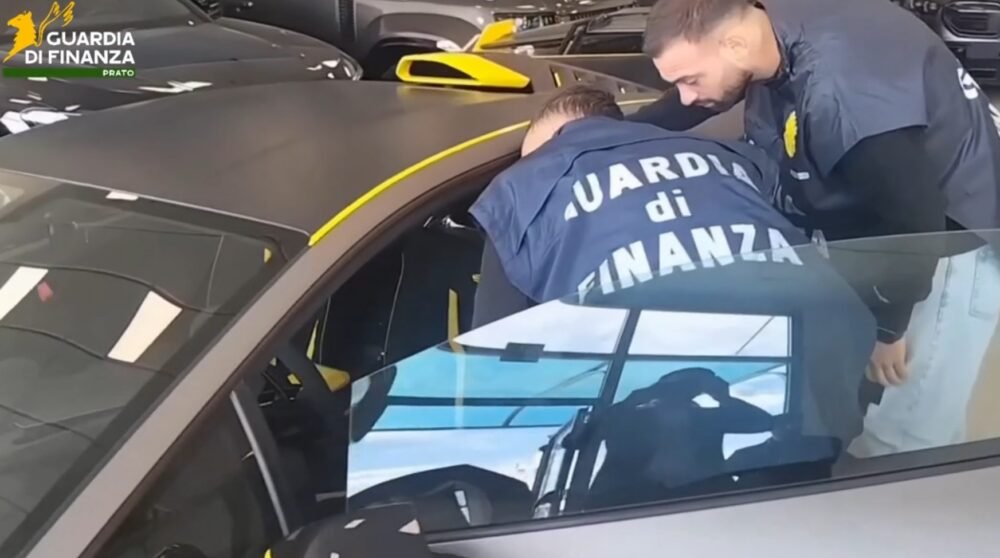
San Marino, therefore, represented a “key step” in the fraudulent mechanism, allowing sellers to charge more competitive prices on the Italian market thanks to the failure to pay VAT. The seized cars include models such as Ferrari Portofino and Superfast, Lamborghini Urus and Huracan, Porsche Macan, 718 Spider and 992 GTS, as well as numerous Mercedes AMG, BMW and Audi.
The investigation led to seven people being investigated, two of whom were under house arrest, and to the seizure of six companies. The military specified that similar measures were also carried out against a criminal group operating in the Bracciano area, in the province of Rome, which acted as brokers for multi-brand dealerships.
The Italian authorities underline how the role of San Marino was decisive in bypassing the Italian VAT legislation, thanks to falsified documentation which attested to a non-existent payment of the tax on the territory of San Marino.
They were right on the Titan celebrated these days processes which essentially reconstructed the same mechanism. Furthermore, not too long ago, the automotive sector itself created quite a few problems in economic relations between the two states.