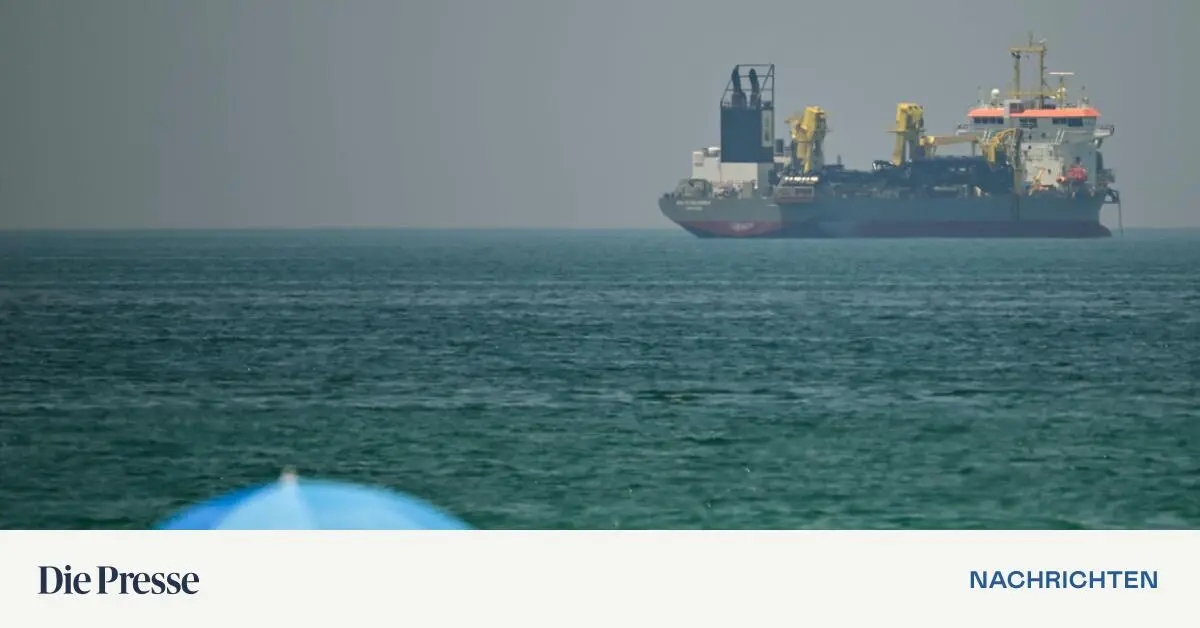
The Strait of Hormuz remains closed. Both the Iranian and American blockades are in place. This can be summed up after the confusion of the weekend, when the Iranians declared the strait open, only to close it again shortly afterwards. In recent days, the Iranian Revolutionary Guard attacked two tankers, one of which was flying the Indian flag, and chased them out of the Strait of Hormuz. The USA, on the other hand, seized an Iranian ship. The incident shows that the Iranian shadow fleet continues to try to break the US blockade.
The conflicting parties want to use the blockades to increase the pressure before the peace talks. The political scientist and marine expert Jeremy Stöhs from the Austrian Center for Intelligence, Propaganda and Security Studies at the University of Graz sees parallels to Venezuela in the US actions in the Strait of Hormuz: Last December, the US Navy pursued sanctioned Venezuelan oil tankers: “It became clear back then that the US has a good picture of the situation and is also willing to enforce the blockade. They pursued and captured the tankers across the Atlantic.”
In the past few days, many ships in the Strait of Hormuz have not moved or have been called back by companies halfway through. Only a handful of tankers unrelated to Iran are out of the strait. According to Stöhs’ observations, a tanker with a Panamanian flag even sailed through the middle of the strait towards the Persian Gulf: a dangerous undertaking. Typically, the ships move along the coast in either Iranian or Omani territorial waters. The Revolutionary Guards may have placed the sea mines in the two shipping lanes in the middle of the road – the “conflict zone”.
It is difficult for analysts to assess whether and how many sea mines the Iranians have actually planted in the strait. Theoretically and practically laying mines is possible, says Stöhs. He also noted that U.S. warships with mine-clearing capabilities, most recently spotted off Malaysia, were moving toward the Middle East. Another indication is that German Chancellor Friedrich Merz could imagine sending minehunters under certain circumstances. Nevertheless, skepticism about the Iranian information is appropriate, says Stöhs; not least because numerous sea mines would also endanger their own shipping. But just by spreading the reports of sea mines, the damage to shipping and insurers has already been done. The sea mine reports therefore also play into the hands of the Iranian regime.
In this context, Stöhs also points to the Black Sea, where some sea mines are floating due to the war in Ukraine – shipping still takes place. While the mines can damage robust oil tankers, but do not necessarily cause them to sink, the situation is different for smaller military ships.
It is also interesting that the massive aircraft carrier USS Gerald R. Ford was relocated back to the Middle East. The Gerald Ford has been in use for more than 300 record-breaking days and was recently withdrawn for repairs. The aircraft carrier was also used during the hunt for Venezuelan oil tankers. His passage through the Suez Canal is another indication that the US is preparing for a long period of blockade.
Iran, on the other hand, is also working to create facts in the Strait of Hormuz. Tehran wants to control traffic in the strait in the future and collect tolls, which would be a breach of international law. Iranian media report that the parliamentary draft for this project is almost ready.