The proportion of the population that has an education other than primary school is increasing only slowly, and several key goals in the current education strategy will not be achieved with the current effort and development, the Greenland Education Council assesses in a new report.
In a recently published status report casts doubt on Greenland’s Board of Education as to whether a number of key targets for the population’s level of education will be achieved.
The current development is simply too slow in relation to achieving the goals set in Naalakkersuisut’s Education Strategy 2024-2030.
The council states in the report that there is a development where the population’s level of education increases, but not at the rate that the politicians have set as a goal.
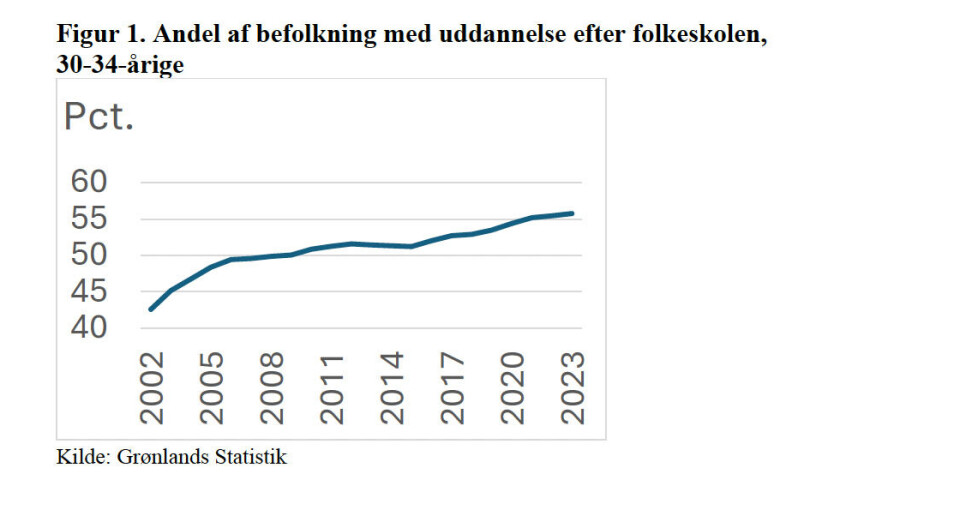
This applies, among other things, to a goal that 70 percent of the 30-35-year-olds must have an education providing vocational skills by 2030.
Greenland’s Education Council estimates that the target will not be achieved, as the level has been around 55 percent for a long period of time.
The development of key areas has stagnated
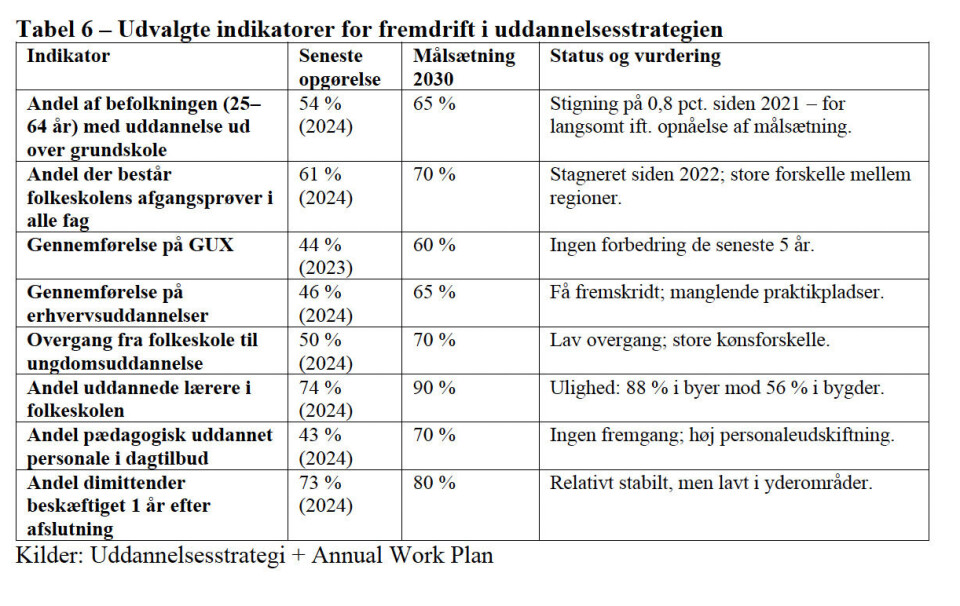
Greenland’s Education Council has prepared an overview of a number of the different objectives, and the gap between the current status and the set objectives towards 2030:
“Although some indicators show a weak positive development, including the proportion of adults with education beyond primary school, progress is generally slow and is insufficient in relation to the pace required to achieve the set goals,” writes Greenland’s Education Council in its report.
According to the council, key areas such as implementation at GUX and vocational training as well as the transition from primary school to secondary education have been characterized by stagnation over a longer period.
The Education Council points out that the field of education is characterized by continuous resource pressure, where financial and personnel limitations reduce the capacity for systematic follow-up, evaluation and learning.
“Overall, it is assessed that without strengthened implementation capacity and a better data basis, the Education Strategy 2024–2030 risks remaining an overall ambition rather than an effective management tool,” writes the council.
The council makes a number of recommendations to translate the strategy from paper to action. According to the council, the strategy should in particular be coupled with a binding implementation plan, where goals, responsibilities and budgets are clearly linked, says the council.
The council also describes how the education sector is affected by current savings due to financial challenges for the national treasury, and here the council recommends that financial stability be ensured so that “development efforts are not undermined by short-term or linear savings.”