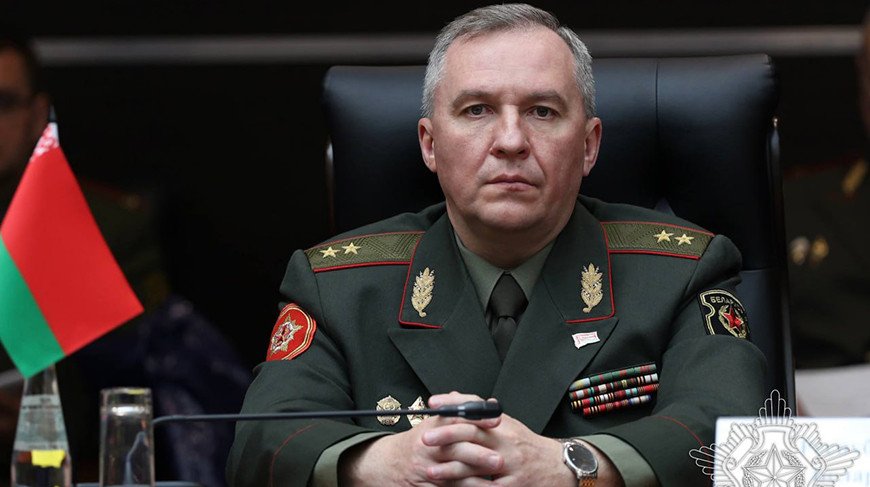

Viktor Khrenin. Photo courtesy of the Belarusian Defense Ministry
During an exchange of views on challenges and threats to military security across the CSTO collective security regions, Viktor Khrenin noted that the situation within the organization’s area of responsibility has not improved since the joint meeting in 2025. Furthermore, the situation in Iran has given rise to new security risks in Central Asia.
Viktor Khrenin also expressed concern over the potential emergence of a humanitarian crisis and migration flows capable of displacing extremist ideologies and terrorist organizations into CSTO member states due to the border conflict between Afghanistan and Pakistan. Focusing on the military and political developments in the Eastern European region, the defense minister noted that the situation is characterized by a highly dangerous escalation of negative trends and a total lack of interest among the countries of the collective West in building a multipolar world based on the principles of respecting the interests of other states and the indivisibility of security.
“Belarus has repeatedly informed its CSTO allies about the large-scale re-equipment of European armies, the buildup of capabilities to deploy coalition troops to NATO’s eastern border, and the maintenance of a forward military presence in Poland and the Baltic states,” Viktor Khrenin said. “Today, around 21,000 troops involved in U.S. Armed Forces and NATO Allied armed forces operations to reinforce the alliance’s eastern flank are stationed in the aforementioned states alone. Against the backdrop of U.S. President Donald Trump’s statement regarding a troop reduction in Germany, Poland is holding talks with the Pentagon to expand the U.S. military presence on its territory. The leadership of Latvia and Lithuania has expressed a similar interest.”
The minister pointed out that within numerous operational and combat training activities, the troops of the NATO states continue to practice the full spectrum of tasks: from redeployment to the eastern flank to the direct execution of offensive operations by established forces against Russia and Belarus. “The annual combined military expenditures of NATO member states have reached a record high of over $1.6 trillion and continue to grow. Western political elites and associated defense corporations view war precisely as a guarantee for internal consolidation and steady profits. This means they will not abandon this method of resolving interstate contradictions. It is no coincidence that the message of the need to be prepared for a military conflict with our CSTO ally, Russia, in the near term has become the foundation of doctrinal documents on security, defense, and foreign policy adopted by the USA, the UK, Germany, France, and a number of other European states,” the Belarusian defense minister said.
Assessing the current situation in the Eastern European region, Viktor Khrenin emphasized that the probability of unleashing a military conflict against Russia and Belarus – both CSTO members – as well as the potential for its subsequent transformation from a regional into a global one, is extremely high. “This and other challenges facing our organization require unconditional consolidation, rapid decision-making, and the ability to act as a single organism. It is hard to imagine what the security situation within the organization’s space would look like if our countries had not maintained close cooperation and developed it in line with the changing environment,” the minister stressed.
Viktor Khrenin called for active representation of all member states in operational and combat training activities of the CSTO Collective Forces. He noted the need to step up work with third countries and other organizations that share the CSTO’s principles and approaches in ensuring international security. “We are capable of not only providing an appropriate response to modern challenges and threats but also becoming a driving force in shaping a new international security architecture, for which a pressing demand has grown in Eurasia,” the defense minister said.
Viktor Khrenin also invited representatives of the CSTO member states to take part in the 8th international military-scientific conference, which will be held in Minsk on 19-20 November.
During the meeting, the parties reviewed and signed relevant decisions of the CSTO Defense Ministers Council on key issues. The decisions adopted at the event will be aimed at developing common approaches and mechanisms to advance the CSTO military component, taking into account the national interests and priorities of the parties.