The Revolution / Ibrahim Al-Wadaei
News agencies and international and regional media outlets are reporting that each in its own way is celebrating the imminence of an Iranian-American agreement that will end the current round of fighting but will not end the entrenched hostility between the Islamic regime in Tehran and the center of international Zionist power in Washington. Whatever the content of the agreement, Iran, according to the leaks, is on the cusp of a new victory in a second round of direct fighting that was made possible by several factors, including the military strength that it built for decades during the Islamic Revolution led by Imam Khomeini and which restored Iran from its embrace. Zionism to the embrace of Islam, the cohesion of the Islamic regime, the consolidation of the mechanisms for the transition of government in the most difficult circumstances, and the people’s rally around Iran as a nationality and around the gains of the Islamic regime compared to the Balhawi regime, and other reasons related to the reality of the region, including the growing strength of the axis of resistance and the influential Yemeni presence from the gate of the Bab al-Mandab Strait.
But there are other reasons related to the reality of the United States of America, including the defeat of its forces in the Battle of the Red Sea and the pressure that the Iranian war produced on the American and global economy, and another reason that is growing in the United States and has begun to attract attention, which is the political division that puts great pressure on the political parties within the United States and goes beyond the general interest of America as a country to partisan interests and personal disputes that benefit weak countries today..
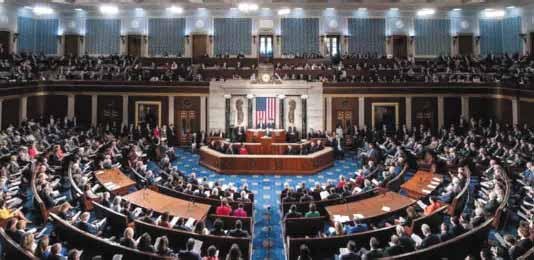
Last week, it was noteworthy that Congress took a decision to prevent further strikes against Iran. Although such a decision lacks institutional mechanisms for implementation, it reflects the transfer of American political disagreement to institutions, such that these institutions turn into arenas for bickering and conflict and deviate from their role as institutions of a unifying state, as happened, for example, in Yemen during 2011 AD, when it turned government institutions into an arena for conflict between the ruling Al-Ahmar family at the time.
To understand what is happening in the US Congress regarding Iran, the past months have witnessed a series of Democratic attempts to restrict President Donald Trump’s military powers, all of which were rejected by the Republican majority.
Since the start of military operations against Iran in February 2026, Democratic lawmakers have repeatedly sought to invoke the War Powers Resolution of 1973. This law requires the president to obtain congressional approval to continue any hostilities beyond 60 days.
The Senate and the House of Representatives witnessed several votes on draft resolutions aimed at ending or restricting operations, but the Republican majority in Congress continued its support for President Trump and rejected these projects.
And the last vote: in mid-May 2026, where the Senate voted on a procedural measure pushed by the Democrats, and although it showed some division within the Republican Party (as a small number of Republicans defected), the fundamental attempts to end the war failed to obtain the required majority.
What you are currently witnessing is a “symbolic battle” that is more political than an accomplished legal one. Even if the Democrats succeed one day in passing a resolution in Congress, it is almost certain that President Trump will use the right of veto, and the opposition does not currently have the two-thirds of the votes required in the two chambers to override this veto. The Democrats are waiting for the November midterm elections to obtain this percentage and perhaps go to impeach Trump.
Democratic movements in Congress can be read within a dual political strategy. On the one hand, it expresses ideological and legal convictions regarding issues, including the Middle East crisis, and on the other hand, it is a smart electoral maneuver in preparation for upcoming electoral cycles. This effort to “distance oneself” can be understood in the following points:
1. Creating a “voting record” against the war
Democrats are seeking to have their positions documented in official congressional records. When they vote for draft resolutions that restrict or end war, they build a “record” that they can return to in their election campaigns.
The goal: to tell voters: “We warned of the financial cost, the dangers of regional escalation, and the abuse of constitutional powers.” This position gives them a political “lifeline” if things worsen militarily or economically, and it is heading in this direction in light of the ambiguity of Trump’s goals in the war against Iran compared to the clarity of Israeli goals.
2. Put the burden on Republicans
By introducing “embarrassing” bills to restrict war, Democrats are putting Republicans to a tough test:
If Republicans vote “no,” they bear full and sole responsibility for any future deterioration or loss of human or financial loss associated with military operations.
This turns the war from a “general American decision” into a “Trump-Republican war” in the popular and media imagination, which absolves Democrats from the charge of complicity in an “adventure” that could end with disastrous results.
3. Exploiting the division within the Republican camp
Democrats are betting that the continuation of the war for a long period will necessarily lead to the erosion of support within the Republican Party itself, especially from the wing that tends toward “isolationism” (America First) and which may find the high costs of the war a contradiction to its slogans.
By stoking these debates, Democrats are putting pressure on Republican “moderate representatives” in areas where the war might be unpopular, which could lead to fissures within the ruling party.
4. Political tactic: “Responsible opposition”
This approach gives the Democrats the role of the “responsible opposition” that tries to restrain the executive authority without appearing “traitorous” or “against the national interest and not clashing with the deep “Zionist” lobby” if an Iranian attack occurs against American forces. They are calling for “rationalizing” the war, not “stopping it immediately” in a way that might harm the soldiers in the field, which would spare them the accusation of “failing the armed forces.”
In conclusion:
Yes, there is a clear attempt to hold the current administration and Republicans accountable for the “political consequences” of any failure or prolongation of this crisis. They plant the seeds of an electoral narrative that: “Republicans led the country into a quagmire, while Democrats tried to sound the alarm at the right time.”
Based on this level of clash, it can be noted that the political conflict within the United States in May 2026 reached levels described as “severe polarization” that threatens traditional democratic norms, and the current situation is no longer merely a dispute between two parties over policies, but rather a state of “emotional hostility that has gone beyond rational debate to the point that the other party is considered an “existential enemy.”
This boils down to several points:
1. From “difference of opinion” to “emotional hostility”
Studies (such as the 2026 ANES data) suggest that popular polarization has reached historic levels. The American citizen no longer contents himself with opposing the other party, but rather feels mistrust and hatred towards him.
Erosion of norms: American politics has lost many of the values of “mutual tolerance” that ensured the smooth transfer of power. The “other” party, in the eyes of many, is no longer a national competitor, but rather a “hypocrite” or “ignorant.”
Information bubbles: Social media plays a central role in deepening this rift, as algorithms isolate users in “bubbles” in which they only hear what confirms their convictions, which makes national debate on issues such as the war with Iran practically impossible.
2. The institution of Congress as a disruptive arena
In 2026, Congress is no longer a place for compromise. Rather, it has become an arena for displaying power, managing crises, and disrupting institutions, as last year witnessed the longest government shutdown in American history (43 days), which reflects the inability of the legislative institution to agree even on basic budgets.
There are increasing fears of “politicization of the law,” as each side accuses the other of using government agencies (such as the Ministry of Justice) to pursue political opponents, which weakens public confidence in the integrity of institutions, as we witnessed in the selective publication of the Epstein case files.
3. The pressures of war with Iran as fuel for the conflict
Since the outbreak of direct military conflict between America and Israel against Iran in what is known as the first round in February 2026, the intensity of internal tension has increased, as it appeared that there is widespread popular dissatisfaction with the war due to the lack of a clear “exit plan” or convincing explanation of the goals. This has led to the emergence of narratives (such as Israel’s involvement in dragging America into the war), creating divisions even within traditional political alliances.
Polls showed that the two parties (Democratic and Republican) suffer from unprecedented levels of unpopularity, as neither party enjoys the support of a comfortable majority, which enhances a state of political instability. We are talking here about a loss of confidence.
The Constitutional Threat Here, experts (such as Philip Bobbitt and others) believe that the greatest danger does not lie in partisan differences, but in “the erosion of the rule of law.” There are practices such as: executive abuses, such as the administration’s tendency to exceed the powers of Congress in financing and military decision-making, the politicization of the judiciary and the shift towards what some call “the rule of the judges” or challenging the legitimacy of the Supreme Court, which makes the final authority of the law in question.
In conclusion:
The conflict in America today is not just a “transient crisis,” but rather a systemic crisis. The United States enters the year 2026 suffering from a deep social and institutional division that makes it difficult to agree on any major strategic file. The war in Iran, instead of uniting Americans behind a “presumptive” national goal, became a “stress test” that exposed the fragility of the home front and demonstrated that political forces are willing to gamble with the country’s stability in order to score electoral points.
• Mogherini’s warning
Federica Mogherini’s description in 2016 of the American division as “vertical and horizontal” was an accurate prediction of what things will turn out to be in the year 2026. What was seen as political polarization at the time, today has turned into a state of social and institutional fragmentation that touches the core of the American fabric.
The indicators of this division today can be summarized in the following points:
1. Vertical division (at the level of elites and institutions)
This division appears in the state of “legislative paralysis” and the collapse of trust between the authorities:
Disrupting institutions: There is an intense conflict between the executive administration and Congress, which has reached the point of repeatedly threatening to close the government (more than 70% of ministries were threatened with closure in early 2026), with an inability to pass basic budgets due to partisan differences.
Erosion of the “institutional state”: The conflict is no longer about policies, but rather about the legitimacy of the institutions themselves. There is a mutual use of the judiciary and federal agencies as tools in the political conflict, which has led to an almost complete collapse in trust between citizens (especially in states with a Democratic majority) and the security and federal agencies.
2. Horizontal division (at the level of society and people)
The dispute is no longer just political, but has become “emotional” and “value-based,” with each party seeing the other as a moral enemy, as has become clear in many cases of clashes that are difficult to explain.
• Tearing down the social fabric: Data from 2026 showed that more than 60% of Americans find it very difficult to talk to those with whom they disagree politically. The division is no longer limited to electoral ballot boxes, but rather extends to “friendship networks.” The percentage of people who ended friendships or boycotted their relatives due to political orientations increased.
• Core values: Recent studies (such as the 2026 IGC reports) indicate that majorities in both the Democratic and Republican parties now believe that the other party does not share their core values, and even describe them as “more corrupt or dishonest” than the rest of the citizenry.
• Geographical and media isolation: American society has become divided into circles or “bubbles” whose members do not communicate or share sources of information, which has made national consensus on major issues (such as the war with Iran) almost impossible, as each issue is viewed from a “purely partisan” perspective.
3. Additional indicators in 2026:
Midterm elections: These elections in themselves have become a factor causing tension, as the fragile balances in Congress hinder any ability to make strategic decisions, making American foreign policy (such as the Iran file) hostage to internal electoral bidding.
Collapse of national loyalty: There is no longer confidence in the political system’s ability to manage crises or overcome differences, which has strengthened feelings of pessimism on both sides (74% of Democrats and 60% of Republicans express a pessimistic view of the country’s political future).
In short, America has moved from the stage of “difference in viewpoints” that Mogherini spoke about a decade ago, to the stage of “coexistence in parallel worlds” that only intersect in arenas of conflict and protest.
In general, the American political system, which many praised as a system that does not know the decline, is eroding today, and America, which was united by the desire to seize the lands of the Indians and the world’s wealth later, is about to fight among itself and is standing on the cusp of that, according to an investigative investigation in the form of a documentary carried out by the DW network, that the grudges have moved from the political core to the supporters at the public level, and everyone now sees in the other an enemy worse than Nazism, according to the description of one of Trump’s supporters, and what matters is that. This matter will reflect positively on the oppressed peoples, and with its erosion from within and the strikes of the Mujahideen in the world from without, we are witnessing accelerating processes of the fall of the Great Idol of Satan, which some worshiped and until recently saw its fall as impossible.