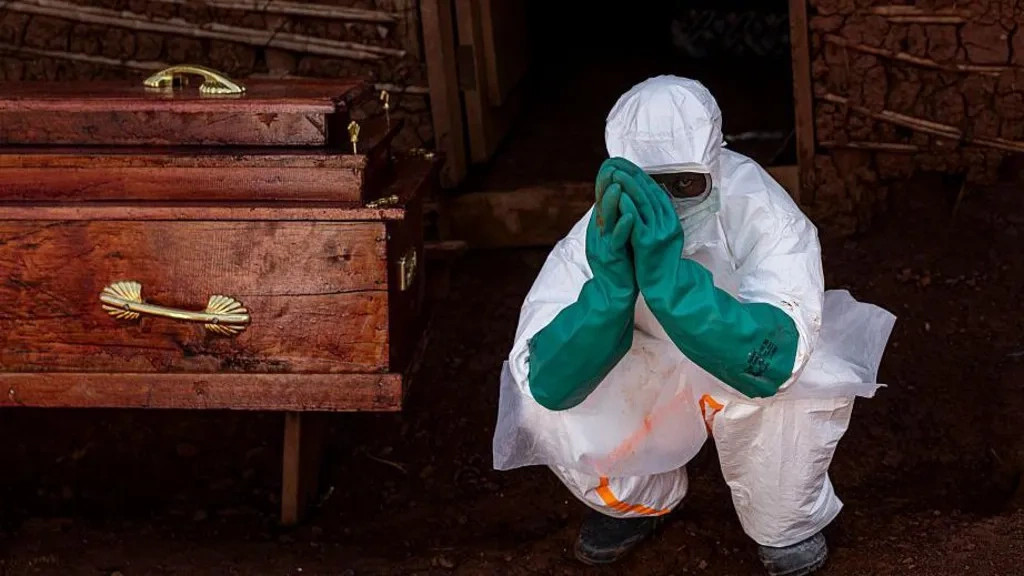
Three new vaccines are being developed to fight the rare type of Ebola that has already killed nearly 250 people, reports “BBC”.
The International AIDS Vaccine Initiative (IAVI), which is working on a vaccine, said the outbreak was threatening to become its worst ever.
The University of Oxford and the pharmaceutical company Moderna are also researching vaccines against the Bundibugyo strain.
The Coalition for Innovations in Epidemic Preparedness, which is funding each group, said “every day counts.”
There are now more than 1,000 suspected cases in the Democratic Republic of Congo, with nine confirmed cases in neighboring Uganda.
Concerns are growing that this outbreak – which was discovered only after it had spread in a conflict zone with limited health resources – could reach the proportions of the largest-ever Ebola outbreak in West Africa in 2014-16. Then, nearly 29,000 people were infected and more than 11,000 died.
“I think this is clearly threatening to become an outbreak as severe as that, if not worse, and the development of a vaccine, as well as other countermeasures, is clearly a priority,” said Dr. Mark Feinberg, head of IAVI.
This echoes the concerns of medical humanitarian organization Médecins Sans Frontières (MSF), which said the situation was “deeply alarming” and that never before had “so many cases” been recorded so quickly.
Vaccines must be developed for each specific type of Ebola – there are six, but only three are known to cause outbreaks.
There is a vaccine for the most common strain, Zaire, but this outbreak is being caused by a different strain, called Bundibugyo. He has only been seen twice before and has no approved vaccine.
IAVI is working on a modified version of the Zaire Ebola vaccine to fight Bundibugyo. The experimental vaccine was tested in monkeys, where it quickly trained the immune system and provided close to 100% protection.
Feinberg said the evidence so far made him “optimistic about the potential,” but it would currently take seven to nine months for the vaccine to be ready for clinical trials — though they are trying to “accelerate those timelines.”
Meanwhile, pharmaceutical company Moderna has announced that it is using its mRNA technology – which was used to rapidly develop vaccines during the Covid-19 pandemic – to work against Bundibugyo.
“We will act with urgency and scientific rigor to support the response and help bring a potential vaccine closer to the communities that need it most,” said Stephane Bancel, CEO of Moderna.
And Oxford University has already revealed it is working with its own vaccine technology, which also saved lives during Covid, to develop a new Ebola vaccine.
This should be ready for clinical trials within two to three months.
Each vaccine aims to train the body to recognize the same structure on the surface of the virus – known as the Bundibugyo glycoprotein. However, each uses a different technology to achieve this.
IAVI uses a live but harmless virus that has been genetically modified to also have the Ebola glycoprotein. The immune system fights the harmless virus and in the process learns to fight Ebola as well.
The mRNA vaccine and the Oxford vaccine deliver a fragment of the genetic code into the body. Once inside the body, it orders the construction of the Bundibugyo glycoprotein, which the organism recognizes as foreign and begins to attack it.
All of this means that the immune system has a head start when it comes to fighting off a real Ebola infection.
However, changes in technology and the way they train the immune system can affect the level of protection or the number of doses needed. All this needs to be tested in clinical trials.
The Coalition for Epidemic Preparedness Innovations (CEPI) is funding the early stages of the research
“With Bundibugyo virus spreading rapidly and no licensed vaccines, every day counts in the race against this deadly disease,” said Dr Richard Hatchett, CEPI’s executive director.
And the director general of the World Health Organization, Tedros Adhanom Ghebreyesus, said that “a vaccine against Bundibugyo can help control this epidemic and strengthen preparedness for future outbreaks”.