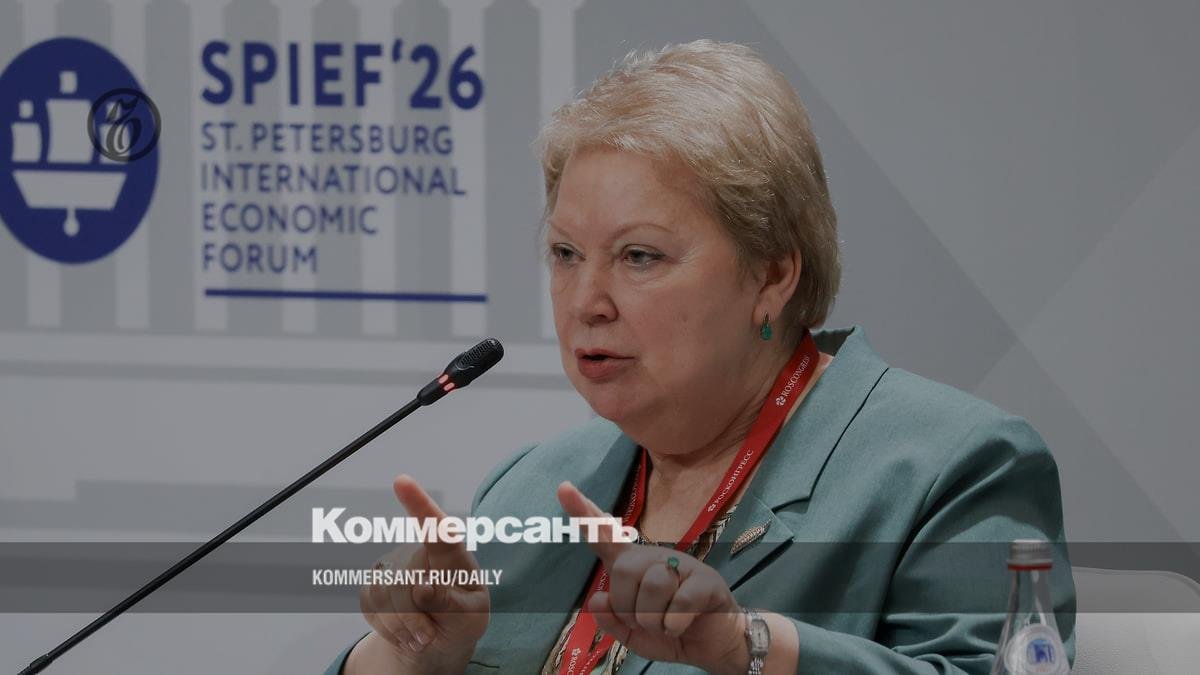
How to promote Russian culture and values around the world using the Russian language was discussed on the sidelines of the St. Petersburg International Economic Forum (SPIEF). Experts noted that there is demand for its study both “in the Global South and in old Europe,” but admitted that there are not yet enough online tools to satisfy it. The President of the Russian Academy of Education, Olga Vasilyeva, urged not to separate the teaching of the Russian language and Russian literature.
One of the first sessions at SPIEF in 2026 was dedicated to the Russian language, or more precisely, to the development of its presence throughout the world. “The issue of developing the Russian language has a clear foreign policy vector in conditions when they are trying to erase us from culture and sports,” said Deputy Foreign Minister Alexander Pankin. “But we have a clear strategic course to promote the Russian language. And specifically for promotion, not imposition.” There is now a demand for its study, he said, in many countries “regardless of what system they belong to and who is in power there.” The motivations of those interested are different: from expanding prospects in work, especially in the field of science, technology and innovation, to humanitarian interest in Russian culture, literature and traditional values. “We are developing relationships with the Global South, which is not the West, but the rest of the planet. The space of the Russian world will not shrink, although there may be even more difficulties than now,” Mr. Pankin concluded.
Deputy head of Rossotrudnichestvo Pavel Shevtsov, however, noted that in old Europe the Russian language still has weight:
“In Germany alone, 5 million people now speak it – and these are not necessarily people from the Russian Federation, there they call all immigrants from the USSR Russian.”
According to him, after the start of SVO there was a decline in interest in the language, but now it is being revived. “In the West there are many Russian schools – not necessarily standard ones, but schools, for example, weekend ones, where our compatriots teach in Russian. For example, ballet or art schools,” he added.
Rossotrudnichestvo has two main tasks in promoting the Russian language, noted the deputy head of the department. The first is retraining and advanced training of teachers of both the Russian language and subjects in Russian around the world. “Language is dynamic and constantly changing, and teachers need to talk about these changes and reach the most inaccessible places,” explained Mr. Shevtsov. The second is to meet the growing demand among foreigners to learn and improve the language online. “There are some difficulties in this part,” the official admitted. “But such a request must be satisfied so as not to form a negative impression of the country.”
It is important to create unifying organizations for Russian scholars around the world and to help teachers at this less official level, noted the head of the International Association of Teachers of Russian Language and Literature, Vladimir Tolstoy. He cited the community he leads as an example: “We are not directly associated with the state and build interaction not on political, but on professional trust.” Support in this matter, both academic and material, allows Russian teachers from abroad to feel that they are not alone and their work is needed, Mr. Tolstoy is sure.
The President of the Russian Academy of Education, Olga Vasilyeva, meanwhile, warned those gathered against the desire (which, in her opinion, is now emerging more and more often “at different levels”) to separate the teaching of the Russian language and Russian literature. “This is all Russian literature. In the West, they first learn about the greatness of Russian culture and Russian literature – and then interest in the Russian language appears. “War and Peace” and “Anna Karenina” are among the ten best-selling novels in the whole world,” she said. Moreover, according to her, Russian students also need to be taught these areas at the same time. Mrs. Vasilyeva even proposed an entire university course on this topic: ““Fundamentals of the Russian language and culture” are necessary for all specialties – not only the humanities, but also engineering and medicine.”